Two triangles are congruent if all corresponding sides and angles are equal.
If three sides of one triangle are equal to three sides of another triangle, the triangles are congruent.
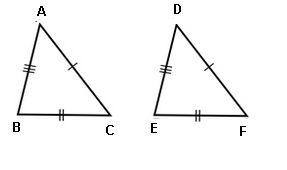
Example:
For \(\triangle ABC\) and \(\triangle DEF\):
If \(AB = DE\), \(BC = EF\), and \(AC = DF\), then \(\triangle ABC \cong \triangle DEF\) where \( \cong \) is the symbol of congruence of two triangles.
If two sides and the included angle of one triangle are equal to those of another triangle, the triangles are congruent.
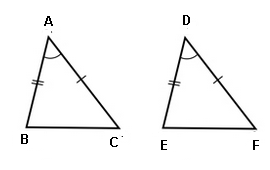
Example:
If \(AB = DE\), \(\angle A = \angle D\), and \(AC = DF\), then \(\triangle ABC \cong \triangle DEF\).
If two angles and the included side of one triangle are equal to those of another triangle, the triangles are congruent.
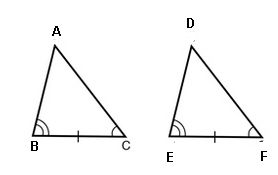
Example:
If \(\angle B = \angle E\), \(BC = EF\), and \(\angle C = \angle F\), then \(\triangle ABC \cong \triangle DEF\).
If two angles and a non-included side of one triangle are equal to those of another triangle, the triangles are congruent.
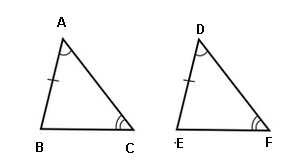
Example:
If \(\angle A = \angle D\), \(\angle C = \angle F\), and \(AB = DE\), then \(\triangle ABC \cong \triangle DEF\).
If the hypotenuse and one leg of a right triangle are equal to those of another right triangle, the triangles are congruent.
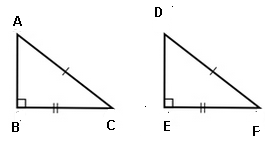
Example:
For right triangles \(\triangle ABC\) and \(\triangle DEF\):
If \(AC = DF\) (hypotenuse) and \(BC = EF\) (leg), then \(\triangle ABC \cong \triangle DEF\).
Corresponding Parts of Congruent Triangles are Congruent:
If \(\triangle ABC \cong \triangle DEF\), then all corresponding angles and sides are equal.
SSA does not guarantee congruence (ambiguous case). It works only for right triangles (HL).
Counterexample:
Two triangles with \(AB = DE\), \(BC = EF\), and \(\angle A = \angle D\) might not be congruent.