Assume that \( 0 \lt x \lt \pi / 2 \) and let us us consider the unit circle, shown below, and a sector OAC with central angle x in standard position. A is a point on the unit circle and AB is tangent to the circle at point A hence a right angle at this point.
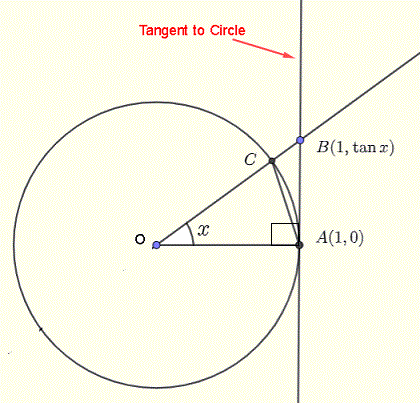
Point C is a point on the unit circle, radius equal to 1, and has coordinates \( (\cos x, \sin x) \). Let us find the areas of triangle OAC , sector OAC and the right triangle OAB .
Use the sine formula of the area of a triangle to obtain:
area of triangle \( OAC = (1/2) \sin x \cdot OA \cdot OC = (1/2) \sin x \cdot 1 \cdot 1 = (1/2) \sin x \)
Use the formula of the area of a sector to obtain:
area of sector \( OAC = (1/2)\cdot(x)\cdot OC^2 = (1/2) x \)
area of right triangle \( OAB = (1/2) \cdot (base) \cdot (height) = (1/2) \cdot (1) \cdot (\tan x) = (1/2) \tan x \)
Comparing, geometrically, the three areas, we can write the inequality \[ \text{area of triangle} \; OAC \; \lt \; \text{area of sector} \; OAC \; \lt \; \text{area of triangle} \; OAB \] Substitute the areas in the above inequality by their expressions obtained above. \[ (1/2)(\sin x) \lt (1/2) x \lt (1/2) \tan x \] Multiply all terms by \( \dfrac{2}{\sin x} \) gives \[ 1 \lt \dfrac{x}{\sin x} \lt 1 / \cos x \] Take the reciprocal and reverse the two inequality symbols in the double inequality \[ 1 \gt \dfrac{\sin x} {x} \gt \cos x \] Which is equivalent to \[ \cos x \lt \dfrac{\sin x} {x} \lt 1 \] It can be shown that the above inequality hols for \( -\pi/ 2 \lt x \lt 0 \) so the the above inequality hold for all \( x \) except \( x = 0 \) where \( \dfrac{\sin x} {x} \) is undefined. Since \[ \lim_{x \to 0} \cos x = 1 \] and \[ \lim_{x \to 0} 1 = 1 \] , we can apply the squeezing theorem to obtain \[ \lim_{x \to 0} \dfrac{\sin x}{x} = 1 \] This result is very important and will be used to find other limits of trigonometric functions and derivatives