Definition and Graph of the Cosine Function
Angle \( \theta \) is an angle in standard position with initial side on the positive x-axis and terminal side on \( OM \) as shown below.

The cosine function \( \cos(\theta) \) is defined by:
\[ \cos(\theta) = \dfrac{x}{r} \]where \( r \) is the distance of \( OM \) (with \( O \) as the origin of the rectangular coordinate system and \( M \) as any point on the terminal side of angle \( \theta \)), given by:
\[ r = \sqrt{x^2 + y^2} \]If point \( M \) on the terminal side of angle \( \theta \) is such that \( OM = r = 1 \), we may use a circle with radius equal to 1 called the unit circle to evaluate the cosine function as follows:
\[ \cos(\theta) = \dfrac{x}{r} = \dfrac{x}{1} = x \]Thus, \( \cos(\theta) \) is equal to the x-coordinate of a point on the terminal side of an angle in standard position located on the unit circle.
No calculator is needed to find \( \cos(\theta) \) for the quadrantal angles: \( 0, \dfrac{\pi}{2}, \pi, \dots \) as shown in the unit circle below:
- The coordinates of the point on the unit circle corresponding to \( \theta = 0 \) are \( (1,0) \). The x-coordinate is 1, hence \( \cos(0) = 1 \).
- The coordinates of the point corresponding to \( \theta = \dfrac{\pi}{2} \) are \( (0,1) \). The x-coordinate is 0, hence \( \cos\left(\dfrac{\pi}{2}\right) = 0 \).
And so on.

Let us now list the values of the quadrantal angles \( 0, \dfrac{\pi}{2}, \pi, \dfrac{3\pi}{2}, 2\pi \) and their cosine values in the table below.
| \( \theta \) | \( \cos(\theta) \) |
|---|---|
| \( 0 \) | \( 1 \) |
| \( \dfrac{\pi}{2} \) | \( 0 \) |
| \( \pi \) | \( -1 \) |
| \( \dfrac{3\pi}{2} \) | \( 0 \) |
| \( 2\pi \) | \( 1 \) |
We now plot the points from the table above in a system of rectangular axes \( (x,y) \) and approximate the graph of the cosine function as shown below.
NOTE: While we are used to \( x \) being the variable of a function, on this graph \( x \) takes the values of \( \theta \) and \( y \) takes the values of \( \cos(\theta) \), written as \( y = \cos(x) \).
After \( 2\pi \), the values of \( \cos(\theta) \) repeat at coterminal angles. We say that the cosine function has a period of \( 2\pi \), shown below in red.
.gif)
General Cosine Function
We now explore interactively the general cosine function:
\( f(x) = a \cos(bx + c) + d \)
and its core properties:
- Amplitude = \( |a| \)
- Period = \( \dfrac{2\pi}{|b|} \)
- Phase shift = \( -\dfrac{c}{b} \)
by changing the parameters \( a, b, c \), and \( d \).
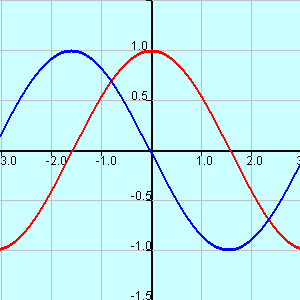
A particular exploration of the phase shift presents:
\( f(x) = a \cos(bx + c) + d \) in blue
and
\( f(x) = a \cos(bx) + d \) in red (\( c = 0 \), no phase shift)
as shown in the figure below.
You may also want to consider another tutorial on the trigonometric unit circle. Once you finish this tutorial, you can go through a self-test on trigonometric graphs.
Interactive Tutorial on the General Cosine Function
\( f(x) = a \cos(bx + c) + d \) in blue
\( f(x) = a \cos(bx) + d \) in red (\( c = 0 \) and no phase shift)
Press the button "draw" to start graphing cosine functions.
Exploration Exercises
Explore how the 4 coefficients \( a, b, c \), and \( d \) affect the graph of \( f(x) \):
-
Amplitude
Set \( a = 1, b = 1, c = 0, \) and \( d = 0 \). Write down \( f(x) \) and take note of the amplitude, period, and phase shift. Now change \( a \); how does it affect the graph? -
Period
Set \( a = 1, c = 0, d = 0 \) and change \( b \). Find the period from the graph and compare it to \( \dfrac{2\pi}{|b|} \). How does \( b \) affect the period of \( f(x) \)? -
Phase Shift (Positive Values)
Set \( a = 1, b = 1, d = 0 \) and change \( c \) starting from zero, moving slowly to large positive values. Take note of the shift (left or right) and compare it to \( -\dfrac{c}{b} \). -
Phase Shift (Negative Values)
Set \( a = 1, b = 1, d = 0 \) and change \( c \) starting from zero, moving slowly to smaller negative values. Take note of the shift (left or right) and compare it to \( -\dfrac{c}{b} \). -
Phase Shift with Different b Values
Repeat steps 3 and 4 above for \( b = 2, 3, \) and \( 4 \). -
Vertical Shift
Set \( a, b, \) and \( c \) to non-zero values and change \( d \). What is the direction of the shift of the graph when \( d \) is positive and when \( d \) is negative?
More References Related to Cosine Functions
Properties of Trigonometric Functions
Graphs of Basic Trigonometric Functions
Unit Circle and Trigonometric Functions sin(x), cos(x), tan(x)