This page presents a detailed study of exponential functions using tables of values and graphs. Key properties such as domain, range, horizontal asymptotes, and intercepts are discussed. We also investigate the conditions under which an exponential function increases or decreases.
The basic exponential function is defined by
\[ f(x) = B^x \]where the base \( B \) satisfies \( B > 0 \) and \( B \neq 1 \).
The domain of the exponential function \( f \) defined above is the set of all real numbers.
The table below shows values of the exponential functions \( 2^x \), \( 4^x \), and \( 7^x \).
| \( x \) | \( 2^x \) | \( 4^x \) | \( 7^x \) |
| \(-10\) | \(0.00097\) | \(9.53674 \times 10^{-7}\) | \(3.54013 \times 10^{-9}\) |
| \(-5\) | \(0.03125\) | \(0.00097\) | \(0.00006\) |
| \(-1\) | \(0.5\) | \(0.25\) | \(0.14285\) |
| \(0\) | \(1\) | \(1\) | \(1\) |
| \(1\) | \(2\) | \(4\) | \(7\) |
| \(3\) | \(8\) | \(64\) | \(343\) |
| \(5\) | \(32\) | \(1024\) | \(16807\) |
| \(10\) | \(1024\) | \(1048576\) | \(282475249\) |
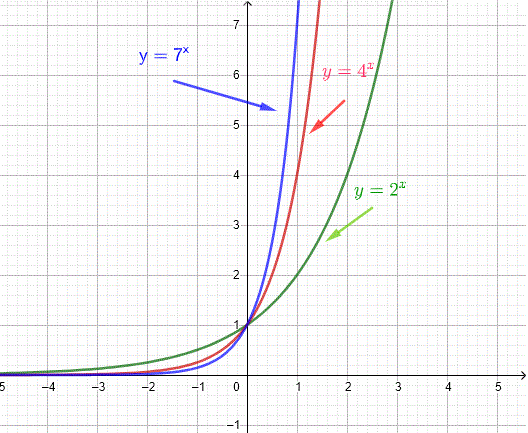
The table below shows values of the exponential functions \( 0.2^x \), \( 0.5^x \), and \( 0.8^x \).
| \( x \) | \( 0.2^x \) | \( 0.5^x \) | \( 0.8^x \) |
| \(-10\) | \(9765625\) | \(1024\) | \(9.31323\) |
| \(-5\) | \(3125\) | \(32\) | \(3.05175\) |
| \(-1\) | \(5\) | \(2\) | \(1.25\) |
| \(0\) | \(1\) | \(1\) | \(1\) |
| \(1\) | \(0.2\) | \(0.5\) | \(0.8\) |
| \(3\) | \(0.008\) | \(0.125\) | \(0.512\) |
| \(5\) | \(0.00032\) | \(0.03125\) | \(0.32768\) |
| \(10\) | \(1.024 \times 10^{-7}\) | \(0.0009765625\) | \(0.1073741824\) |
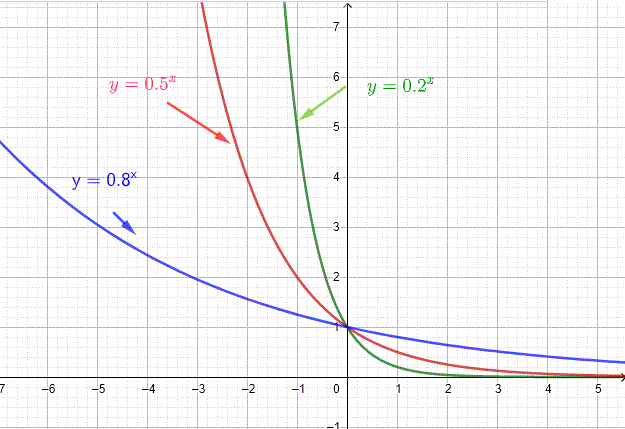
From the tables and graphs above, we conclude:
See also: Finding the Range of Exponential Functions
Let \( f(x) = B^x \). Since \( B = e^{\ln B} \), we have
\[ B^x = (e^{\ln B})^x = e^{x \ln B} \]Thus,
\[ \boxed{B^x = e^{x \ln B}} \]In calculus, natural exponentials are preferred because their derivatives and integrals are especially simple.