This tutorial explains the most important properties of inverse functions, with examples and graphical interpretations. For a general introduction, see the inverse functions tutorial.
The main properties of inverse functions are listed and discussed below.
Only one-to-one functions have inverse functions.
If \( g \) is the inverse of \( f \), then \( f \) is the inverse of \( g \). In this case, we say that \( f \) and \( g \) are inverses of each other.
If \( f \) and \( g \) are inverses of each other, then both functions must be one-to-one.
Functions \( f \) and \( g \) are inverses of each other if and only if:
\[ (f \circ g)(x) = x, \quad x \text{ in the domain of } g \] and \[ (g \circ f)(x) = x, \quad x \text{ in the domain of } f \]
Example
Let \[ f(x) = 3x \quad \text{and} \quad g(x) = \frac{x}{3}. \] Then \[ (f \circ g)(x) = f(g(x)) = 3\left(\frac{x}{3}\right) = x \] and \[ (g \circ f)(x) = g(f(x)) = \frac{3x}{3} = x. \] Therefore, \( f \) and \( g \) are inverses of each other.
If \( f \) and \( g \) are inverses of each other, then:
The domain of \( f \) equals the range of \( g \),
and the range of \( f \) equals the domain of \( g \).
Example
Let \[ f(x) = \sqrt{x - 3}. \]
The domain of \( f \) is \[ [3, +\infty). \] The range of \( f \) is \[ [0, +\infty). \]
To find the inverse function, square both sides of \[ y = \sqrt{x - 3} \] and interchange \( x \) and \( y \). This gives \[ f^{-1}(x) = x^2 + 3. \]
According to Property 4:
The domain of \( f^{-1} \) is \[ [0, +\infty), \] and the range of \( f^{-1} \) is \[ [3, +\infty). \]
If \( f \) and \( g \) are inverses of each other, then their graphs are reflections of each other across the line \[ y = x. \]
Example
Below are the graphs of \[ f(x) = \sqrt{x - 3} \] and its inverse \[ f^{-1}(x) = x^2 + 3, \quad x \ge 0. \]
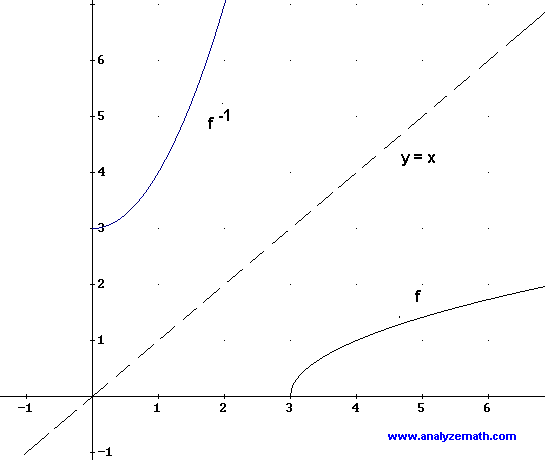
If the point \( (a, b) \) lies on the graph of \( f \), then the point \[ (b, a) \] lies on the graph of the inverse function \( f^{-1} \).