Questions and their Detailed Solutions
What fraction of the large square is red?
What fraction of the large square is blue?
What fraction of the large square is orange?
What fraction of the large square is green?
What fraction of the large square is black?
What fraction of the large square is yellow?

Solution
The large square consists of 16 equal small squares. Among them, 4 are red. Therefore, the fraction of the large square that is red is:
\[ \dfrac{4}{16} \]
Simplifying the fraction by dividing numerator and denominator by 4:
\[ \dfrac{4}{16} = \dfrac{1}{4} \]
There is 1 blue square. The fraction of the large square that is blue is:
\[ \dfrac{1}{16} \]
There is half of a square that is orange. The fraction of the large square that is orange is:
\[ \dfrac{1}{2} \times \dfrac{1}{16} = \dfrac{1}{32} \]
There are one and a half green squares. The fraction of the large square that is green is:
\[ \dfrac{1}{16} + \dfrac{1}{2} \times \dfrac{1}{16} = \dfrac{1}{16} + \dfrac{1}{32} = \dfrac{2}{32} + \dfrac{1}{32} = \dfrac{3}{32} \]
There are 3 black squares. The fraction of the large square that is black is:
\[ \dfrac{3}{16} \]
There are 3 yellow squares. The fraction of the large square that is yellow is:
\[ \dfrac{3}{16} \]
What fraction is the shaded part?
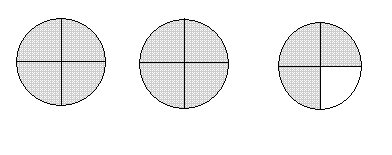
Solution
There are two whole items and \(\dfrac{3}{4}\) of one item. Hence, the shaded part is:
\[ 2 + \dfrac{3}{4} = 2 \dfrac{3}{4} \]
Which point on the number line represents 1 1/5?

Solution
Note that \(1 \dfrac{1}{5}\) is larger than 1 and smaller than 2. Each small division on the number line represents:
\[ \dfrac{1}{10} \]
Hence, point R represents:
\[ 1 + \dfrac{2}{10} = 1 \dfrac{2}{10} \]
Simplifying the fraction:
\[ 1 \dfrac{2}{10} = 1 \dfrac{1}{5} \]
Therefore, point R represents \(1 \dfrac{1}{5}\).
\[ 3 \dfrac{1}{2} + 5 \dfrac{1}{2} = \]Solution
To add the mixed numbers, combine the whole numbers and the fractional parts separately:
\[ 3 \dfrac{1}{2} + 5 \dfrac{1}{2} = (3 + 5) + \left(\dfrac{1}{2} + \dfrac{1}{2}\right) \]
\[ = 8 + \dfrac{2}{2} = 8 + 1 = 9 \]
\[ \dfrac{1}{2} + \dfrac{1}{14} = \]Solution
To add fractions, first write them with a common denominator:
\[ \dfrac{1}{2} + \dfrac{1}{14} = \dfrac{7}{14} + \dfrac{1}{14} \]
Now add the numerators:
\[ \dfrac{7}{14} + \dfrac{1}{14} = \dfrac{8}{14} \]
Finally, simplify the fraction by dividing numerator and denominator by 2:
\[ \dfrac{8}{14} = \dfrac{4}{7} \]
\[ \dfrac{1}{3} - \dfrac{1}{12} = \]Solution
To subtract fractions, first write them with a common denominator:
\[ \dfrac{1}{3} - \dfrac{1}{12} = \dfrac{4}{12} - \dfrac{1}{12} \]
Now subtract the numerators:
\[ \dfrac{4}{12} - \dfrac{1}{12} = \dfrac{3}{12} \]
Finally, simplify the fraction by dividing numerator and denominator by 3:
\[ \dfrac{3}{12} = \dfrac{1}{4} \]
one half is the same as?- one quarter
- two quarters
- three quarters
- four quarters
Solution
one half is written as \[ \dfrac{1}{2} \] one quarter is written as \[ \dfrac{1}{4} \] two quarters is written as \[ \dfrac{2}{4} \] divide numerator and denominator to reduce fraction \[ \dfrac{2}{4} = \dfrac{1}{2} \] Hence one half is the same as two quarters.
Question: Which two fractions are not equivalent?
- \(\dfrac{1}{2}\) and \(\dfrac{2}{4}\)
- \(\dfrac{4}{3}\) and \(\dfrac{8}{6}\)
- \(\dfrac{1}{5}\) and \(\dfrac{3}{15}\)
- \(\dfrac{2}{3}\) and \(\dfrac{8}{9}\)
Solution
\(\dfrac{2}{4}\) is equivalent to \(\dfrac{1}{2}\) since:
\[ \dfrac{2}{4} = \dfrac{1}{2} \quad \text{(after dividing numerator and denominator of \(\dfrac{2}{4}\) by 2)} \]
\(\dfrac{8}{6}\) is equivalent to \(\dfrac{4}{3}\) since:
\[ \dfrac{4}{3} = \dfrac{8}{6} \quad \text{(after multiplying numerator and denominator of \(\dfrac{4}{3}\) by 2)} \]
\(\dfrac{1}{5}\) is equivalent to \(\dfrac{3}{15}\) since:
\[ \dfrac{1}{5} = \dfrac{3}{15} \quad \text{(after multiplying numerator and denominator of \(\dfrac{1}{5}\) by 3)} \]
However, \(\dfrac{2}{3}\) and \(\dfrac{8}{9}\) are not equivalent.
\[ 5 \dfrac{2}{3} + 5 \dfrac{1}{2} = \]Solution
To add the mixed numbers, combine the whole numbers and then add the fractional parts:
\[ 5 \dfrac{2}{3} + 5 \dfrac{1}{2} = (5 + 5) + \left(\dfrac{2}{3} + \dfrac{1}{2}\right) \]
Find a common denominator for the fractions:
\[ \dfrac{2}{3} + \dfrac{1}{2} = \dfrac{4}{6} + \dfrac{3}{6} = \dfrac{7}{6} \]
Now substitute back:
\[ 10 + \dfrac{7}{6} = 10 + \left(\dfrac{6}{6} + \dfrac{1}{6}\right) = 10 + 1 + \dfrac{1}{6} = 11 \dfrac{1}{6} \]
Question: Order the following fractions from least to greatest: \(\dfrac{8}{9}, \dfrac{17}{18}, \dfrac{2}{3}, \dfrac{7}{6}\).
Solution
It is easier to compare fractions when they have the same denominator. We choose 18 as the common denominator and rewrite each fraction:
\[ \dfrac{8}{9} = \dfrac{16}{18}, \quad \dfrac{17}{18} = \dfrac{17}{18}, \quad \dfrac{2}{3} = \dfrac{12}{18}, \quad \dfrac{7}{6} = \dfrac{21}{18} \]
Now, order the fractions from least to greatest:
\[ \dfrac{12}{18} \; \lt \; \dfrac{16}{18} \; \lt \; \dfrac{17}{18} \; \lt \; \dfrac{21}{18} \]
Therefore, the correct order is:
\[ \dfrac{2}{3},\; \dfrac{8}{9},\; \dfrac{17}{18},\; \dfrac{7}{6} \]
Question: Which fraction is closest to 1?
- \(\dfrac{10}{11}\)
- \(\dfrac{11}{10}\)
- \(\dfrac{9}{11}\)
- \(-\dfrac{9}{10}\)
Solution
To compare the fractions, we write them with a common denominator of 110. We then see which one is closest to \(\dfrac{110}{110} = 1\).
\[ \dfrac{10}{11} = \dfrac{100}{110}, \quad \dfrac{11}{10} = \dfrac{121}{110}, \quad \dfrac{9}{11} = \dfrac{90}{110}, \quad - \dfrac{9}{10} = - \dfrac{99}{110} \]
Now, since they share the same denominator, we look for the numerator closest to 110:
- \(100\) is 10 away from 110.
- \(121\) is 11 away from 110.
- \(90\) is 20 away from 110.
- \(-99\) is far below 110.
The fraction with the numerator closest to 110 is:
\[ \dfrac{10}{11} \]
Therefore, the fraction \(\dfrac{10}{11}\) is closest to 1.
\[ \dfrac{5}{2} \div \dfrac{2}{5} = \]Solution
To divide fractions, multiply the first fraction by the reciprocal of the second:
\[ \dfrac{5}{2} \div \dfrac{2}{5} = \dfrac{5}{2} \times \dfrac{5}{2} \]
Now multiply the numerators and denominators:
\[ \dfrac{5}{2} \times \dfrac{5}{2} = \dfrac{25}{4} \]
Convert the improper fraction to a mixed number:
\[ \dfrac{25}{4} = \dfrac{24}{4} + \dfrac{1}{4} = 6 \dfrac{1}{4} \]
Therefore, \(\dfrac{5}{2} \div \dfrac{2}{5} = \; 6 \dfrac{1}{4}\).
\[ 5 \div \dfrac{1}{5} = \]Solution
To divide a whole number by a fraction, multiply the whole number by the reciprocal of the fraction:
\[ 5 \div \dfrac{1}{5} = 5 \times \dfrac{5}{1} \]
Now perform the multiplication:
\[ 5 \times \dfrac{5}{1} = \dfrac{25}{1} = 25 \]
Therefore, \(5 \div \dfrac{1}{5} = \; 25\).
\[ \dfrac{2}{5} \times \dfrac{7}{8} = \]Solution
To multiply fractions, multiply the numerators together and the denominators together:
\[ \dfrac{2}{5} \times \dfrac{7}{8} = \dfrac{2 \times 7}{5 \times 8} \]
Simplify before multiplying where possible:
\[ \dfrac{2 \times 7}{5 \times 8} = \dfrac{1 \times 7}{5 \times 4} = \dfrac{7}{20} \]
Therefore, \(\dfrac{2}{5} \times \dfrac{7}{8} = \dfrac{7}{20}\).
Solution
Write the mixed number \( 7 \dfrac{7}{8} \) as an improper fraction.
Solution
To convert a mixed number into an improper fraction, multiply the whole number by the denominator, then add the numerator:
\[ 7 \dfrac{7}{8} = \dfrac{7 \times 8}{8} + \dfrac{7}{8} \]
\[ = \dfrac{56}{8} + \dfrac{7}{8} = \dfrac{56 + 7}{8} = \dfrac{63}{8} \]
Therefore, the mixed number \(7 \dfrac{7}{8}\) written as an improper fraction is \(\dfrac{63}{8}\).
Question: Write the fraction \(\dfrac{31}{8}\) as a mixed number.
Solution
To convert an improper fraction to a mixed number, divide the numerator by the denominator:
\[ \dfrac{31}{8} = \dfrac{24 + 7}{8} = \dfrac{24}{8} + \dfrac{7}{8} \]
\[ \dfrac{24}{8} = 3, \quad \text{so we get: } 3 \dfrac{7}{8} \]
Therefore, the fraction \(\dfrac{31}{8}\) written as a mixed number is \(3 \dfrac{7}{8}\).
\[ 3 \times \dfrac{1}{4} = \]Solution
To multiply a whole number by a fraction, first write the whole number as a fraction with denominator 1:
\[ 3 \times \dfrac{1}{4} = \dfrac{3}{1} \times \dfrac{1}{4} \]
Multiply the numerators and denominators:
\[ \dfrac{3 \times 1}{1 \times 4} = \dfrac{3}{4} \]
Therefore, \(3 \times \dfrac{1}{4} = \dfrac{3}{4}\).
-
\[ 3 \dfrac{1}{4} \div 5 \dfrac{1}{3} = \]Solution
First, convert the mixed numbers into improper fractions:
\[ 3 \dfrac{1}{4} = \dfrac{13}{4}, \qquad 5 \dfrac{1}{3} = \dfrac{16}{3} \]
Now, divide the fractions by multiplying the first fraction by the reciprocal of the second:
\[ \dfrac{13}{4} \div \dfrac{16}{3} = \dfrac{13}{4} \times \dfrac{3}{16} \]
Multiply the numerators and denominators:
\[ \dfrac{13 \times 3}{4 \times 16} = \dfrac{39}{64} \]
Therefore, \(3 \dfrac{1}{4} \div 5 \dfrac{1}{3} = \dfrac{39}{64}\).
-
\[ 4 \dfrac{2}{7} \times 5 \dfrac{3}{5} = \]Solution
First, convert the mixed numbers into improper fractions:
\[ 4 \dfrac{2}{7} = \dfrac{30}{7}, \qquad 5 \dfrac{3}{5} = \dfrac{28}{5} \]
Now multiply the fractions:
\[ \dfrac{30}{7} \times \dfrac{28}{5} = \dfrac{30 \times 28}{7 \times 5} \]
Simplify before multiplying:
\[ \dfrac{30 \times 28}{7 \times 5} = \dfrac{30 \times 4}{5} = \dfrac{120}{5} = 24 \]
Therefore, \(4 \dfrac{2}{7} \times 5 \dfrac{3}{5} = 24\).
-
To have \(F + 2 \dfrac{5}{7} = 4\), what must \(F\) be equal to?
Solution
We want to solve for \(F\) in the equation:
\[ F + 2 \dfrac{5}{7} = 4 \]
Subtract \(2 \dfrac{5}{7}\) from both sides:
\[ F = 4 - 2 \dfrac{5}{7} \]
\[ F = (4 - 2) - \dfrac{5}{7} = 2 - \dfrac{5}{7}) \]
Now compute: \[ 2 - \dfrac{5}{7} = \dfrac{14}{7} - \dfrac{5}{7} = \dfrac{9}{7} \]
So: \[ F = 2 - \dfrac{5}{7} = \dfrac{9}{7} \]
Convert to a mixed number: \[ \dfrac{9}{7} = 1 \dfrac{2}{7} \]
Therefore, \(F = \; 1 \dfrac{2}{7}\).
-
Tom runs \(\dfrac{3}{4}\) of an hour every Monday, 30 minutes every Tuesday, half an hour every Wednesday, \(1 \dfrac{1}{4}\) hours every Thursday, and \(\dfrac{2}{3}\) of an hour on Friday. How many hours does Tom run from Monday to Friday?
Solution
We first convert the running times for each day into minutes:
Monday: \[ \dfrac{3}{4} \times 60 = \dfrac{180}{4} = 45 \text{ minutes} \]
Tuesday: \[ 30 \text{ minutes} \]
Wednesday: Half an hour \[ \dfrac{1}{2} \times 60 = 30 \text{ minutes} \]
Thursday: \[ 1 \dfrac{1}{4} \text{ hours} = 60 + \dfrac{1}{4} \times 60 = 60 + 15 = 75 \text{ minutes} \]
Friday: \[ \dfrac{2}{3} \times 60 = 40 \text{ minutes} \]
Now add up the total minutes:
\[ 45 + 30 + 30 + 75 + 40 = 220 \text{ minutes} \]
Convert to hours and minutes: \[ 220 = 180 + 40 = 3 \text{ hours and } 40 \text{ minutes} \]
Therefore, Tom runs a total of 3 hours and 40 minutes from Monday to Friday.
-
Order from least to greatest: \[ 5 \dfrac{3}{4}, \; 3 \dfrac{4}{5}, \; 3 \dfrac{1}{5}, \; 4 \dfrac{5}{6} \]Solution
When ordering mixed numbers, we first compare the whole number parts. The number with the smallest whole number will be the smallest overall.
- \(3 \dfrac{1}{5}\) has whole number part 3 → smallest.
- \(3 \dfrac{4}{5}\) also has whole number part 3 but is greater than \(3 \dfrac{1}{5}\).
- \(4 \dfrac{5}{6}\) has whole number part 4 → larger than both 3’s.
- \(5 \dfrac{3}{4}\) has whole number part 5 → largest.
Thus, the correct order from least to greatest is:
\[ 3 \dfrac{1}{5}, \; 3 \dfrac{4}{5}, \; 4 \dfrac{5}{6}, \; 5 \dfrac{3}{4} \]
Order from least to greatest: \(7 \dfrac{2}{3}, \; 7 \dfrac{3}{5}, \; 7 \dfrac{3}{4}, \; 7 \dfrac{6}{11}\).
Solution
Since all the mixed numbers have the same whole number part (7), we only need to compare their fractional parts. To make comparison easier, we write all fractions with the lowest common denominator, which is 660.
\[ \dfrac{2}{3} = \dfrac{440}{660}, \quad \dfrac{3}{5} = \dfrac{396}{660}, \quad \dfrac{3}{4} = \dfrac{495}{660}, \quad \dfrac{6}{11} = \dfrac{360}{660} \]
Now, compare the numerators since the denominators are equal:
- \(\dfrac{360}{660}\) (from \( \dfrac{6}{11} \))
- \(\dfrac{396}{660}\) (from \( \dfrac{3}{5} \))
- \(\dfrac{440}{660}\) (from \( \dfrac{2}{3} \))
- \(\dfrac{495}{660}\) (from \( \dfrac{3}{4} \))
Therefore, the order from least to greatest is:
\[ 7 \dfrac{6}{11}, \; 7 \dfrac{3}{5}, \; 7 \dfrac{2}{3}, \; 7 \dfrac{3}{4} \]
What fraction of 1 hour is 50 minutes?
Solution
A fraction represents a part of a whole. Since 1 hour = 60 minutes, we compare 50 minutes to 60 minutes:
\[ \text{Fraction of an hour} = \dfrac{50}{60} \]
Now reduce the fraction by dividing numerator and denominator by 10:
\[ \dfrac{50}{60} = \dfrac{5}{6} \]
Therefore, 50 minutes is \(\dfrac{5}{6}\) of an hour.
\(\dfrac{1}{3}\) is \(\dfrac{1}{8}\) of what number?
Solution
Let the unknown number be \(n\). We can translate the problem into an equation:
\[ \dfrac{1}{3} = \dfrac{1}{8} \times n \]
Simplify the right-hand side: \[ \dfrac{1}{3} = \dfrac{n}{8} \]
Now solve for \(n\) by multiplying both sides by 8: \[ n = 8 \times \dfrac{1}{3} = \dfrac{8}{3} \]
Therefore, the number is: \[ n = \dfrac{8}{3} \]