The concept of multiplying fractions is explained using visual examples, followed by the general rule.
Visual Examples with Explanations
Example 1: Let us explain how to do the following multiplication: \(\dfrac{1}{2} \times \dfrac{1}{3}\)
We start with a rectangle. We use a picture to represent \(\dfrac{1}{3}\) (in red).
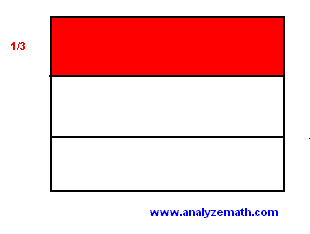
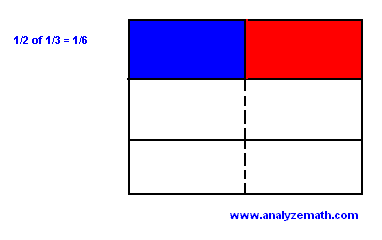
We now take \(\dfrac{1}{2}\) of the red part (blue). The blue part which is \(\dfrac{1}{2}\) of \(\dfrac{1}{3}\) is also \(\dfrac{1}{6}\) of the unit we started with. We can write:
\[ \dfrac{1}{2} \times \dfrac{1}{3} = \dfrac{1}{6} \]
Example 2: Let us explain how to do the following multiplication: \(\dfrac{1}{3} \times \dfrac{3}{4}\)
We start with a rectangle. We use a picture to represent \(\dfrac{3}{4}\) (in red).
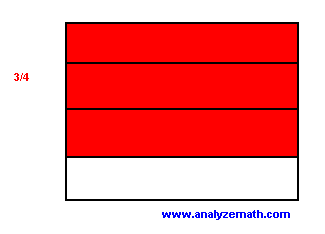
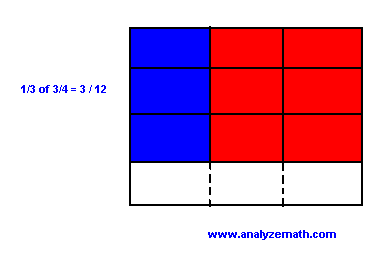
We now take \(\dfrac{1}{3}\) of the red part (blue). The blue part which is \(\dfrac{1}{3}\) of \(\dfrac{3}{4}\) is also \(\dfrac{3}{12}\) of the unit we started with. We can write:
\[ \dfrac{1}{3} \times \dfrac{3}{4} = \dfrac{3}{12} \]
General Rule of Multiplication of Fractions
To multiply two fractions, multiply their numerators together and their denominators together:
\[ \dfrac{a}{b} \times \dfrac{c}{d} = \dfrac{a \times c}{b \times d} \]
Example 3: Evaluate:
a) \(\dfrac{2}{3} \times \dfrac{5}{3}\)
b) \(\dfrac{3}{10} \times \dfrac{5}{21}\)
► View Step-by-Step Solution
a) \(\dfrac{2}{3} \times \dfrac{5}{3} = \dfrac{2 \times 5}{3 \times 3} = \dfrac{10}{9}\)
b) \(\dfrac{3}{10} \times \dfrac{5}{21} = \dfrac{3 \times 5}{10 \times 21} = \dfrac{15}{210}\)