Real Cube Root of a Real Number
A number \( y \) is the cube root of a number \( x \) if \( y^3 = x \).
Numerical examples
\( 1 \) is the cube root of \( 1 \) because \( 1^3 = 1 \)
\( 2 \) is the cube root of \( 8 \) because \( 2^3 = 8 \)
\( -10 \) is the cube root of \( -1000 \) because \( (-10)^3 = -1000 \)
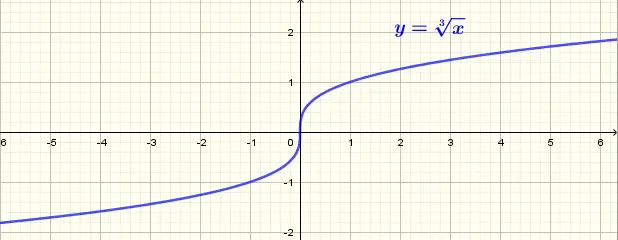
\( y = \sqrt[3]{x} \)
The graph of the cube root function is shown below.
Complex Cube Roots (De Moivre's Theorem)
If we allow complex numbers, any non‑zero real \( x \) has three cube roots: one real and two complex conjugates. They are given by:
\( y_1 = \sqrt[3]{x} \) (real root)
\( y_2 = \sqrt[3]{x}\left( -\dfrac{1}{2} + i\dfrac{\sqrt{3}}{2} \right) \)
\( y_3 = \sqrt[3]{x}\left( -\dfrac{1}{2} - i\dfrac{\sqrt{3}}{2} \right) \)
where \( i = \sqrt{-1} \) is the imaginary unit.
Example with \( x = -27 \)
\( y_1 = \sqrt[3]{-27} = -3 \)
\( y_2 = -3\left( -\dfrac{1}{2} + i\dfrac{\sqrt{3}}{2} \right) = \dfrac{3}{2} - \dfrac{3\sqrt{3}}{2}\,i \)
\( y_3 = -3\left( -\dfrac{1}{2} - i\dfrac{\sqrt{3}}{2} \right) = \dfrac{3}{2} + \dfrac{3\sqrt{3}}{2}\,i \)
(Approximately \(1.5 - 2.598i\) and \(1.5 + 2.598i\))