This is a tutorial with detailed solutions to problems related to the ellipse equation. An HTML5 Applet to Explore Equations of Ellipses is also included on this website.
Review
An ellipse with center at the origin \( (0,0) \) is the graph of:
\[ \dfrac{x^2}{a^2} + \dfrac{y^2}{b^2} = 1 \]or
\[ \dfrac{x^2}{b^2} + \dfrac{y^2}{a^2} = 1 \]with \( a > b > 0 \).
- The length of the major axis is \( 2a \), and the length of the minor axis is \( 2b \).
- The two foci are located at \( (\pm c, 0) \) or at \( (0, \pm c) \), where \( c^2 = a^2 - b^2 \).
Problem 1
Given the following equation:
\[ 9x^2 + 4y^2 = 36 \]- a) Find the \(x\)- and \(y\)-intercepts of the graph of the equation.
- b) Find the coordinates of the foci.
- c) Find the length of the major and minor axes.
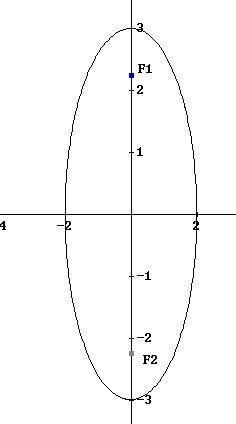
- d) Sketch the graph of the equation.
View Solution
a) We first write the given equation in standard form by dividing both sides of the equation by 36 and simplifying:
\[ \dfrac{9x^2}{36} + \dfrac{4y^2}{36} = \dfrac{36}{36} \implies \dfrac{x^2}{4} + \dfrac{y^2}{9} = 1 \]We now identify the equation with standard forms where \( a > b \). Here, \( a^2 = 9 \implies a = 3 \) and \( b^2 = 4 \implies b = 2 \).
Set \( y = 0 \) to find the \( x \)-intercepts:
\[ \dfrac{x^2}{2^2} = 1 \implies x^2 = 4 \implies x = \pm 2 \]Set \( x = 0 \) to find the \( y \)-intercepts:
\[ \dfrac{y^2}{3^2} = 1 \implies y^2 = 9 \implies y = \pm 3 \]b) Find \( c \) using the relationship \( c^2 = a^2 - b^2 \):
\[ c^2 = 3^2 - 2^2 = 9 - 4 = 5 \implies c = \pm \sqrt{5} \]Since the major axis is vertical (along the \( y \)-axis), the foci are:
\[ F_1(0, \sqrt{5}) \quad \text{and} \quad F_2(0, -\sqrt{5}) \]c) The lengths of the axes are:
- Major axis length: \( 2a = 2(3) = 6 \)
- Minor axis length: \( 2b = 2(2) = 4 \)
d) Locate the \( x \)- and \( y \)-intercepts, use the foci, and sketch the graph:
Problem 2
Given the following equation:
\[ 4x^2 - 16x + 4 + y^2 + 2y + 1 = 9 \]- a) Find the \(x\)- and \(y\)-intercepts of the graph of the equation.
- b) Find the coordinates of the foci.
- c) Find the length of the major and minor axes.
- d) Sketch the graph of the equation.
View Solution
a) To find the intercepts and analyze the graph, let us first rewrite the equation in standard form by grouping terms and completing the square:
\[ (4x^2 - 16x + 4) + (y^2 + 2y + 1) = 9 \] \[ 4(x^2 - 4x) + 4 + (y^2 + 2y) + 1 = 9 \] \[ 4(x^2 - 4x + 4 - 4) + 4 + (y^2 + 2y + 1 - 1) + 1 = 9 \] \[ 4(x - 2)^2 - 16 + 4 + (y + 1)^2 - 1 + 1 = 9 \] \[ 4(x - 2)^2 - 12 + (y + 1)^2 = 9 \implies 4(x - 2)^2 + (y + 1)^2 = 21 \]Divide both sides by 21 to obtain the standard ellipse equation:
\[ \dfrac{(x - 2)^2}{\frac{21}{4}} + \dfrac{(y + 1)^2}{21} = 1 \]This is an ellipse centered at \( (h, k) = (2, -1) \) with \( b^2 = \frac{21}{4} \) and \( a^2 = 21 \). Since \( a > b \) (\( 21 > 5.25 \)), the major axis is vertical with \( a = \sqrt{21} \) and \( b = \frac{\sqrt{21}}{2} \).
Finding \( y \)-intercepts (set \( x = 0 \)):
\[ 4(0)^2 - 16(0) + 4 + y^2 + 2y + 1 = 9 \implies y^2 + 2y - 4 = 0 \] \[ y = \frac{-2 \pm \sqrt{4 - 4(1)(-4)}}{2} = \frac{-2 \pm \sqrt{20}}{2} = -1 \pm \sqrt{5} \]Thus, the \( y \)-intercepts are \( (0, -1 + \sqrt{5}) \) and \( (0, -1 - \sqrt{5}) \).
Finding \( x \)-intercepts (set \( y = 0 \)):
\[ 4x^2 - 16x + 4 + (0)^2 + 2(0) + 1 = 9 \implies 4x^2 - 16x - 4 = 0 \implies x^2 - 4x - 1 = 0 \] \[ x = \frac{4 \pm \sqrt{16 - 4(1)(-1)}}{2} = \frac{4 \pm \sqrt{20}}{2} = 2 \pm \sqrt{5} \]Thus, the \( x \)-intercepts are \( (2 + \sqrt{5}, 0) \) and \( (2 - \sqrt{5}, 0) \).
b) Find \( c \) using the relationship \( c^2 = a^2 - b^2 \):
\[ c^2 = 21 - \frac{21}{4} = \frac{63}{4} \implies c = \frac{3\sqrt{7}}{2} \]Since the center is at \( (2, -1) \) and the major axis is vertical, the foci are located at:
\[ F_1\left(2, -1 + \dfrac{3\sqrt{7}}{2}\right) \quad \text{and} \quad F_2\left(2, -1 - \dfrac{3\sqrt{7}}{2}\right) \]c) The lengths of the axes are:
- Major axis length: \( 2a = 2\sqrt{21} \)
- Minor axis length: \( 2b = 2\left(\frac{\sqrt{21}}{2}\right) = \sqrt{21} \)
d) Sketch the ellipse using the center \( (2, -1) \), vertical semi-axis \( a = \sqrt{21} \), horizontal semi-axis \( b = \frac{\sqrt{21}}{2} \), and the calculated intercepts.
Problem 3 (Challenging Extension)
Given the general equation of a shifted ellipse:
\[ 9x^2 + 16y^2 - 36x + 96y + 36 = 0 \]- a) Find the standard form of the ellipse equation, identifying its center, \(a\), and \(b\).
- b) Find the coordinates of the foci and the vertices.
- c) Find the lengths of the major and minor axes.
View Solution
a) Group the \( x \) and \( y \) terms together and move the constant to the right side:
\[ (9x^2 - 36x) + (16y^2 + 96y) = -36 \]Factor out the leading coefficients from each group:
\[ 9(x^2 - 4x) + 16(y^2 + 6y) = -36 \]Complete the square inside each parenthesis by adding and subtracting appropriate terms:
\[ 9(x^2 - 4x + 4 - 4) + 16(y^2 + 6y + 9 - 9) = -36 \] \[ 9((x - 2)^2 - 4) + 16((y + 3)^2 - 9) = -36 \] \[ 9(x - 2)^2 - 36 + 16(y + 3)^2 - 144 = -36 \]Combine constants on the left and move them to the right:
\[ 9(x - 2)^2 + 16(y + 3)^2 - 180 = -36 \] \[ 9(x - 2)^2 + 16(y + 3)^2 = 144 \]Divide every term by 144 to put the equation in standard form:
\[ \dfrac{9(x - 2)^2}{144} + \dfrac{16(y + 3)^2}{144} = 1 \implies \dfrac{(x - 2)^2}{16} + \dfrac{(y + 3)^2}{9} = 1 \]This is an ellipse centered at \( (h, k) = (2, -3) \) with horizontal major axis where \( a^2 = 16 \implies a = 4 \) and \( b^2 = 9 \implies b = 3 \).
b) Find \( c \) using the relationship \( c^2 = a^2 - b^2 \):
\[ c^2 = 16 - 9 = 7 \implies c = \sqrt{7} \]Since the major axis is horizontal along the line \( y = -3 \), the foci are:
\[ F_1(2 + \sqrt{7}, -3) \quad \text{and} \quad F_2(2 - \sqrt{7}, -3) \]The vertices along the major axis are:
\[ V_1(2 + 4, -3) = (6, -3) \quad \text{and} \quad V_2(2 - 4, -3) = (-2, -3) \]c) The lengths of the axes are:
- Major axis length: \( 2a = 2(4) = 8 \)
- Minor axis length: \( 2b = 2(3) = 6 \)
More Links and References on Ellipses
- College Algebra Problems With Answers - Sample 8: Equation of Ellipse
- Points of Intersection of an Ellipse and a Line
- HTML5 Applet to Explore Equations of Ellipses
- Find the Points of Intersection of a Circle and an Ellipse
- Ellipse Area and Perimeter Calculator
- Find the Points of Intersection of Two Ellipses
- Home Page