This is a tutorial on how to solve quadratic equations graphically and check the answers analytically. The quadratic equations explored are of the type:
\[ ax^2 + bx + c = 0 \]
Review
The analytical solutions to a quadratic equation are given by the quadratic formula:
\[ x_1 = \frac{-b + \sqrt{\Delta}}{2a}, \quad x_2 = \frac{-b - \sqrt{\Delta}}{2a} \]
where \(\Delta = b^2 - 4ac\) is called the discriminant. It gives information about the number and type of solutions:
- If \(\Delta > 0\), the quadratic equation has 2 real solutions.
- If \(\Delta = 0\), the quadratic equation has 1 real solution.
- If \(\Delta < 0\), the equation has 2 complex conjugate solutions.
The graphical solutions are obtained by graphing the function \(y = ax^2 + bx + c\). The x-intercepts, if they exist, provide approximate solutions.
Question 1: Solve \(2x^2 + 3x = 5\) graphically and analytically
Graphical solution
Rewrite in standard form:
\[ 2x^2 + 3x - 5 = 0 \]
Graph the function:
\[ y = 2x^2 + 3x - 5 \]
Locate x-intercepts: \(x_1 \approx -2.5\), \(x_2 \approx 1\).
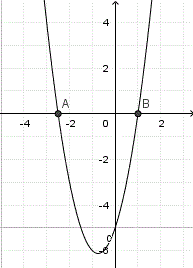
Figure 1. Graphical solution of \(2x^2 + 3x = 5\).
Analytical solution
Discriminant:
\[ \Delta = b^2 - 4ac = 3^2 - 4(2)(-5) = 49 \]
Since \(\Delta > 0\), two real solutions exist:
\[ x_1 = \frac{-3 + \sqrt{49}}{2\cdot 2} = 1, \quad x_2 = \frac{-3 - \sqrt{49}}{2\cdot 2} = -2.5 \]
The graphical and analytical solutions match. Graphical solutions are approximate in general.
Question 2: Solve \(x^2 + 4x + 4 = 0\) graphically and analytically
Graphical solution
Graph the function:
\[ y = x^2 + 4x + 4 \]
There is one x-intercept: \(x = -2\).
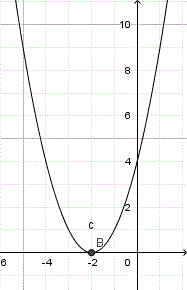
Figure 2. Graphical solution of \(x^2 + 4x + 4 = 0\).
Analytical solution
Discriminant:
\[ \Delta = b^2 - 4ac = 16 - 16 = 0 \]
Since \(\Delta = 0\), one solution exists:
\[ x = \frac{-b}{2a} = \frac{-4}{2 \cdot 1} = -2 \]
Question 3: Solve \(-x^2 + 4x - 5 = 0\) graphically and analytically
Graphical solution
Graph the function:
\[ y = -x^2 + 4x - 5 \]
No x-intercepts; no real solutions, only complex ones.
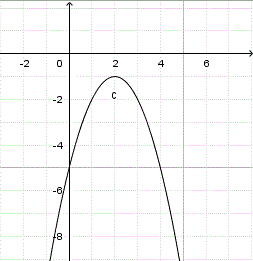
Figure 3. Graphical solution of \(y = -x^2 + 4x - 5\) with no x-intercepts.
Analytical solution
Discriminant:
\[ \Delta = b^2 - 4ac = 4^2 - 4(-1)(-5) = -4 \]
Since \(\Delta < 0\), two complex conjugate solutions exist:
\[ x_1 = \frac{-4 + \sqrt{-4}}{2(-1)} = 2 - i, \quad x_2 = \frac{-4 - \sqrt{-4}}{2(-1)} = 2 + i \]
Graphical method cannot find imaginary solutions.
More Questions and Solutions
Solve graphically and analytically:
- \(-x^2 - 2x = 1\)
- \(x^2 + 2x + 10 = 0\)
- \(x^2 + 2x = 0 \)
Analytical Solutions to Above Questions
- 1: Graphical: one x-intercept at \(x=-1\); Analytical: double solution \(x=-1\)
- 2: Graphical: no x-intercepts; Analytical: two complex solutions \(x=-1-3i, x=-1+3i\)
- 3: Graphical: two x-intercepts at \(x=0\) and \(x=-2\); Analytical: \(x=0, x=-2\)