Problems on 3D shapes such as prisms, cubes, cylinders, and composite solids are presented along with detailed solutions.
Problems & Step-by-Step Solutions
Problem 1: Rectangular Prism Height
A rectangular prism of volume \(3200 \text{ mm}^3\) has a rectangular base of length \(10 \text{ mm}\) and width \(8 \text{ mm}\). Find the height \(h\) of the prism.

Solution:
Volume is given by:
\[ V = \text{length} \times \text{width} \times \text{height} \] \[ V = 10 \text{ mm} \times 8 \text{ mm} \times h \implies 3200 = 80h \]Solve for \(h\):
\[ h = \frac{3200}{80} = 40 \text{ mm} \]Problem 2: Volume of a Cube
The area of one square face of a cube is equal to \(64 \text{ cm}^2\). Find the volume of the cube.

Solution:
The area of one square face is given by \(s \times s = 64\).
Solve for \(s\):
\[ s = \sqrt{64} = 8 \text{ cm} \]The volume \(V\) of the cube is given by \(V = s^3\):
\[ V = 8^3 = 512 \text{ cm}^3 \]Problem 3: Triangular Prism Dimensions
The triangular base of a prism is a right triangle of sides \(a\) and \(b = 2a\). The height \(h\) of the prism is equal to \(10 \text{ mm}\) and its volume is equal to \(40 \text{ mm}^3\). Find the lengths of the sides \(a\) and \(b\).
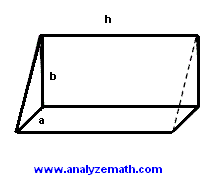
Solution:
The volume \(V\) of the prism is given by:
\[ V = \frac{1}{2}ab h \implies 40 = \frac{1}{2}ab(10) \]Substitute \(b = 2a\):
\[ 40 = \frac{1}{2}a(2a)(10) \implies 40 = 10a^2 \]Solve for \(a\) and calculate \(b\):
\[ a^2 = 4 \implies a = 2 \text{ mm} \] \[ b = 2a = 4 \text{ mm} \]Problem 4: L-Shaped Rectangular Structure Volume
Find the volume of the given L-shaped rectangular structure.
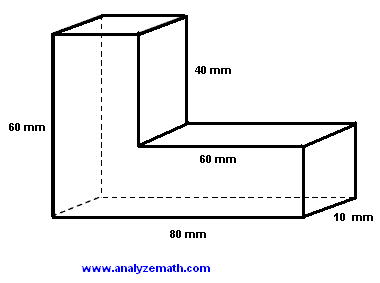
Solution:
We can think of the given shape as a larger rectangular prism of dimensions \(60\), \(80\), and \(10 \text{ mm}\), from which a smaller prism of dimensions \(40\), \(60\), and \(10 \text{ mm}\) has been removed.
\[ V = 60 \times 80 \times 10 - 40 \times 60 \times 10 \] \[ V = 48000 - 24000 = 24000 \text{ mm}^3 \]Problem 5: Thickness of a Hollow Cylinder
Find the thickness \(x\) of the hollow cylinder of height \(1000 \text{ mm}\) if the volume between the inner and outer cylinders is equal to \(11000\pi \text{ mm}^3\) and the outer diameter is \(12 \text{ mm}\).

Solution:
If \(R\) and \(r\) are the outer and inner radii of the hollow cylinder, the volume \(V\) between the cylinders is given by:
\[ V = h\pi(R^2 - r^2) \implies 11000\pi = 1000\pi(36 - r^2) \]Solve for \(r\):
\[ 11000 = 1000(36 - r^2) \implies 11 = 36 - r^2 \implies r^2 = 25 \implies r = 5 \text{ mm} \]Find the thickness \(x = R - r\):
\[ x = 6 - 5 = 1 \text{ mm} \]Problem 6: U-Shaped Structure Variable
Find \(x\) so that the volume of the U-shaped rectangular structure is equal to \(165 \text{ cm}^3\).

Solution:
We can think of the given shape as a larger rectangular prism of dimensions \(8\), \(3\), and \(10 \text{ cm}\), from which a smaller prism of dimensions \(x\), \(x\), and \(3 \text{ cm}\) has been removed.
\[ V = 8 \times 3 \times 10 - 3x^2 \] \[ 240 - 3x^2 = 165 \implies 75 = 3x^2 \implies x^2 = 25 \implies x = 5 \text{ cm} \]Problem 7: Volume of a Hexagonal Prism
Find the volume of the hexagonal prism whose base is a regular hexagon of side \(x = 10 \text{ cm}\).

Solution:
The hexagon is made up of 6 equilateral triangles. Hence the area \(A\) of the base is:
\[ A = 6\left(\frac{x^2\sqrt{3}}{4}\right) = 6\left(\frac{100\sqrt{3}}{4}\right) = 150\sqrt{3} \]If the height of the prism is \(24 \text{ cm}\), then the volume \(V\) is:
\[ V = 24 \times 150\sqrt{3} \approx 6235.4 \text{ cm}^3 \]