This geometry problem explores how to express the sine of an angle in a kite constructed inside a square. We use congruent triangles and area methods to derive the formula step by step.
Problem Statement
Let \(ABCD\) be a square with side length equal to 2 units. Points \(M\) and \(N\) lie on sides \(BC\) and \(CD\) respectively such that:
\[ BM = DN = x \]Express \( \sin(\alpha) \) as a function of \( x \), where \( \alpha = \angle MAN \).
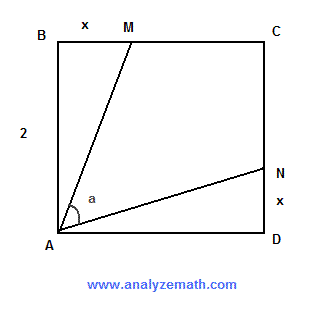
Step-by-Step Solution
Step 1: Area of Right Triangles
Triangles \(ABM\) and \(ADN\) are congruent right triangles. Each has area:
\[ \text{Area} = \frac{1}{2} \cdot 2 \cdot x = x \]Step 2: Area of the Kite Using Subtraction
The area of the square is:
\[ 2 \times 2 = 4 \]Subtracting the areas of the two right triangles:
\[ \text{Area of kite } AMCN = 4 - 2x \]Step 3: Area of the Kite Using Triangles
The kite \(AMCN\) can also be decomposed into:
- Isosceles triangle \(AMN\)
- Right triangle \(MCN\)
First compute \(AM\). Using the Pythagorean theorem:
\[ AM^2 = x^2 + 2^2 = x^2 + 4 \]Area of triangle \(AMN\):
\[ \frac{1}{2} \sin(\alpha) \cdot AM \cdot AN \]Since \(AM = AN\),
\[ \text{Area of } AMN = \frac{1}{2} \sin(\alpha) (x^2 + 4) \]Area of triangle \(MCN\):
\[ \frac{1}{2}(x - 2)^2 \]Total area of the kite:
\[ \frac{1}{2} \sin(\alpha) (x^2 + 4) + \frac{1}{2}(x - 2)^2 \]Step 4: Equating the Two Area Expressions
Multiply both sides by 2:
\[ \sin(\alpha)(x^2 + 4) + (x - 2)^2 = 2(4 - 2x) \]Step 5: Solve for \( \sin(\alpha) \)
After simplifying and solving:
\[ \sin(\alpha) = \frac{4 - x^2}{4 + x^2} \]Final Result
\[ \boxed{ \sin(\alpha) = \frac{4 - x^2}{4 + x^2} } \]Try This
Set \( x = 0 \) in the formula:
\[ \sin(\alpha) = \frac{4}{4} = 1 \]What is the value of \( \alpha \)? Does this match the geometry of the figure?