Definitions and theorems related to inscribed and central angles in circles are discussed using clear examples and step-by-step mathematical solutions.
Definitions
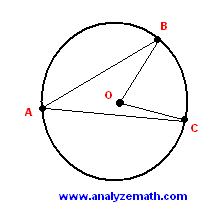
- Central Angle: An angle whose vertex is at the center of the circle. For example, \(\angle BOC\) in the figure below.
- Inscribed Angle: An angle whose vertex is on the circle and whose sides are chords. For example, \(\angle CAB\) in the figure below.
Theorems
- Theorem 1: The measure of an inscribed angle is half the measure of the central angle intercepting the same arc: \[ \angle BAC = \frac{1}{2} \angle BOC \]
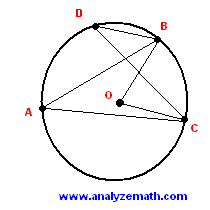
- Theorem 2: Two or more inscribed angles intercepting the same arc are congruent: \[ \angle BAC = \angle BDC \]
Worked Problem & Solution
Problem: Find the inscribed angle \(\angle CBA\) given chord length and radius
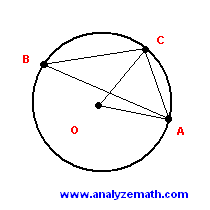
In the figure below, chord \(CA = 12 \text{ cm}\). The circle with center \(O\) has a radius of \(14 \text{ cm}\). Find the measure of the inscribed angle \(\angle CBA\) (approximate to two decimal places).
Solution:
- First, find the central angle \(\angle COA\). Triangle \(COA\) is isosceles because \(CO = AO = 14 \text{ cm}\) (radii).
- Use the Law of Cosines in \(\triangle COA\): \[ CA^2 = CO^2 + AO^2 - 2(CO)(AO)\cos(\angle COA) \] Substitute known values: \[ 12^2 = 14^2 + 14^2 - 2(14)(14)\cos(\angle COA) \] \[ 144 = 392 - 392\cos(\angle COA) \] \[ \cos(\angle COA) = \frac{392 - 144}{392} = \frac{248}{392} = \frac{31}{49} \]
- Therefore: \[ \angle COA = \arccos\left(\frac{31}{49}\right) \]
- By the inscribed angle theorem: \[ \angle CBA = \frac{1}{2} \angle COA = \frac{1}{2} \arccos\left(\frac{31}{49}\right) \] Evaluating: \[ \angle CBA \approx 25.38^\circ \]