Theorem Overview
Consider the circle and the secants \(AB\) and \(CD\) such that each cuts the circle at two points.
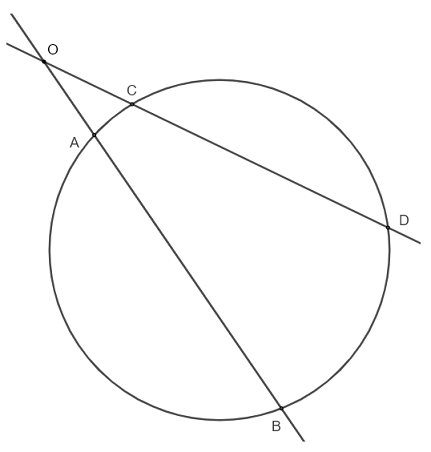
The intersecting secant theorem [1] states that for the two secants \(AB\) and \(CD\) intersecting a circle, there is a relationship between the lengths of the segments as follows:
Questions With Solutions
Question 1: Find \(x = AD\) given segment lengths
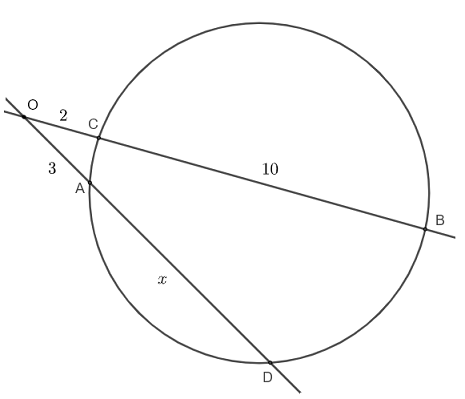
Given the lengths of segments: \(OA = 3\), \(OC = 2\), and \(CB = 10\). Find \(x = AD\) in the figure below.
Solution:
- Apply the intersecting secant theorem above to the secants \(OD\) and \(OB\) to write: \[ OA \times OD = OC \times OB \]
- Substitute the known and given quantities: \[ 3 \times (3 + x) = 2 \times (2 + 10) \]
- Expand and simplify: \[ 9 + 3x = 24 \]
- Solve for \(x\): \[ x = \dfrac{24 - 9}{3} = 5 \]
Question 2: Quadratic equation with algebraic segment lengths
Given the lengths of segments \(OA = x\), \(OC = 3\), \(CD = 13\), and \(AB = 2x\), find \(x\).

Solution:
- Apply the intersecting secant theorem to \(OB\) and \(OD\) to write: \[ OA \times OB = OC \times OD \]
- Substitute the given quantities: \[ x \times (x + 2x) = 3 \times (3 + 13) \]
- Expand and group like terms: \[ 3x^2 = 48 \]
- Divide both sides by \(3\) and rewrite the above equation as: \[ x^2 = 16 \]
- Solve for \(x\): \[ x = \pm 4 \]
- \(x\) must be positive because the lengths of segments are positive, hence the solution to the given question is: \[ x = 4 \]
Question 3: Find the radius of the circle given a diameter secant
In the figure below, \(OB\) and \(OD\) are secants to the circle such that \(OD\) passes through the center \(G\) of the circle and \(OA = 4\), \(AB = 10\), and \(OC = 3\). Find the length of the radius of the circle.

Solution:
- Since \(G\) is the center of the circle, \(CD\) is a diameter and \(CD = 2r\) where \(r\) is the length of the radius.
- Apply the intersecting secant theorem to \(OB\) and \(OD\) to write: \[ OA \times OB = OC \times OD \]
- Substitute the known and unknown quantities: \[ 4 \times (4 + 10) = 3 \times (3 + 2r) \]
- Expand: \[ 56 = 9 + 6r \]
- Group and solve for \(r\): \[ r = \dfrac{47}{6} \]
Question 4: Formulate an algebraic relationship between variables
In the figure below, \(OB\) and \(OD\) are secants to the circle. Find the relationship between \(x\) and \(y\) of the form \(ax + by = c\) such that \(OC = 45\), \(OA = 42\), \(CD = y\), and \(AB = x\).

Solution:
- Apply the intersecting secant theorem to \(OB\) and \(OD\) to write: \[ OA \times OB = OC \times OD \]
- Substitute the known quantities: \[ 42 \times (42 + x) = 45 \times (45 + y) \]
- Expand: \[ 1764 + 42x = 2025 + 45y \]
- Rearrange terms into standard form: \[ 42x - 45y = 261 \]
More References and Links
The Four Pillars of Geometry - John Stillwell - Springer; 2005th edition (Aug. 9 2005) - ISBN-10 : 0387255303[cite: 1]