Problem Statement
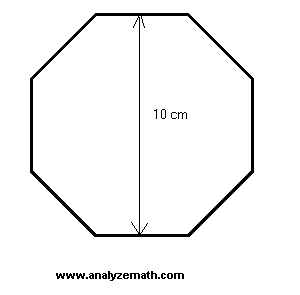
Given a regular octagon with distance \(10\) cm between two opposite sides (span), find:
- The length of one side \(x\)
- The perimeter \(P\)
- The area \(A\)
Solution
Step 1: Interior Angle
A regular octagon has \(8\) sides. The measure of one interior angle is: \[ \dfrac{(8-2) \times 180^\circ}{8} = 135^\circ \]
Step 2: Analyze the Isosceles Right Triangle

Consider triangle \(ABC\) where \(AC \perp BC\). Since the interior angle is \(135^\circ\), angle \(ABC\) is: \[ 135^\circ - 90^\circ = 45^\circ \] Thus, triangle \(ABC\) is an isosceles right triangle.
Step 3: Establish Equations
Let \(x\) be the side length of the octagon and \(y\) be the equal legs of triangle \(ABC\). The span of \(10\) cm equals \(x + 2y\): \[ x + 2y = 10 \quad \text{(1)} \] By the Pythagorean theorem in triangle \(ABC\): \[ x^2 = y^2 + y^2 = 2y^2 \quad \text{(2)} \]
Step 4: Solve for Side Length \(x\)
From equation (2): \(y = \dfrac{x}{\sqrt{2}}\).
Substitute into equation (1):
\[
x + 2\left(\dfrac{x}{\sqrt{2}}\right) = 10
\]
\[
x + \sqrt{2}x = 10
\]
\[
x(1 + \sqrt{2}) = 10
\]
\[
x = \dfrac{10}{1 + \sqrt{2}} \ \text{cm}
\]
Rationalizing the denominator:
\[
x = \dfrac{10}{1 + \sqrt{2}} \cdot \dfrac{1 - \sqrt{2}}{1 - \sqrt{2}} = 10(\sqrt{2} - 1) \ \text{cm}
\]
Numerically: \(x \approx 4.142 \ \text{cm}\)
Step 5: Calculate Perimeter \(P\)
\[ P = 8x = 8 \times \dfrac{10}{1 + \sqrt{2}} = \dfrac{80}{1 + \sqrt{2}} \ \text{cm} \] Rationalized form: \[ P = 80(\sqrt{2} - 1) \ \text{cm} \quad (\approx 33.137 \ \text{cm}) \]
Step 6: Calculate Area \(A\)
Method: Subtract areas of four right triangles from the area of the bounding square of side \(10\) cm. \[ A = 10^2 - 4 \times \left( \dfrac{1}{2} y^2 \right) = 100 - 2y^2 \] From equation (2): \(y^2 = \dfrac{x^2}{2}\). Thus: \[ A = 100 - 2 \left( \dfrac{x^2}{2} \right) = 100 - x^2 \] Substitute \(x = 10(\sqrt{2} - 1)\): \[ x^2 = 100(3 - 2\sqrt{2}) \] \[ A = 100 - 100(3 - 2\sqrt{2}) = 100(1 - 3 + 2\sqrt{2}) = 200(\sqrt{2} - 1) \ \text{cm}^2 \] Numerically: \(A \approx 82.842 \ \text{cm}^2\)
Final Answers
- Side length: \(x = 10(\sqrt{2} - 1) \ \text{cm} \approx 4.142 \ \text{cm}\)
- Perimeter: \(P = 80(\sqrt{2} - 1) \ \text{cm} \approx 33.137 \ \text{cm}\)
- Area: \(A = 200(\sqrt{2} - 1) \ \text{cm}^2 \approx 82.842 \ \text{cm}^2\)
General Formulas (for any span \(S\))
- Side length: \(x = \dfrac{S}{1 + \sqrt{2}} = S(\sqrt{2} - 1)\)
- Perimeter: \(P = \dfrac{8S}{1 + \sqrt{2}} = 8S(\sqrt{2} - 1)\)
- Area: \(A = 2S^2(\sqrt{2} - 1)\)