Parts of a circle such as radius, diameter, chord, arc, central angle, and sector are presented and explained with definitions and formulas.
Circle, Radius & Circumference
A circle is a set of points in a plane that are equidistant from a fixed point called the center of the circle. In the figure below, \(O\) is the center of the circle, and points \(A\), \(B\), and \(C\) lie on the circle at the same distance \(r\) from the center \(O\).
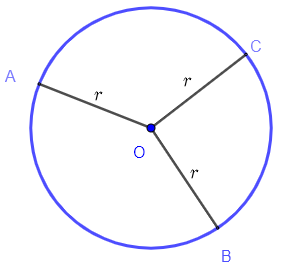
The radius of a circle is the line segment from any point on the circle to the center. In the diagram above, \(OA\), \(OB\), and \(OC\) are radii having the same length \(r\).
The circumference of a circle is the perimeter or total distance around its curved edge. The formula for the circumference \(C_i\) of a circle of radius \(r\) is given by: \[ C_i = 2 \pi r \]
The formula for the area \(A\) of the surface enclosed by a circle of radius \(r\) is given by: \[ A = \pi r^2 \]
Chords & Diameters
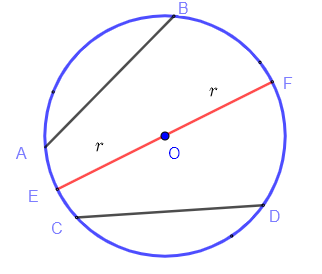
A chord of a circle is any line segment joining two points that lie on the circle. In the figure below, \(AB\), \(EF\), and \(CD\) are chords of the circle.
A diameter of a circle is a chord that passes through the center of the circle. In the figure below, \(EF\) is a diameter. The length of the diameter is equal to \(2r\) (twice the length of the radius).
Arcs & Central Angles
An arc of a circle is a connected portion of the circle's circumference. In the figure below, two points \(A\) and \(B\) split the circle into two arcs: the smaller one is called the minor arc and the larger one is called the major arc. The symbol \(\overset{\LARGE\frown}{}\) is used above letters to represent an arc, such as \(\overset{\LARGE\frown}{AB}\).

A central angle of a circle is an angle whose vertex is the center of the circle and whose sides (legs) are two radii. In the figure above, \(\theta\) is a central angle.
The length \(S\) of an arc corresponding to a central angle \(\theta\) in a circle of radius \(r\) is given by: \[ S = \theta r \quad \text{with } \theta \text{ in radians} \]
Sectors & Tangents
A sector is a region of a circle enclosed by an arc and two radii meeting at the center. In the figure below, the blue surface represents a sector.

The area \(A\) of a sector with central angle \(\theta\) and radius \(r\) is given by: \[ A = \dfrac{1}{2} \theta r^2 \quad \text{with } \theta \text{ in radians} \]
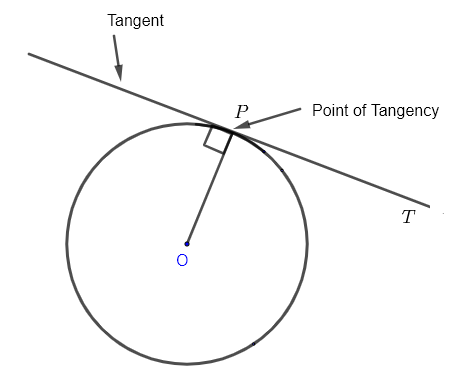
A straight line that touches a circle at exactly one point is called a tangent to a circle. In the figure below, the tangent line touches the circle at the point of tangency \(P\).
More References and Links
The Four Pillars of Geometry - John Stillwell - Springer; 2005th edition (Aug. 9 2005) - ISBN-10 : 0387255303[cite: 1]