Practice solving trapezoid problems involving area, height, and side lengths with detailed step-by-step mathematical solutions.
Trapezoid Area Formula
The area of a trapezoid is given by:
\[ A = \frac{1}{2} h (a + b) \]where \(h\) is the height (altitude) and \(a\), \(b\) are the lengths of the parallel bases.
Problems & Step-by-Step Solutions
Problem 1: Find Base Length Given Area, Angle, and Side
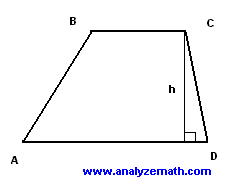
Problem Statement: Trapezoid \(ABCD\) has \(AD \parallel BC\), \(\angle D = 40^\circ\), \(DC = 2 \, \text{m}\), \(BC = 5 \, \text{m}\), and area \(= 20 \, \text{m}^2\). Find the length of \(AD\).
Solution:
- Find height \(h\) using right triangle trigonometry: \[ \sin 40^\circ = \frac{h}{DC} \implies h = 2 \sin 40^\circ \]
- Substitute into area formula: \[ 20 = \frac{1}{2} \cdot 2 \sin 40^\circ \cdot (5 + AD) \]
- Solve for \(AD\): \[ 20 = \sin 40^\circ (5 + AD) \implies AD = \frac{20}{\sin 40^\circ} - 5 \approx 26.11 \, \text{m} \]
Problem 2: Coordinate Geometry Proof and Area Calculation
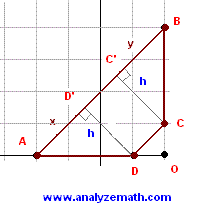
Problem Statement: Show that quadrilateral \(ABCD\) with vertices \(A(-2,0)\), \(B(2,4)\), \(C(2,1)\), and \(D(1,0)\) is a trapezoid and calculate its area.
Solution:
- Calculate slopes to check parallelism: \[ \text{slope of } AB = \frac{4 - 0}{2 - (-2)} = 1, \quad \text{slope of } BC = \frac{1 - 4}{2 - 2} \text{ (undefined)} \] \[ \text{slope of } CD = \frac{0 - 1}{1 - 2} = 1, \quad \text{slope of } DA = \frac{0 - 0}{-2 - 1} = 0 \] Since \(AB\) and \(CD\) have equal slopes (\(1 = 1\)), \(AB \parallel CD\), confirming a trapezoid.
- Calculate area by subtracting triangle areas: \[ \text{Area of } \triangle ODC = \frac{1}{2} \times 1 \times 1 = 0.5 \] \[ \text{Area of } \triangle OAB = \frac{1}{2} \times 4 \times 4 = 8 \] \[ \text{Area of trapezoid } ABCD = 8 - 0.5 = 7.5 \, \text{units}^2 \]
Problem 3: Area of Trapezoid Given Four Side Lengths
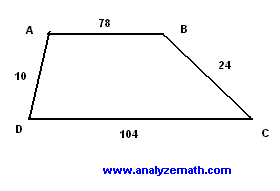
Problem Statement: Find the area of trapezoid \(ABCD\) given its side lengths: \(AB = 78\), \(BC = 24\), \(CD = 104\), \(DA = 10\), with \(AB \parallel CD\).
Solution:
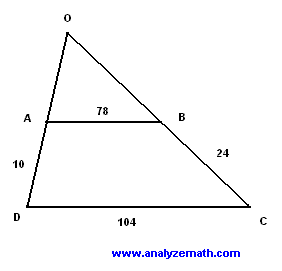
- Extend sides \(DA\) and \(CB\) to intersect at \(O\). Triangles \(AOB\) and \(DOC\) are similar: \[ \frac{OA}{OD} = \frac{OB}{OC} = \frac{AB}{DC} = \frac{78}{104} = \frac{3}{4} \]
- Let \(OA = 3x\), \(OD = 4x\). Since \(OD = OA + 10\): \[ 4x = 3x + 10 \implies x = 10 \implies OA = 30,\; OD = 40 \]
- Let \(OB = 3y\), \(OC = 4y\). Since \(OC = OB + 24\): \[ 4y = 3y + 24 \implies y = 24 \implies OB = 72,\; OC = 96 \]
- Use Heron's formula for \(\triangle AOB\): \[ s = \frac{30 + 72 + 78}{2} = 90 \] \[ \text{Area} = \sqrt{90(90 - 30)(90 - 72)(90 - 78)} = 1080 \, \text{units}^2 \]
- Use Heron's formula for \(\triangle DOC\): \[ s = \frac{40 + 96 + 104}{2} = 120 \] \[ \text{Area} = \sqrt{120(120 - 40)(120 - 96)(120 - 104)} = 1920 \, \text{units}^2 \]
- Trapezoid area: \[ \text{Area of } ABCD = 1920 - 1080 = 840 \, \text{units}^2 \]