Make a Cone from a Sector Calculator
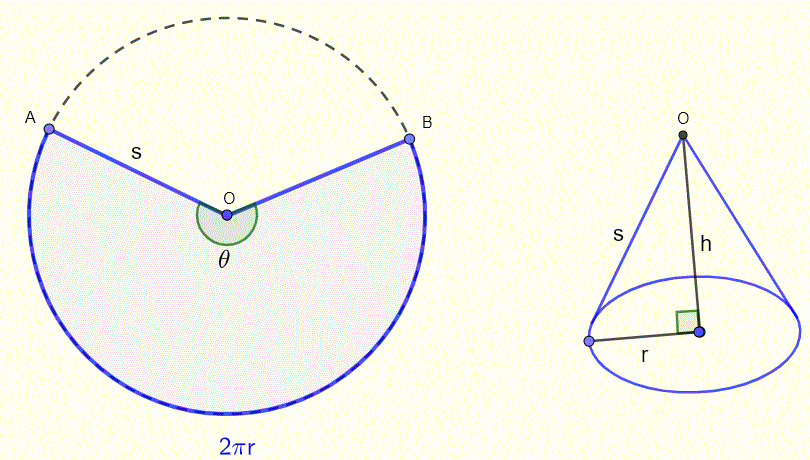
To make a cone, start with a sector of central angle \(\theta\) and radius \(s\). Join points A and B, allowing point O to move upward until OA and OB coincide. The sector radius \(s\) equals the slant height of the finished cone.
Cone Dimensions to Sector
Enter base radius and height to get the flat pattern layout dimensions
Results rounded to 2 decimal places. All inputs must be positive.
Mathematical Formulas
For a cone with base radius \(r\) and height \(h\):
1. Slant height (sector radius):
\[ s = \sqrt{r^2 + h^2} \]2. Sector central angle (degrees):
\[ \theta = 360^\circ \times \frac{r}{s} = \frac{360^\circ \cdot r}{\sqrt{r^2 + h^2}} \]Derivation: The arc length of the sector (\(\theta s\)) equals the base circumference (\(2\pi r\)). Solving for \(\theta\) in radians and converting to degrees gives the formula above.
Worked Example
Example: r = 6 cm, h = 8 cm
Step 1 – Slant height:
\(s = \sqrt{6^2 + 8^2} = \sqrt{36 + 64} = \sqrt{100} = 10\,\text{cm}\)
Step 2 – Sector angle:
\(\theta = 360 \times \dfrac{6}{10} = 360 \times 0.6 = 216^{\circ}\)
Result: Cut a sector with radius \(10\,\text{cm}\) and central angle \(216^{\circ}\). When joined, this forms a cone of base radius \(6\,\text{cm}\) and height \(8\,\text{cm}\).
More References and Links
- Cone Calculator – Volume, surface area, and other cone properties
- Cone Problems – Geometry exercises with solutions
- Online Geometry Calculators and Solvers – Collection of all geometry tools