formulas & simplification
Given three points \[ A=(A_x,A_y,A_z),\quad B=(B_x,B_y,B_z),\quad C=(C_x,C_y,C_z) \] define the vectors
\[ \vec{AB}=\langle B_x-A_x,B_y-A_y,B_z-A_z\rangle \] \[ \vec{AC}=\langle C_x-A_x,C_y-A_y,C_z-A_z\rangle \]The cross product of the vetcors \( \vec{AB} \) and \( \vec{AC} \) is perpendicular to the plane and is given by:
\[ \vec{AB}\times\vec{AC}= \langle AB_y AC_z-AB_zAC_y,\; AB_z AC_x-AB_xAC_z,\; AB_x AC_y-AB_yAC_x \rangle \]Let \(M=(x,y,z)\) be any point on the plane and
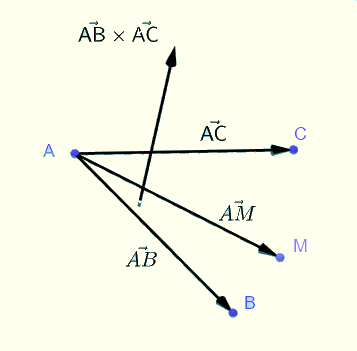
The plane equation comes from
\[ \vec{AM}\cdot(\vec{AB}\times\vec{AC})=0 \]which expands to
\[ (x-A_x)a+(y-A_y)b+(z-A_z)c=0 \] where \[ a=AB_yAC_z-AB_zAC_y \] \[ b=AB_zAC_x-AB_xAC_z \] \[ c=AB_x AC_y-AB_yAC_x \] \[ d=-A_xa-A_yb-A_zc \]Final plane equation:
\[ ax+by+cz+d=0 \]enter three points
full step-by-step with GCD simplification
point \( A (A_x, A_y, A_z) \)
point \( B (B_x, B_y, B_z) \)
point \( C (C_x, C_y, C_z) \)
detailed steps (with simplification)
1. vectors AB & AC
\(\vec{AB} = \langle 6, 6, 4 \rangle\), \(\vec{AC} = \langle -6, 0, -8 \rangle\)
2. cross product (normal vector to the plane)
\(\vec{AB}\times\vec{AC} = \langle -48, 24, 36 \rangle\)
3. coefficients a,b,c,d (unsimplified)
\(a=-48,\;b=24,\;c=36,\;d = -(-48\cdot2 +24\cdot4 +36\cdot6) = -(-96+96+216) = -216\)
4. GCD simplification (divide all coefficients by GCD)
gcd = 12, simplified: \(a=-4,\;b=2,\;c=3,\;d=-18\)
5. final reduced equation
\(-4x + 2y + 3z -18 = 0\)
-4x + 2y + 3z -18 = 0