Geometry of a Conical Frustum
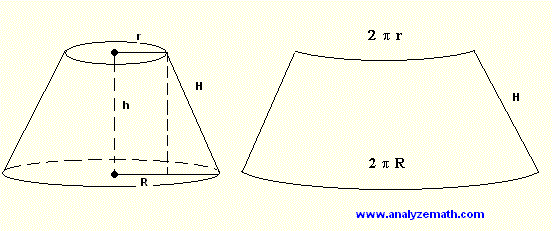
A frustum is the portion of a cone that remains after its top is cut off by a plane parallel to the base. The figure below illustrates the main dimensions: R (base radius), r (top radius), h (height), and H (slant height).
Formulas used
The calculations are based on the following standard formulas:
\[ \text{Lateral Surface Area} = \pi (R + r) \sqrt{(R - r)^2 + h^2} \] \[ \text{Total Surface Area} = \pi \left[ (R + r) \sqrt{(R - r)^2 + h^2} + R^2 + r^2 \right] \] \[ \text{Volume} = \frac{\pi}{3} \, h \left( R^2 + R r + r^2 \right) \]Construction parameters (for sheet metal / pattern making)
If you cut the frustum along its slant height and flatten it, you get a sector of an annulus. To reconstruct the frustum, you need the following values (see diagram below):
- x – inner radius of the developed sector (corresponds to top circumference)
- y – outer radius of the developed sector (corresponds to base circumference)
- θ – central angle (in degrees) of the sector
They are derived from the frustum dimensions as follows:
\[ H = \sqrt{(R - r)^2 + h^2}, \quad x = \frac{r \cdot H}{R - r}, \quad y = x + H, \quad \theta = 360^\circ \left(1 - \frac{2\pi R}{2\pi y}\right) = 360^\circ \left(1 - \frac{R}{y}\right) \]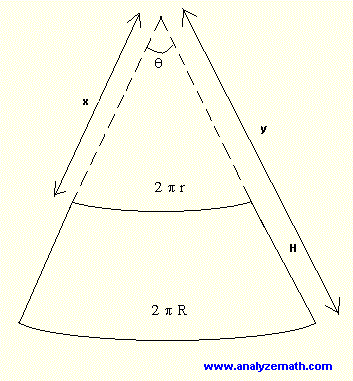
The calculator above gives you all three parameters (x, y, θ) directly, so you can immediately draw the pattern.
How to use the calculator
Simply enter any positive real numbers for r (top radius), R (base radius, with R > r) and h (height). Decimal values are accepted (e.g. 3.75). Press Calculate to obtain all results. The Reset button restores the default example values (r = 5, R = 12, h = 34).
Use the decimal places selector to choose how many digits to show after the decimal point (default is 3).