Graph, Domain and Range of Absolute Value Functions

This is a step-by-step tutorial on how to graph functions with absolute value. Properties of the graph of these functions such as domain, range, and \(x\)- and \(y\)-intercepts are also discussed. Free graph paper is available.

Examples & Step-by-Step Solutions

Example 1: Linear Absolute Value Function \( f(x) = |x - 2| \)

Problem: Let function \( f \) be given by \( f(x) = |x - 2| \).

  1. Find the \( x \)- and \( y \)-intercepts of the graph of \( f \).
  2. Find the domain and range of \( f \).
  3. Sketch the graph of \( f \).

Solution:

  1. The \( y \)-intercept is given by: \[ (0, f(0)) = (0, |0 - 2|) = (0, |-2|) = (0, 2) \] The \( x \)-coordinate of the \( x \)-intercept is equal to the solution of the equation: \[ |x - 2| = 0 \implies x = 2 \] Thus, the \( x \)-intercept is at the point \( (2, 0) \).
  2. The domain of \( f \) is the set of all real numbers \( (-\infty, +\infty) \).
    Since \( |x - 2| \) is either positive or zero, the range of \( f \) is given by the interval: \[ [0, +\infty) \]
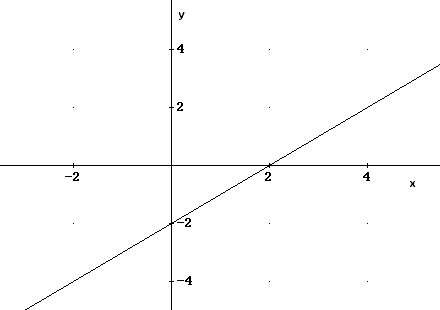
  3. To sketch the graph of \( f(x) = |x - 2| \), we first sketch the graph of the inner linear function \( y = x - 2 \) and then take the absolute value of \( y \).
    The graph of \( y = x - 2 \) is a line with \( x \)-intercept \( (2, 0) \) and \( y \)-intercept \( (0, -2) \):

    Graph of y = x - 2

    Next, we use the definition of the absolute value: if \( y \ge 0 \), \( |y| = y \); if \( y \lt 0 \), \( |y| = -y \).
    For values of \( x \) where \( y \) is negative (interval \( (-\infty, 2) \)), that part of the graph is reflected across the \( x \)-axis:
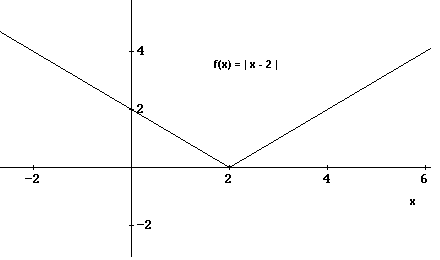
    Graph of f(x) = |x - 2|

Example 2: Quadratic Absolute Value Function \( f(x) = |(x - 2)^2 - 4| \)

Problem: Let function \( f \) be given by \( f(x) = |(x - 2)^2 - 4| \).

  1. Find the \( x \)- and \( y \)-intercepts of the graph of \( f \).
  2. Find the domain and range of \( f \).
  3. Sketch the graph of \( f \).

Solution:

  1. The \( y \)-intercept is given by: \[ (0, f(0)) = (0, |(0 - 2)^2 - 4|) = (0, |4 - 4|) = (0, 0) \] The \( x \)-coordinates of the \( x \)-intercepts are solutions to: \[ |(x - 2)^2 - 4| = 0 \implies (x - 2)^2 = 4 \] Solving for \( x \): \[ x - 2 = \pm 2 \implies x = 0 \quad \text{and} \quad x = 4 \] The \( x \)-intercepts are at the points \( (0, 0) \) and \( (4, 0) \).
  2. The domain of \( f \) is the set of all real numbers \( (-\infty, +\infty) \).
    Since absolute values are non-negative, the range of \( f \) is given by the interval: \[ [0, +\infty) \]
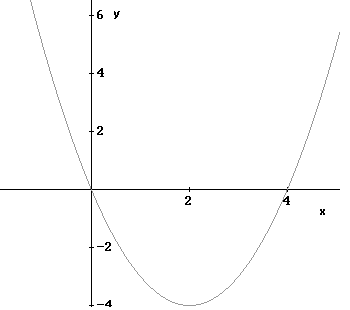
  3. To sketch the graph of \( f(x) = |(x - 2)^2 - 4| \), we first sketch the underlying parabola \( y = (x - 2)^2 - 4 \). This parabola has vertex at \( (2, -4) \), \( x \)-intercepts at \( (0, 0) \) and \( (4, 0) \), and \( y \)-intercept at \( (0, 0) \):

    Graph of y = (x - 2)^2 - 4

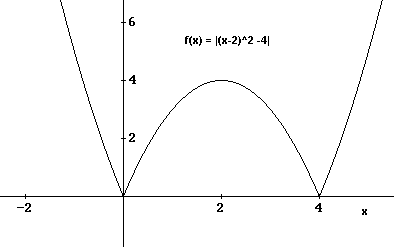
    The graph of \( f \) is obtained by reflecting the portion of the parabola where \( y \) is negative across the \( x \)-axis:

    Graph of y = |(x - 2)^2 - 4|

More References and Links to Graphing, Graphs and Absolute Value Functions

Explore additional graphing tutorials and resources:

Graphing Functions | Graphs of Basic Functions | Absolute Value Functions | Definition of Absolute Value | Home Page