Triangle Geometry Problems and Solutions
Comprehensive collection of triangle geometry problems with detailed step-by-step solutions covering area, perimeter, congruence, similarity, and Pythagorean theorem applications.
Basic Triangle Problems
Problem 1: Right Triangle Area and Hypotenuse
The right triangle shown below has an area of 25. Find its hypotenuse.

Solution
- Since points A and B share the same x-coordinate, segment AB is vertical. Therefore, BC is horizontal, making the y-coordinate of point C equal to 3.
- The area formula for a triangle is \( \text{Area} = \frac{1}{2} \times \text{base} \times \text{height} \).
- Here, \( d(A,B) = 5 \) and \( d(B,C) = |x - 2| \).
- Substitute into the area formula: \( 25 = \frac{1}{2} \times 5 \times |x - 2| \).
- Solve: \( |x - 2| = 10 \), giving \( x = 12 \) or \( x = -8 \).
- Select \( x = 12 \) since C is to the left of B (x > 2).
- Calculate hypotenuse using distance formula:
\[
d(A,C) = \sqrt{(12 - 2)^2 + (3 - 8)^2} = \sqrt{100 + 25} = \sqrt{125} = 5\sqrt{5}
\]
Problem 2: Triangle Inscribed in a Square
Triangle ABC is inscribed inside a square of side 20 cm. Find the area of the triangle.
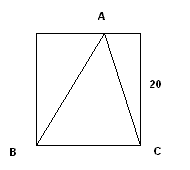
Solution
- The triangle's base and height are both 20 cm (equal to the square's side).
- Area calculation:
\[
\text{Area} = \frac{1}{2} \times \text{base} \times \text{height} = \frac{1}{2} \times 20 \times 20 = 200 \text{ cm}^2
\]
Problem 3: Equilateral Triangle Area
Find the area of an equilateral triangle with side length 10 cm.

Solution
- Let M be the midpoint of BC. Triangle AMC is a right triangle.
- Using Pythagorean theorem: \( h^2 + 5^2 = 10^2 \).
- Solve for height: \( h^2 = 100 - 25 = 75 \), so \( h = 5\sqrt{3} \) cm.
- Calculate area:
\[
\text{Area} = \frac{1}{2} \times \text{base} \times \text{height} = \frac{1}{2} \times 10 \times 5\sqrt{3} = 25\sqrt{3} \text{ cm}^2
\]
Challenging Triangle Problems
Problem 4: Triangle with Angle Bisector
In triangle ABC, angle A measures 60°. The angle bisector of angle A meets side BC at point D. If AB = 8 cm, AC = 6 cm, find the length of AD.
Solution
- Using the Angle Bisector Theorem: \( \frac{BD}{DC} = \frac{AB}{AC} = \frac{8}{6} = \frac{4}{3} \).
- Let \( BD = 4x \) and \( DC = 3x \), so \( BC = 7x \).
- Using the formula for angle bisector length:
\[
AD = \frac{2 \cdot AB \cdot AC \cdot \cos(\frac{A}{2})}{AB + AC}
\]
- Substitute values: \( \cos(30°) = \frac{\sqrt{3}}{2} \), so:
\[
AD = \frac{2 \times 8 \times 6 \times \frac{\sqrt{3}}{2}}{8 + 6} = \frac{48\sqrt{3}}{14} = \frac{24\sqrt{3}}{7} \text{ cm}
\]
Problem 5: Medians and Area
In triangle ABC, the medians from vertices A and B are perpendicular to each other. If AC = 6 cm and BC = 7 cm, find the area of triangle ABC.
Solution
- Let the medians from A and B intersect at the centroid G.
- In any triangle, the sum of squares of medians is related to the sides:
\[
m_a^2 + m_b^2 + m_c^2 = \frac{3}{4}(a^2 + b^2 + c^2)
\]
- Given medians from A and B are perpendicular, so \( m_a^2 + m_b^2 = AB^2 \).
- Using median length formulas and solving the system:
\[
\begin{aligned}
m_a^2 &= \frac{2b^2 + 2c^2 - a^2}{4} \\
m_b^2 &= \frac{2a^2 + 2c^2 - b^2}{4}
\end{aligned}
\]
- With \( a = BC = 7 \), \( b = AC = 6 \), and substituting into \( m_a^2 + m_b^2 = c^2 \), we get:
\[
c^2 = \frac{4c^2 + 148}{4} \Rightarrow 4c^2 = 4c^2 + 148
\]
- Solving gives \( c = \sqrt{37} \).
- Using Heron's formula with semi-perimeter \( s = \frac{7 + 6 + \sqrt{37}}{2} \):
\[
\text{Area} = \sqrt{s(s-a)(s-b)(s-c)} \approx 15.3 \text{ cm}^2
\]
Problem 6: Triangle with Incircle and Circumcircle
Triangle ABC has sides AB = 10 cm, BC = 17 cm, and AC = 21 cm. Find the ratio of the area of the incircle to the area of the circumcircle.
Solution
- First, calculate the area using Heron's formula:
\[
s = \frac{10 + 17 + 21}{2} = 24
\]
\[
\text{Area} = \sqrt{24(24-10)(24-17)(24-21)} = \sqrt{24 \times 14 \times 7 \times 3} = 84 \text{ cm}^2
\]
- Inradius \( r = \frac{\text{Area}}{s} = \frac{84}{24} = 3.5 \) cm.
- Circumradius \( R = \frac{abc}{4\text{Area}} = \frac{10 \times 17 \times 21}{4 \times 84} = \frac{3570}{336} = 10.625 \) cm.
- Area ratio:
\[
\frac{\text{Area}_{\text{incircle}}}{\text{Area}_{\text{circumcircle}}} = \frac{\pi r^2}{\pi R^2} = \left(\frac{r}{R}\right)^2 = \left(\frac{3.5}{10.625}\right)^2 \approx 0.1085
\]
Moderately Challenging Triangle Problems
Problem 7: Triangle with Two Medians and a Right Angle
In triangle ABC, median AD and median BE intersect at point G (centroid). If AD = 12 cm, BE = 9 cm, and angle AGB = 90°, find the length of side AB.
Solution
- At the centroid, medians are divided in ratio 2:1, with the longer segment from vertex to centroid.
- So, \( AG = \frac{2}{3} AD = \frac{2}{3} \times 12 = 8 \) cm
- And \( BG = \frac{2}{3} BE = \frac{2}{3} \times 9 = 6 \) cm
- Since triangle AGB is right-angled at G (given), use Pythagorean theorem:
\[
AB^2 = AG^2 + BG^2 = 8^2 + 6^2 = 64 + 36 = 100
\]
- Therefore, \( AB = \sqrt{100} = 10 \) cm
Problem 8: Triangle with Perpendicular Bisector and Area Constraint
Triangle ABC has vertices at A(0,0), B(8,0), and C(x,y). The perpendicular bisector of AB intersects side AC at point P such that AP:PC = 2:3. If the area of triangle ABC is 24 square units, find the coordinates of point C.
Solution
- The perpendicular bisector of AB is vertical line through midpoint of AB.
- Midpoint of AB: \( M = \left(\frac{0+8}{2}, \frac{0+0}{2}\right) = (4,0) \)
- So perpendicular bisector is line \( x = 4 \)
- Point P lies on AC and on \( x = 4 \), and divides AC in ratio 2:3
- Using section formula: If \( \frac{AP}{PC} = \frac{2}{3} \), then coordinates of P are:
\[
P = \left(\frac{3 \times 0 + 2 \times x}{2+3}, \frac{3 \times 0 + 2 \times y}{2+3}\right) = \left(\frac{2x}{5}, \frac{2y}{5}\right)
\]
- Since P has x-coordinate 4: \( \frac{2x}{5} = 4 \Rightarrow x = 10 \)
- Area of triangle ABC with vertices (0,0), (8,0), (10,y):
\[
\text{Area} = \frac{1}{2} \left| 0(0-y) + 8(y-0) + 10(0-0) \right| = \frac{1}{2} \left| 8y \right| = 4|y|
\]
- Given area = 24: \( 4|y| = 24 \Rightarrow |y| = 6 \)
- So \( y = 6 \) or \( y = -6 \)
- Thus C can be at (10,6) or (10,-6)
- Verify with section formula: For C(10,6), P = \( \left(\frac{2 \times 10}{5}, \frac{2 \times 6}{5}\right) = (4, 2.4) \) which lies on \( x = 4 \)