Right Triangle Problems: Step-by-Step Solutions for 9 Different Cases

This page presents 9 different cases for solving right triangle problems, progressing from basic to advanced. Each mode includes a worked example with a detailed mathematical solution. Click the "Show Solution" button to reveal the step-by-step derivation. A right triangle calculator that uses all the math presented here may be used to check all the answers in the problems below.

Right Triangle Reference Diagram
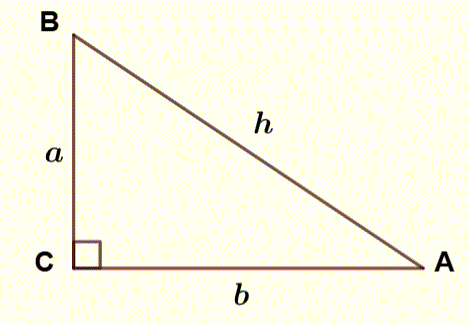
Right triangle diagram: sides a, b, hypotenuse h, and angles A, B, C

Notation: Sides a and b are the legs, h is the hypotenuse. Angle A is opposite side a, angle B is opposite side b, and angle C = 90°.

Key Formulas

Quantity Formula
Pythagorean Theorem \( a^2 + b^2 = h^2 \)
Sine Ratio \( \sin A = \frac{a}{h} \)
Cosine Ratio \( \cos A = \frac{b}{h} \)
Tangent Ratio \( \tan A = \frac{a}{b} \)
Area \( \text{Area} = \frac{1}{2}ab \)
Perimeter \( \text{Perimeter} = a + b + h \)
Complementary Angles \( A + B = 90^\circ \)
1

Two Sides (a and b)

Easy

Example: In a right triangle, side a = 3, side b = 4. Find the hypotenuse, angles, area, and perimeter.

Step-by-Step Solution:
Step 1: Apply Pythagorean theorem to find hypotenuse h \[ h = \sqrt{a^2 + b^2} = \sqrt{3^2 + 4^2} = \sqrt{9 + 16} = \sqrt{25} = 5 \]
Step 2: Find angle A using inverse sine \[ A = \arcsin\left(\frac{a}{h}\right) = \arcsin\left(\frac{3}{5}\right) \approx 36.87^\circ \]
Step 3: Find angle B (complementary) \[ B = 90^\circ - A \approx 53.13^\circ \]
Step 4: Calculate area \[ \text{Area} = \frac{1}{2}ab = \frac{1}{2}(3)(4) = 6 \]
Step 5: Calculate perimeter \[ \text{Perimeter} = a + b + h = 3 + 4 + 5 = 12 \]
✅ Condition for Solvability: Both a and b must be positive real numbers.
Final Answer: h = 5, A ≈ 36.87°, B ≈ 53.13°, Area = 6, Perimeter = 12
2

Side & Hypotenuse (a, h)

Easy

Example: In a right triangle, side a = 3, hypotenuse h = 5. Find side b, angles, area, and perimeter.

Step-by-Step Solution:
Step 1: Apply Pythagorean theorem to find side b \[ b = \sqrt{h^2 - a^2} = \sqrt{5^2 - 3^2} = \sqrt{25 - 9} = \sqrt{16} = 4 \]
Step 2: Find angle A \[ A = \arcsin\left(\frac{a}{h}\right) = \arcsin\left(\frac{3}{5}\right) \approx 36.87^\circ \]
Step 3: Find angle B \[ B = 90^\circ - A \approx 53.13^\circ \]
Step 4: Calculate area \[ \text{Area} = \frac{1}{2}ab = \frac{1}{2}(3)(4) = 6 \]
Step 5: Calculate perimeter \[ \text{Perimeter} = a + b + h = 3 + 4 + 5 = 12 \]
✅ Condition for Solvability: \( h > a > 0 \)
The hypotenuse must be greater than the given side.
Final Answer: b = 4, A ≈ 36.87°, B ≈ 53.13°, Area = 6, Perimeter = 12
3

Side & Area (a, area)

Easy

Example: In a right triangle, side a = 3, area = 6. Find side b, hypotenuse, angles, and perimeter.

Step-by-Step Solution:
Step 1: Use area formula to find side b \[ \text{Area} = \frac{1}{2}ab \implies 6 = \frac{1}{2}(3)b \implies b = \frac{2 \times 6}{3} = 4 \]
Step 2: Apply Pythagorean theorem \[ h = \sqrt{a^2 + b^2} = \sqrt{3^2 + 4^2} = 5 \]
Step 3: Find angle A \[ A = \arcsin\left(\frac{a}{h}\right) = \arcsin\left(\frac{3}{5}\right) \approx 36.87^\circ \]
Step 4: Find angle B \[ B = 90^\circ - A \approx 53.13^\circ \]
Step 5: Calculate perimeter \[ \text{Perimeter} = a + b + h = 3 + 4 + 5 = 12 \]
✅ Condition for Solvability: \( a > 0 \) and \( \text{area} > 0 \)
Final Answer: b = 4, h = 5, A ≈ 36.87°, B ≈ 53.13°, Perimeter = 12
4

Side & Angle (a, A)

Medium

Example: In a right triangle, side a = 3, angle A = 36.87°. Find side b, hypotenuse, angle B, area, and perimeter.

Step-by-Step Solution:
Step 1: Use tangent ratio to find side b \[ \tan A = \frac{a}{b} \implies b = \frac{a}{\tan A} = \frac{3}{\tan(36.87^\circ)} \approx \frac{3}{0.75} = 4 \]
Step 2: Use sine ratio to find hypotenuse \[ \sin A = \frac{a}{h} \implies h = \frac{a}{\sin A} = \frac{3}{\sin(36.87^\circ)} \approx \frac{3}{0.6} = 5 \]
Step 3: Find angle B (complementary) \[ B = 90^\circ - A = 90^\circ - 36.87^\circ = 53.13^\circ \]
Step 4: Calculate area \[ \text{Area} = \frac{1}{2}ab = \frac{1}{2}(3)(4) = 6 \]
Step 5: Calculate perimeter \[ \text{Perimeter} = a + b + h = 3 + 4 + 5 = 12 \]
✅ Condition for Solvability: \( a > 0 \), \( 0^\circ < A < 90^\circ \)
Angle A must be acute (less than 90°).
Final Answer: b = 4, h = 5, B = 53.13°, Area = 6, Perimeter = 12
5

Hypotenuse & Angle (h, A)

Medium

Example: In a right triangle, hypotenuse h = 5, angle A = 36.87°. Find sides a, b, angle B, area, and perimeter.

Step-by-Step Solution:
Step 1: Use sine ratio to find side a \[ \sin A = \frac{a}{h} \implies a = h \sin A = 5 \times \sin(36.87^\circ) \approx 5 \times 0.6 = 3 \]
Step 2: Use cosine ratio to find side b \[ \cos A = \frac{b}{h} \implies b = h \cos A = 5 \times \cos(36.87^\circ) \approx 5 \times 0.8 = 4 \]
Step 3: Find angle B \[ B = 90^\circ - A = 90^\circ - 36.87^\circ = 53.13^\circ \]
Step 4: Calculate area \[ \text{Area} = \frac{1}{2}ab = \frac{1}{2}(3)(4) = 6 \]
Step 5: Calculate perimeter \[ \text{Perimeter} = a + b + h = 3 + 4 + 5 = 12 \]
✅ Condition for Solvability: \( h > 0 \), \( 0^\circ < A < 90^\circ \)
Final Answer: a = 3, b = 4, B = 53.13°, Area = 6, Perimeter = 12
6

Area & Angle (area, A)

Medium

Example: In a right triangle, area = 6, angle A = 36.87°. Find sides a, b, hypotenuse, angle B, and perimeter.

Step-by-Step Solution:
Step 1: Use area formula and tangent relationship \[ \text{Area} = \frac{1}{2}ab \quad \text{and} \quad \tan A = \frac{a}{b} \] \[ \text{From } \tan A = \frac{a}{b} \implies a = b \tan A \]
Step 2: Substitute into area formula \[ \text{Area} = \frac{1}{2}(b \tan A)(b) = \frac{1}{2}b^2 \tan A \]
Step 3: Solve for b \[ b^2 = \frac{2 \times \text{Area}}{\tan A} \implies b = \sqrt{\frac{2 \times 6}{\tan(36.87^\circ)}} = \sqrt{\frac{12}{0.75}} = \sqrt{16} = 4 \]
Step 4: Find a \[ a = b \tan A = 4 \times 0.75 = 3 \]
Step 5: Find hypotenuse \[ h = \sqrt{a^2 + b^2} = \sqrt{9 + 16} = 5 \]
Step 6: Find angle B and perimeter \[ B = 90^\circ - A = 53.13^\circ, \quad \text{Perimeter} = a + b + h = 12 \]
✅ Condition for Solvability: \( \text{area} > 0 \), \( 0^\circ < A < 90^\circ \)
Final Answer: a = 3, b = 4, h = 5, B = 53.13°, Perimeter = 12
7

Hypotenuse & Area (h, area)

Advanced

Example: In a right triangle, hypotenuse h = 5, area = 6. Find sides a, b, angles, and perimeter.

Step-by-Step Solution:
Step 1: Set up equations \[ a^2 + b^2 = h^2 = 25 \quad \text{and} \quad ab = 2 \times \text{area} = 12 \]
Step 2: Let \( s = a^2 \). Then \( b^2 = h^2 - s \)
Step 3: From \( ab = 2 \times \text{area} \), square both sides \[ a^2 b^2 = 4 \times \; \text{area}^2 \implies s(h^2 - s) = 4 \times \text{area}^2 \]
Step 4: Rearrange to standard quadratic form \[ s^2 - h^2 s + 4 \; \text{area}^2 = 0 \quad (1) \]
Step 5: Discriminant \( \Delta \) must be positive or zero in order to have solutions \[ ( h^2)^2 - 4 (1) ( 4 \; \text{area}^2) \ge 0 \implies h^4 \ge 16 \; \text{area}^2 \]
Step 6: Substitute h = 5 and area = 6 into the quadratic equation (1) \[ s^2 - 25 s + 144 = 0 \]
Step 7: Solve the quadratic \[ s = \frac{25 \pm \sqrt{25^2 - 4(1)(144)}}{2} = \frac{25 \pm \sqrt{625 - 576}}{2} = \frac{25 \pm \sqrt{49}}{2} \] \[ s = \frac{25 \pm 7}{2} \implies s_1 = 16, \quad s_2 = 9 \]
Step 8: Find a and b \[ a = \sqrt{s} \implies a_1 = 4, a_2 = 3 \] \[ b = \sqrt{h^2 - s} \implies b_1 = \sqrt{25-16} = 3, \quad b_2 = \sqrt{25-9} = 4 \]

Both solutions give the same triangle (just swapping a and b).

Step 9: Find angles (taking a as the larger side) \[ A = \arcsin\left(\frac{a}{h}\right) = \arcsin\left(\frac{4}{5}\right) \approx 53.13^\circ \] \[ B = 90^\circ - A \approx 36.87^\circ \]
Step 10: Calculate perimeter \[ \text{Perimeter} = a + b + h = 3 + 4 + 5 = 12 \]
✅ Condition for Solvability: \[ h > 0, \quad \text{area} > 0, \quad h^4 \geq 16 \times \text{area}^2 \]
For our example: \( 625 \geq 576 \) ✓
Final Answer: a = 4, b = 3, A ≈ 53.13°, B ≈ 36.87°, Perimeter = 12
8

Side & Perimeter (a, p)

Advanced

Example: In a right triangle, side a = 3, perimeter p = 12. Find side b, hypotenuse, angles, and area.

Step-by-Step Solution:
Step 1: Set up the perimeter equation \[ p = a + b + h = 3 + b + h = 12 \implies h = p - a - b \]
Step 2: From Pythagorean theorem \[ h^2 = a^2 + b^2 \]
Step 2: Substitute \( h \) by \( p - a - b \) in the above equation \[ ( p - a - b )^2 = a^2 + b^2 \]
Step 2: Expand and solve for \( b \) \[ (p - a)^2 - 2(p - a)b + b^2 = a^2 + b^2 \] \[ (p - a)^2 - 2(p - a)b = a^2 \] \[ 2(p - a)b = (p - a)^2 - a^2 \] \[ b = \frac{(p - a)^2 - a^2}{2(p - a)} \]
Step 2: For \( b \) to be positive we need to have \[ (p - a)^2 > a^2 \implies p - a > a \; \text{or} \; p > 2a \]
Step 3: From Step 1, \( h = 9 - b \). Substitute into Pythagorean theorem \[ (9 - b)^2 = 9 + b^2 \]
Step 4: Substitute \( p \) and \( a \) by their values and solve for \( b \) \[ b = \frac{(p - a)^2 - a^2}{2(p - a)} = \frac{(12 - 3)^2 - 3^2}{2(12 - 3)} = 4\]
Step 5: Find hypotenuse \[ h = 9 - b = 5 \]
Step 6: Find angle A \[ A = \arcsin\left(\frac{a}{h}\right) = \arcsin\left(\frac{3}{5}\right) \approx 36.87^\circ \]
Step 7: Calculate area \[ \text{Area} = \frac{1}{2}ab = \frac{1}{2}(3)(4) = 6 \]
✅ Condition for Solvability: \[ a > 0, \quad p > a, \quad p > 2 a \]
For a=3, need p > 6 ✓
Final Answer: b = 4, h = 5, A ≈ 36.87°, B ≈ 53.13°, Area = 6
9

Perimeter & Area (p, area)

Most Advanced

Example: In a right triangle, perimeter p = 12, area = 6. Find all sides and angles.

Step-by-Step Solution:
Step 1: Let \( S = a + b \) and \( P = ab = 2 \times \text{area} = 12 \)
Step 2: Express perimeter in terms of S \[ p = a + b + h = S + \sqrt{a^2 + b^2} = S + \sqrt{(a+b)^2 - 2ab} = S + \sqrt{S^2 - 2P} \] \[ 12 = S + \sqrt{S^2 - 24} \]
Step 3: Isolate the square root and square both sides \[ \sqrt{S^2 - 24} = 12 - S \] \[ S^2 - 24 = 144 - 24S + S^2 \]
Step 4: Cancel S² and solve for S \[ -24 = 144 - 24S \] \[ 24S = 168 \] \[ S = 7 \]
Step 5: Now we have sum and product \[ a + b = 7, \quad ab = 12 \]
Step 6: Form quadratic equation \[ t^2 - 7t + 12 = 0 \]
Step 7: Solve the quadratic \[ t = \frac{7 \pm \sqrt{49 - 48}}{2} = \frac{7 \pm 1}{2} \] \[ t_1 = 4, \quad t_2 = 3 \]
Step 8: Therefore \( a = 4, \quad b = 3 \) (or vice versa)
Step 9: Find hypotenuse \[ h = \sqrt{a^2 + b^2} = \sqrt{16 + 9} = 5 \]
Step 10: Find angles \[ A = \arcsin\left(\frac{a}{h}\right) = \arcsin\left(\frac{4}{5}\right) \approx 53.13^\circ \] \[ B = 90^\circ - A \approx 36.87^\circ \]
✅ Condition for Solvability: \[ p \geq \sqrt{8 \times \text{area}} + \sqrt{4 \times \text{area}} \]
For our example: \( \sqrt{48} + \sqrt{24} \approx 6.93 + 4.90 = 11.83 \leq 12 \) ✓
Final Answer: a = 4, b = 3, h = 5, A ≈ 53.13°, B ≈ 36.87°