Graphing Arcsin(x) Functions

A step-by-step tutorial on graphing and sketching arcsin functions. The domain, range, key coordinates, and transformations of these functions are examined in detail.

Graph, Domain, and Range of arcsin(x)

In what follows, \( \arcsin(x) \) is the inverse function of \( f(x) = \sin(x) \) for \( -\dfrac{\pi}{2} \le x \le \dfrac{\pi}{2} \).

The graph of both \( f(x) = \sin(x) \) for \( -\dfrac{\pi}{2} \le x \le \dfrac{\pi}{2} \) and its inverse \( \arcsin(x) \) are shown below:
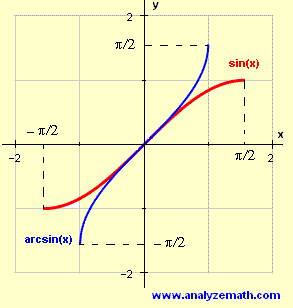
Graph of sin(x) and arcsin(x)

Table of Key Values for arcsin(x)

A table of values of \( \arcsin(x) \) can be constructed using 3 key points:

\( x \) \(-1\) \(0\) \(1\)
\( y = \arcsin(x) \) \(-\dfrac{\pi}{2}\) \(0\) \(\dfrac{\pi}{2}\)

These 3 key points used to sketch \( \arcsin(x) \) are: \[ \left(-1, -\frac{\pi}{2}\right), \; (0, 0), \; \text{and} \; \left(1, \frac{\pi}{2}\right) \]

Examples & Step-by-Step Solutions

Example 1: Horizontal Shift \( y = \arcsin(x - 2) \)

Problem: Find the domain, range, and graph the function \( y = \arcsin(x - 2) \).


Solution:

The graph of \( y = \arcsin(x - 2) \) will be that of \( \arcsin(x) \) shifted \( 2 \) units to the right.

The domain is found by setting the argument inside the inverse sine between \(-1\) and \(1\): \[ -1 \le x - 2 \le 1 \] Solve the double inequality to find the domain: \[ 1 \le x \le 3 \]

Using the 3 key points via table transformation:

\( x - 2 \) \(-1\) \(0\) \(1\)
\( y = \arcsin(x - 2) \) \(-\dfrac{\pi}{2}\) \(0\) \(\dfrac{\pi}{2}\)
\( x \) \(1\) \(2\) \(3\)

The value of \( x \) is calculated from \( x - 2 \) (e.g., when \( x - 2 = -1 \), solving for \( x \) gives \( x = 1 \)).

Graph of y = arcsin(x - 2)

Example 2: Vertical Stretch & Shift \( y = 2\arcsin(x + 1) \)

Problem: Find the domain, range, and graph the function \( y = 2\arcsin(x + 1) \).


Solution:

We evaluate the transformations using the 3 key reference points, computing the intermediate values and final coordinates:

\( x + 1 \) \(-1\) \(0\) \(1\)
\( \arcsin(x + 1) \) \(-\dfrac{\pi}{2}\) \(0\) \(\dfrac{\pi}{2}\)
\( y = 2\arcsin(x + 1) \) \(-\pi\) \(0\) \(\pi\)
\( x \) \(-2\) \(-1\) \(0\)

Graph of y = 2arcsin(x+1)

Geometric description: The graph is that of \( \arcsin(x) \) shifted one unit to the left and stretched vertically by a factor of \( 2 \).

Example 3: Reflection & Horizontal Shift \( y = -\arcsin(x - 1) \)

Problem: Find the domain, range, and graph the function \( y = -\arcsin(x - 1) \).


Solution:

We track the key points including the vertical reflection:

\( x - 1 \) \(-1\) \(0\) \(1\)
\( \arcsin(x - 1) \) \(-\dfrac{\pi}{2}\) \(0\) \(\dfrac{\pi}{2}\)
\( y = -\arcsin(x - 1) \) \(\dfrac{\pi}{2}\) \(0\) \(-\dfrac{\pi}{2}\)
\( x \) \(0\) \(1\) \(2\)

Graph of y = -arcsin(x-1)

Geometric description: The graph is that of \( \arcsin(x) \) shifted one unit to the right and reflected across the \( x \)-axis.

More References and Links to Graphing

Explore additional graphing tutorials and resources:

Graphing Functions | Inverse Trigonometric Functions | Home Page