Euler’s number \( e \) is one of the most important constants in mathematics. It appears naturally across calculus, finance, physics, engineering, and population dynamics. This guide explores how \( e \) originates from compound interest, limit definitions, and its role as the base of natural exponential and logarithmic functions.
Definition of Euler’s Constant \( e \)
In the study of compound interest, if a principal amount \( P \) is invested at an annual interest rate \( r \), the total amount \( A \) after \( t \) years with annual compounding is:
\[ A = P(1 + r)^t \]If the interest is compounded \( n \) times per year, the amount becomes:
\[ A = P\left(1 + \dfrac{r}{n}\right)^{nt} \]Letting \( N = \dfrac{n}{r} \), we have \( \dfrac{r}{n} = \dfrac{1}{N} \) and \( n = rN \). Substituting these into the formula yields:
\[ A = P\left(1 + \dfrac{1}{N}\right)^{Nrt} = P\left( \left(1 + \dfrac{1}{N}\right)^N \right)^{rt} \]As the number of compoundings \( n \) (and thus \( N \)) increases without bound (\( N \to \infty \)), the inner expression approaches a constant value known as Euler’s number (\( e \)), named after Leonhard Euler:
\[ e \approx 2.71828182846 \]Numerical Approximation of \( e \)
The table below demonstrates how the expression \( \left(1 + \dfrac{1}{N}\right)^N \) converges toward \( e \) as \( N \) grows larger.
| \( N \) | \( \left(1 + \dfrac{1}{N}\right)^N \) |
|---|---|
| 1 | 2.00000 |
| 2 | 2.25000 |
| 3 | 2.37037 |
| 10 | 2.59374 |
| 20 | 2.65329 |
| 40 | 2.68506 |
| 100 | 2.70481 |
| 200 | 2.71149 |
| 400 | 2.71488 |
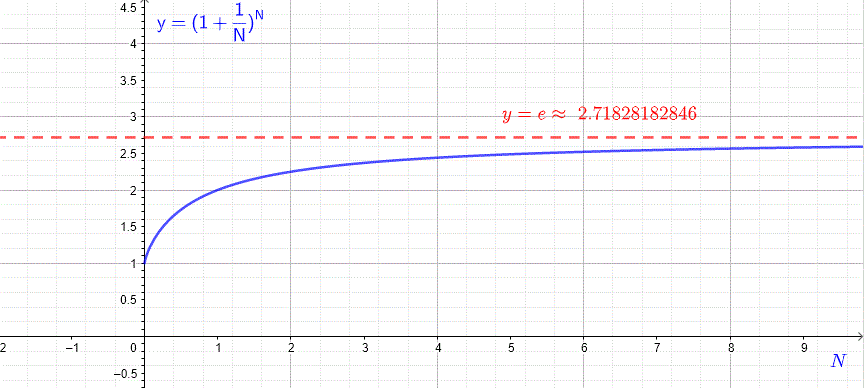
The graph below illustrates \( y = \left(1 + \dfrac{1}{N}\right)^N \) as a function of \( N \). As \( N \to \infty \), the curve asymptotically approaches the horizontal line \( y = e \).
Limit Definitions of \( e \)
Rigorously, Euler’s number is defined by the limit:
\[ e = \lim_{N \to \infty} \left(1 + \dfrac{1}{N}\right)^N \]By substituting \( m = \dfrac{1}{N} \), an equivalent limit definition as \( m \to 0 \) is obtained:
\[ e = \lim_{m \to 0} (1 + m)^{\dfrac{1}{m}} \]When interest is compounded continuously, the total amount after \( t \) years is given by the continuous exponential growth formula:
\[ A = Pe^{rt} \]Exponential and Logarithmic Functions with Base \( e \)
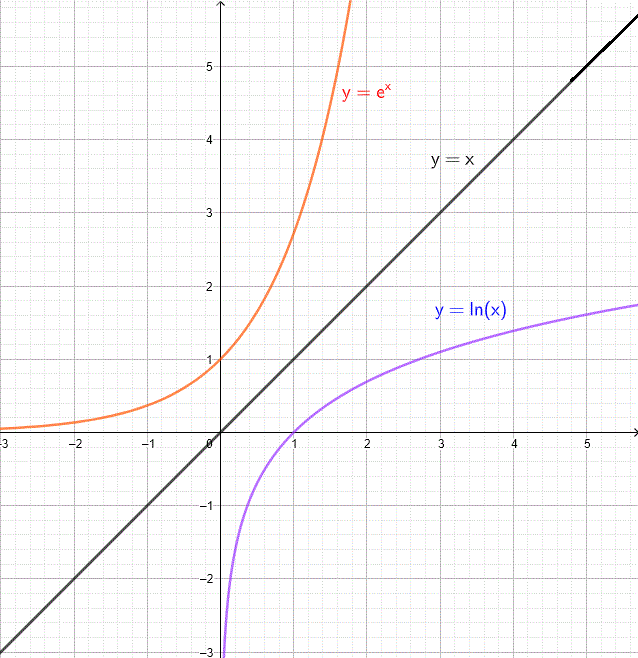
Euler’s number \( e \) plays a foundational role in calculus and advanced mathematics. The natural exponential function is defined as:
\[ f(x) = e^x \]Its inverse function, the natural logarithm, is denoted by:
\[ g(x) = \ln(x) \]The graphs of both the natural exponential function and the natural logarithm are shown below.