Questions and Solutions
- Find the missing items in the pattern:
\[1, 2, 3, 4, 5, \dots\]
- \(7, 8\)
- \(6, 8\)
- \(7, 9\)
- \(6, 7\)
View Step-by-Step Solution
Problem: Find the next two numbers in the pattern \(1, 2, 3, 4, 5, \dots\)
Explanation: The pattern increases by 1 each time. After 5, the next numbers are \(5 + 1 = 6\) and \(6 + 1 = 7\).
Therefore, the correct option is D.
- Find the missing items in the pattern:
\[1, 3, 5, 7, 9, \dots\]
- \(11, 13\)
- \(10, 11\)
- \(12, 14\)
- \(10, 15\)
View Step-by-Step Solution
Problem: Find the next two numbers in the pattern \(1, 3, 5, 7, 9, \dots\)
Explanation: The pattern increases by 2 each time (consecutive odd numbers). After 9, the next numbers are \(9 + 2 = 11\) and \(11 + 2 = 13\).
Therefore, the correct option is A.
- Find the missing items in the pattern:
\[0, 2, 4, 6, 8, \dots\]
- \(9, 12\)
- \(10, 12\)
- \(10, 11\)
- \(10, 13\)
View Step-by-Step Solution
Problem: Find the next two numbers in the pattern \(0, 2, 4, 6, 8, \dots\)
Explanation: The pattern increases by 2 each time (consecutive even numbers). After 8, the next numbers are \(8 + 2 = 10\) and \(10 + 2 = 12\).
Therefore, the correct option is B.
- Find the missing items in the pattern:
\[0, 3, 6, 9, 12, \dots\]
- \(14, 16\)
- \(13, 14\)
- \(15, 18\)
- \(14, 15\)
View Step-by-Step Solution
Problem: Find the next two numbers in the pattern \(0, 3, 6, 9, 12, \dots\)
Explanation: The pattern increases by 3 each time (multiples of 3). After 12, the next numbers are \(12 + 3 = 15\) and \(15 + 3 = 18\).
Therefore, the correct option is C.
- Find the missing items in the pattern:
\[3, 8, 13, 18, 23, \dots\]
- \(28, 33\)
- \(27, 32\)
- \(28, 32\)
- \(27, 33\)
View Step-by-Step Solution
Problem: Find the next two numbers in the pattern \(3, 8, 13, 18, 23, \dots\)
Explanation: Each number increases by 5. After 23, the next numbers are \(23 + 5 = 28\) and \(28 + 5 = 33\).
Therefore, the correct option is A.
- Find the missing items in the pattern:
\[3, 13, 23, 33, 43, \dots\]
- \(63, 73\)
- \(53, 63\)
- \(54, 73\)
- \(44, 45\)
View Step-by-Step Solution
Problem: Find the next two numbers in the pattern \(3, 13, 23, 33, 43, \dots\)
Explanation: Each number increases by 10. After 43, the next numbers are \(43 + 10 = 53\) and \(53 + 10 = 63\).
Therefore, the correct option is B.
- Find the missing items in the pattern:
\[0, 5, 10, \dots, \dots, 25, 30, \dots\]
- \(15, 16\)
- \(11, 20\)
- \(12, 13\)
- \(15, 20\)
View Step-by-Step Solution
Problem: Find the missing numbers in \(0, 5, 10, \dots, \dots, 25, 30, \dots\)
Explanation: The pattern increases by 5 each time. After 10, the missing terms are \(10 + 5 = 15\) and \(15 + 5 = 20\).
Therefore, the correct option is D.
- Find the missing items in the pattern:
\[100, 98, 96, \dots, \dots, 90, 88, \dots\]
- \(95, 94\)
- \(97, 98\)
- \(94, 92\)
- \(92, 91\)
View Step-by-Step Solution
Problem: Find the missing numbers in \(100, 98, 96, \dots, \dots, 90, 88, \dots\)
Explanation: The pattern decreases by 2 each time. After 96, the missing terms are \(96 - 2 = 94\) and \(94 - 2 = 92\).
Therefore, the correct option is C.
- Find the missing items in the pattern:
\[200, 190, 180, \dots, \dots, 150, 140, \dots\]
- \(170, 160\)
- \(181, 182\)
- \(170, 171\)
- \(182, 184\)
View Step-by-Step Solution
Problem: Find the missing numbers in \(200, 190, 180, \dots, \dots, 150, 140, \dots\)
Explanation: The pattern decreases by 10 each time. After 180, the missing terms are \(180 - 10 = 170\) and \(170 - 10 = 160\).
Therefore, the correct option is A.
- Find the missing items in the pattern:
\[1, 2, 4, 7, 11, \dots, \dots\]
- \(14, 17\)
- \(15, 18\)
- \(16, 21\)
- \(16, 22\)
View Step-by-Step Solution
Problem: Find the next two numbers in the pattern \(1, 2, 4, 7, 11, \dots, \dots\)
Explanation: The differences between consecutive terms increase by 1 each time (+1, +2, +3, +4, +5, +6):
- \(2 - 1 = 1\)
- \(4 - 2 = 2\)
- \(7 - 4 = 3\)
- \(11 - 7 = 4\)
Therefore, the correct option is D.
- Figure Pattern:

View Step-by-Step Solution
Explanation: Analyzing the geometric progression and rotation rules across the sequence shows that option B correctly displays the next shape in the progression.
Therefore, the correct option is B.
- Figure Pattern:
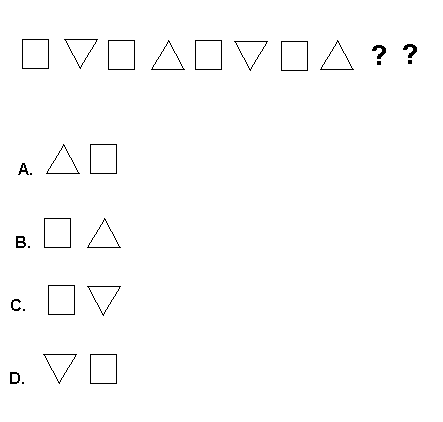
View Step-by-Step Solution
Explanation: Examining the visual elements and symmetry changes in the figure sequence shows that option C represents the correct subsequent figure.
Therefore, the correct option is C.