Grade 5 maths multiple choice questions on fractions are presented along with detailed step-by-step solutions and explanations. Note that mixed numbers are written as whole parts followed by a proper fraction (for example, \(5 \dfrac{1}{2}\) means \(5 + \dfrac{1}{2}\)).
Questions and Step-by-Step Solutions
-
Question 1: Write \(1\) as a fraction.
- \(\dfrac{1}{1}\) only
- \(\dfrac{2}{2}\) only
- \(\dfrac{3}{3}\) only
- Any fraction of the form \(\dfrac{n}{n}\) where \(n\) is a whole number
► View Step-by-Step Solution
Use any whole number \(n\) to write 1 as a fraction as follows:
If \(n = 1\), \(\quad 1 = \dfrac{1}{1}\)
If \(n = 2\), \(\quad 1 = \dfrac{2}{2}\)
If \(n = 11\), \(\quad 1 = \dfrac{11}{11}\)
and so on.
Note: We cannot write \(1 = \dfrac{0}{0}\) because a fraction cannot have a denominator equal to zero.Therefore, option D is correct.
-
Question 2: Write 5 as a reduced fraction.
- \(\dfrac{5}{5}\)
- \(\dfrac{1}{5}\)
- \(\dfrac{5}{1}\)
- \(\dfrac{1}{1}\)
► View Step-by-Step Solution
Any whole number \(n\) may be written as a reduced fraction over 1: \(\dfrac{n}{1}\).
Hence \(5\) may be written as \(\dfrac{5}{1}\).Therefore, option C is correct.
-
Question 3: \[ \dfrac{1}{4} + \dfrac{2}{4} = ? \]
- \(\dfrac{3}{4}\)
- \(\dfrac{3}{8}\)
- \(\dfrac{7}{8}\)
- \(3\)
► View Step-by-Step Solution
When adding fractions with a common denominator, add the numerators directly while keeping the denominator the same:
\[ \dfrac{1}{4} + \dfrac{2}{4} = \dfrac{1+2}{4} = \dfrac{3}{4} \]Therefore, option A is correct.
-
Question 4: \[ \dfrac{4}{7} - \dfrac{2}{7} = ? \]
- \(\dfrac{2}{14}\)
- \(\dfrac{6}{7}\)
- \(\dfrac{2}{7}\)
- \(\dfrac{4}{7}\)
► View Step-by-Step Solution
When subtracting fractions with a common denominator, subtract the numerators directly while keeping the denominator the same:
\[ \dfrac{4}{7} - \dfrac{2}{7} = \dfrac{4 - 2}{7} = \dfrac{2}{7} \]Therefore, option C is correct.
-
Question 5: \[ \dfrac{1}{5} + \dfrac{2}{3} = ? \]
- \(\dfrac{3}{8}\)
- \(\dfrac{2}{15}\)
- \(\dfrac{1}{8}\)
- \(\dfrac{13}{15}\)
► View Step-by-Step Solution
Step 1: Find a common denominator by multiplying the denominators: \(5 \times 3 = 15\).
Step 2: Rewrite the fractions with the common denominator:
\(\dfrac{1}{5} = \dfrac{1 \times 3}{5 \times 3} = \dfrac{3}{15}\)
\(\dfrac{2}{3} = \dfrac{2 \times 5}{3 \times 5} = \dfrac{10}{15}\)
Step 3: Add the adjusted fractions:
\[ \dfrac{3}{15} + \dfrac{10}{15} = \dfrac{3+10}{15} = \dfrac{13}{15} \]Therefore, option D is correct.
-
Question 6: \[ 3 \dfrac{1}{2} + 5 \dfrac{1}{3} = ? \]
- \(8\)
- \(8 \dfrac{2}{5}\)
- \(8 \dfrac{5}{6}\)
- \(\dfrac{2}{5}\)
► View Step-by-Step Solution
Step 1: Add the whole parts: \(3 + 5 = 8\).
Step 2: Add the fraction parts: \(\dfrac{1}{2} + \dfrac{1}{3}\).
Step 3: Find a common denominator (6) for the fractions:
\(\dfrac{1}{2} = \dfrac{3}{6}\) and \(\dfrac{1}{3} = \dfrac{2}{6}\).
Step 4: Combine them:
\[ 3 \dfrac{1}{2} + 5 \dfrac{1}{3} = (3+5) + \left(\dfrac{3}{6} + \dfrac{2}{6}\right) = 8 + \dfrac{5}{6} = 8 \dfrac{5}{6} \]Therefore, option C is correct.
-
Question 7: It takes Julia \(\dfrac{1}{2}\) hour to wash, comb her hair and put on her clothes, and \(\dfrac{1}{4}\) hour to have her breakfast. How much time does it take Julia to be ready for school?
- \(\dfrac{3}{4}\) hour
- 1 hour
- \(\dfrac{2}{4}\) hour
- 1 and \(\dfrac{1}{4}\) hours
► View Step-by-Step Solution
Total time = \(\dfrac{1}{2}\text{ hour} + \dfrac{1}{4}\text{ hour} = \left(\dfrac{1}{2} + \dfrac{1}{4}\right)\text{hour}\).
Convert \(\dfrac{1}{2}\) to fourths: \(\dfrac{1}{2} = \dfrac{2}{4}\).
\[ \dfrac{2}{4} + \dfrac{1}{4} = \dfrac{3}{4}\text{ hour} \]Therefore, option A is correct.
-
Question 8: Which two fractions are equivalent?
- \(\dfrac{5}{2}\) and \(\dfrac{2}{5}\)
- \(\dfrac{4}{3}\) and \(\dfrac{8}{6}\)
- \(\dfrac{1}{4}\) and \(\dfrac{2}{4}\)
- \(\dfrac{2}{3}\) and \(\dfrac{1}{3}\)
► View Step-by-Step Solution
Let's check option B: Write \(\dfrac{4}{3}\) with denominator 6 by multiplying numerator and denominator by 2:
\[ \dfrac{4}{3} = \dfrac{4 \times 2}{3 \times 2} = \dfrac{8}{6} \]
Therefore, \(\dfrac{4}{3}\) and \(\dfrac{8}{6}\) are equivalent fractions.Therefore, option B is correct.
-
Question 9: \[ 5 \dfrac{2}{3} - 3 \dfrac{1}{2} = ? \]
- \(2\)
- \(1 \dfrac{2}{5}\)
- \(2 \dfrac{7}{6}\)
- \(2 \dfrac{1}{6}\)
► View Step-by-Step Solution
Step 1: Convert mixed numbers to improper fractions:
\(5 \dfrac{2}{3} = \dfrac{17}{3}\) and \(3 \dfrac{1}{2} = \dfrac{7}{2}\).
Step 2: Find a common denominator (6):
\(\dfrac{17}{3} = \dfrac{34}{6}\) and \(\dfrac{7}{2} = \dfrac{21}{6}\).
Step 3: Subtract:
\[ \dfrac{34}{6} - \dfrac{21}{6} = \dfrac{13}{6} = 2 \dfrac{1}{6} \]Therefore, option D is correct.
-
Question 10: Billy ate \(1 \dfrac{1}{4}\) of a pizza and John ate \(1 \dfrac{2}{3}\) pizzas. How much more pizza did John eat than Billy?
- \(\dfrac{2}{3}\)
- \(\dfrac{5}{12}\)
- \(\dfrac{1}{4}\)
- \(\dfrac{7}{12}\)
► View Step-by-Step Solution
Difference = \(1 \dfrac{2}{3} - 1 \dfrac{1}{4} = \left(1 - 1\right) + \left(\dfrac{2}{3} - \dfrac{1}{4}\right) = \dfrac{2}{3} - \dfrac{1}{4}\).
Using common denominator 12:
\(\dfrac{2}{3} = \dfrac{8}{12}\) and \(\dfrac{1}{4} = \dfrac{3}{12}\).
\[ \dfrac{8}{12} - \dfrac{3}{12} = \dfrac{5}{12} \]Therefore, option B is correct.
-
Question 11: \[ \dfrac{5}{2} \div \dfrac{3}{4} = ? \]
- \(\dfrac{10}{3}\)
- \(\dfrac{10}{8}\)
- \(\dfrac{13}{4}\)
- \(1\)
► View Step-by-Step Solution
To divide fractions, multiply by the reciprocal of the second fraction:
\[ \dfrac{5}{2} \div \dfrac{3}{4} = \dfrac{5}{2} \times \dfrac{4}{3} = \dfrac{20}{6} = \dfrac{10}{3} \]Therefore, option A is correct.
-
Question 12: \[ 5 \div \dfrac{1}{7} = ? \]
- \(\dfrac{5}{7}\)
- \(\dfrac{6}{7}\)
- \(\dfrac{1}{35}\)
- \(35\)
► View Step-by-Step Solution
Multiply 5 by the reciprocal of \(\dfrac{1}{7}\):
\[ 5 \div \dfrac{1}{7} = \dfrac{5}{1} \times \dfrac{7}{1} = 35 \]Therefore, option D is correct.
-
Question 13: \[ \dfrac{2}{5} \times \dfrac{3}{7} = ? \]
- \(\dfrac{14}{15}\)
- \(\dfrac{6}{35}\)
- \(\dfrac{35}{6}\)
- \(\dfrac{15}{14}\)
► View Step-by-Step Solution
Multiply numerators together and denominators together:
\[ \dfrac{2}{5} \times \dfrac{3}{7} = \dfrac{2 \times 3}{5 \times 7} = \dfrac{6}{35} \]Therefore, option B is correct.
-
Question 14: To have \(a + 1 \dfrac{3}{4} = 2\), \(a\) must be equal to:
- \(1\)
- \(\dfrac{3}{4}\)
- \(\dfrac{1}{2}\)
- \(\dfrac{1}{4}\)
► View Step-by-Step Solution
Subtract \(1 \dfrac{3}{4}\) from both sides:
\(a = 2 - 1 \dfrac{3}{4} = 1 - \dfrac{3}{4} = \dfrac{4}{4} - \dfrac{3}{4} = \dfrac{1}{4}\)Therefore, option D is correct.
-
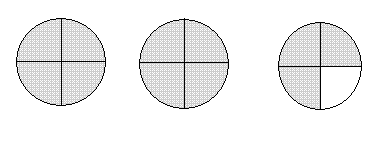
Question 15: What fraction or mixed number is the shaded part?
- \(\dfrac{3}{4}\)
- \(\dfrac{6}{4}\)
- \(2 \dfrac{3}{4}\)
- \(1 \dfrac{3}{4}\)
► View Step-by-Step Solution
There are two whole shaded items and one shaded at \(\dfrac{3}{4}\). Hence the mixed number representing the shaded parts is \(2 \dfrac{3}{4}\).
Therefore, option C is correct.
-
Question 16: True or false: \[ 2 \dfrac{1}{2} = 2 \times \dfrac{1}{2} \]
► View Step-by-Step Solution
False: \(2 \dfrac{1}{2}\) is a mixed number equal to \(2 + \dfrac{1}{2}\), not \(2 \times \dfrac{1}{2}\).
-
Question 17: Tina works 15 hours a week (Monday to Friday). Last week she worked \(3 \dfrac{1}{2}\) hours on Monday, 4 hours on Tuesday, \(2 \dfrac{1}{6}\) hours on Wednesday, and \(1 \dfrac{1}{2}\) hours on Thursday. How many hours did she work on Friday?
- \(4\)
- \(\dfrac{5}{6}\)
- \(3 \dfrac{5}{6}\)
- \(2 \dfrac{5}{6}\)
► View Step-by-Step Solution
Let \(n\) be the hours worked on Friday:
\(3 \dfrac{1}{2} + 4 + 2 \dfrac{1}{6} + 1 \dfrac{1}{2} + n = 15\)
Combine whole numbers and fractions:
\((3 + 4 + 2 + 1) + \left(\dfrac{1}{2} + \dfrac{1}{6} + \dfrac{1}{2}\right) + n = 15\)
\(10 + \left(1 + \dfrac{1}{6}\right) + n = 15 \implies 11 \dfrac{1}{6} + n = 15\)
\(n = 15 - 11 \dfrac{1}{6} = 3 \dfrac{5}{6}\text{ hours}\).Therefore, option C is correct.
-
Question 18: Which point on the number line represents \(1 \dfrac{7}{10}\)?

- S
- R
- W
- K
► View Step-by-Step Solution
\(1 \dfrac{7}{10} = 1.7\), which corresponds to point W on the graph.
Therefore, option C is correct.
-
Question 19: Write \(2 \dfrac{1}{3}\) as an improper fraction.
- \(\dfrac{2}{3}\)
- \(\dfrac{7}{3}\)
- \(\dfrac{1}{3}\)
- \(\dfrac{3}{3}\)
► View Step-by-Step Solution
\(2 \dfrac{1}{3} = 2 + \dfrac{1}{3} = \dfrac{6}{3} + \dfrac{1}{3} = \dfrac{7}{3}\).
Therefore, option B is correct.
-
Question 20: Write the fraction \(\dfrac{31}{8}\) as a mixed number.
- \(4\)
- \(4 \dfrac{7}{8}\)
- \(3 \dfrac{1}{8}\)
- \(3 \dfrac{7}{8}\)
► View Step-by-Step Solution
\(31 \div 8 = 3\) with a remainder of 7.
\[ \dfrac{31}{8} = \dfrac{3 \times 8 + 7}{8} = 3 + \dfrac{7}{8} = 3 \dfrac{7}{8} \]Therefore, option D is correct.
-
Question 21: \[ 3 \times \dfrac{1}{4} = ? \]
- \(3 \dfrac{1}{4}\)
- \(\dfrac{1}{4} + \dfrac{1}{4} + \dfrac{1}{4}\)
- \(\dfrac{1}{4}\)
- \(12\)
► View Step-by-Step Solution
\(3 \times \dfrac{1}{4} = (1 + 1 + 1) \times \dfrac{1}{4} = \dfrac{1}{4} + \dfrac{1}{4} + \dfrac{1}{4}\).
Therefore, option B is correct.
-
Question 22: \[ 3 \dfrac{1}{4} = ? \]
- \(3 \times \dfrac{1}{4}\)
- \(\dfrac{3}{4}\)
- \(3 + \dfrac{1}{4}\)
- \(\dfrac{4}{3}\)
► View Step-by-Step Solution
A mixed number represents the sum of its whole number part and fractional part: \(3 \dfrac{1}{4} = 3 + \dfrac{1}{4}\).
Therefore, option C is correct.
-
Question 23: True or false: \[ \dfrac{2}{5} > \dfrac{3}{8} \]
► View Step-by-Step Solution
Using a common denominator (40):
\(\dfrac{2}{5} = \dfrac{16}{40}\) and \(\dfrac{3}{8} = \dfrac{15}{40}\).
Since \(\dfrac{16}{40} > \dfrac{15}{40}\), the statement is True. -
Question 24: Order from least to greatest the fractions: \[ \dfrac{3}{5}, \; \dfrac{7}{6}, \; \dfrac{1}{3}, \; \dfrac{4}{9} \]
- \(\dfrac{1}{3}, \; \dfrac{4}{9}, \; \dfrac{3}{5}, \; \dfrac{7}{6}\)
- \(\dfrac{4}{9}, \; \dfrac{1}{3}, \; \dfrac{3}{5}, \; \dfrac{7}{6}\)
- \(\dfrac{1}{3}, \; \dfrac{4}{9}, \; \dfrac{7}{6}, \; \dfrac{3}{5}\)
- \(\dfrac{1}{3}, \; \dfrac{3}{5}, \; \dfrac{4}{9}, \; \dfrac{7}{6}\)
► View Step-by-Step Solution
\(\dfrac{7}{6} > 1\), while the others are less than 1.
Using common denominator 45 for the remaining three fractions:
\(\dfrac{3}{5} = \dfrac{27}{45}\), \(\dfrac{1}{3} = \dfrac{15}{45}\), \(\dfrac{4}{9} = \dfrac{20}{45}\).
Ordering from least to greatest: \(\dfrac{1}{3}, \; \dfrac{4}{9}, \; \dfrac{3}{5}, \; \dfrac{7}{6}\).Therefore, option A is correct.
-
Question 25: Write \(\dfrac{2}{3}\) of \(4\) as a mixed number.
- \(4 \dfrac{2}{3}\)
- \(1 \dfrac{2}{3}\)
- \(2 \dfrac{2}{3}\)
- \(\dfrac{8}{3}\)
► View Step-by-Step Solution
\(\dfrac{2}{3} \times 4 = \dfrac{8}{3} = \dfrac{6+2}{3} = 2 + \dfrac{2}{3} = 2 \dfrac{2}{3}\).
Therefore, option C is correct.
-
Question 26: How many minutes are there in \(\dfrac{2}{3}\) of an hour?
- 40 minutes
- 60 minutes
- 20 minutes
- 100 minutes
► View Step-by-Step Solution
\(\dfrac{2}{3} \times 60\text{ minutes} = \dfrac{120}{3} = 40\text{ minutes}\).
Therefore, option A is correct.
-
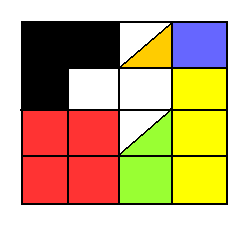
Question 27: In the figure below, a large square was divided into 16 smaller squares of equal sides. Find the fraction of the large square for each color.
- red: \(\dfrac{1}{4}\), blue: \(\dfrac{1}{16}\), orange: \(\dfrac{1}{16}\), green: \(\dfrac{3}{16}\), black: \(\dfrac{3}{16}\), yellow: \(\dfrac{3}{16}\)
- red: \(\dfrac{4}{4}\), blue: \(\dfrac{1}{16}\), orange: \(\dfrac{1}{16}\), green: \(\dfrac{3}{32}\), black: \(\dfrac{3}{16}\), yellow: \(\dfrac{3}{16}\)
- red: \(\dfrac{1}{4}\), blue: \(\dfrac{1}{16}\), orange: \(\dfrac{1}{16}\), green: \(\dfrac{3}{16}\), black: \(\dfrac{3}{16}\), yellow: \(\dfrac{3}{16}\)
- red: \(\dfrac{1}{4}\), blue: \(\dfrac{1}{16}\), orange: \(\dfrac{1}{32}\), green: \(\dfrac{3}{32}\), black: \(\dfrac{3}{16}\), yellow: \(\dfrac{3}{16}\)
► View Step-by-Step Solution
Each small square represents \(\dfrac{1}{16}\) of the large square.
- Red: 4 small squares = \(\dfrac{4}{16} = \dfrac{1}{4}\).
- Blue: 1 small square = \(\dfrac{1}{16}\).
- Orange: Half a small square = \(\dfrac{1}{2} \times \dfrac{1}{16} = \dfrac{1}{32}\).
- Green: 1 and a half small squares = \(\dfrac{1}{16} + \dfrac{1}{32} = \dfrac{3}{32}\).
- Black: 3 small squares = \(\dfrac{3}{16}\).
- Yellow: 3 small squares = \(\dfrac{3}{16}\).Therefore, option D is correct.