Grade 5 word problems and problems on patterns, time addition and subtraction, time-distance-speed, fractions and mixed numbers, ratios, percentages, and area and volume of rectangles and squares are presented with detailed step-by-step solutions and explanations.
Problems and Step-by-Step Solutions
-
Question 1: Sarah baked a cake and cut it into 8 equal slices. She ate 3 slices, and her friend Jake ate 1 slice. What fraction of the cake is left? Simplify the fraction if possible.
► View Step-by-Step Solution
Total slices = 8
Slices eaten = 3 (Sarah) + 1 (Jake) = 4
Slices left = \(8 - 4 = 4\)
\[ \text{The fraction left} = \dfrac{4}{8} \]
Divide both numerator and denominator by 4:
\[ \text{The fraction left} = \dfrac{4 \div 4}{8 \div 4} = \dfrac{1}{2} \] -
Question 2: A bookstore sells books for $15 each. If a customer buys 3 books and then gets a 25% discount on the total price, how much will the customer pay in total?
► View Step-by-Step Solution
Total price before discount: \[ 3 \times 15 = 45 \; \text{dollars} \]
Total discount: \[ 25\% \; \text{of} \; 45 = \dfrac{25}{100} \times 45 = 0.25 \times 45 = 11.25 \; \text{dollars} \]
Total price after discount: \[ 45 - 11.25 = 33.75 \; \text{dollars} \]
The customer will pay $33.75. -
Question 3: The first four numbers in a sequence are 3, 6, 12, 24. Explain the pattern and find the 7th number in the sequence?
► View Step-by-Step Solution
The pattern starts with 3 and then each number is multiplied by 2 to get the next number.
- 1st: 3
- 2nd: \(3 \times 2 = 6\)
- 3rd: \(6 \times 2 = 12\)
- 4th: \(12 \times 2 = 24\)
- 5th: \(24 \times 2 = 48\)
- 6th: \(48 \times 2 = 96\)
- 7th: \(96 \times 2 = 192\)
The 7th number in the sequence is 192. -
Question 4: It takes John 25 minutes to walk to the car park and 45 minutes to drive to work. At what time should he get out of the house in order to get to work at 9:00 a.m.?
► View Step-by-Step Solution
The time it takes John to get to work is the sum of the time to walk to the car park and the time to drive:
\[ \text{Total time} = 25 + 45 = 70 \text{ minutes} \]
Since \(70 \text{ minutes} = 60 \text{ minutes} + 10 \text{ minutes} = 1 \text{ hour and } 10 \text{ minutes}\).
John needs to leave the house 1 hour and 10 minutes before 9:00 a.m.:
\[ 9:00 - 1:10 = 7:50 \text{ a.m.} \]
John should leave the house at 7:50 a.m. -
Question 5: Kim can walk 4 kilometers in one hour. How long does it take Kim to walk 18 kilometers?
► View Step-by-Step Solution
The time to walk 18 km is:
\[ \dfrac{18}{4} = 4.5 = 4 + \dfrac{1}{2} \]
It takes Kim 4.5 hours (or 4 hours and 30 minutes) to walk 18 kilometers. -
Question 6: A factory produced 2,300 TV sets in its first year of production. 4,500 sets were produced in its second year, and 500 more sets were produced in its third year than in its second year. How many TV sets were produced in three years?
► View Step-by-Step Solution
Number of sets produced in the third year:
\[ 4500 + 500 = 5000 \]
Total number of TV sets produced in three years:
\[ 2300 + 4500 + 5000 = 11800 \]
Conclusion: 11,800 TV sets were produced over 3 years. -
Question 7: Tom and Bob have a total of 49 toys. If Bob has 5 more toys than Tom, how many toys does each one have?
► View Step-by-Step Solution
If 5 toys are taken out of the 49 toys and the remaining ones are distributed equally between Tom and Bob:
\[ 49 - 5 = 44 \]
Each one will have:
\[ \dfrac{44}{2} = 22 \text{ toys} \]
Bob has 5 more toys than Tom, so Bob has:
\[ 22 + 5 = 27 \text{ toys} \]
Tom has 22 toys and Bob has 27 toys. -
Question 8: John can eat a quarter of a pizza in one minute. How long does it take John to eat one pizza and a half?
► View Step-by-Step Solution
Method 1: There are 4 quarters in one whole pizza, and 2 quarters in half a pizza. Total quarters: \(4 + 2 = 6\) quarters.
At one minute per quarter: \(6 \times 1 = 6\) minutes.Method 2: One and a half pizzas is \(1\dfrac{1}{2} = \dfrac{3}{2}\).
Dividing by a quarter (\(\dfrac{1}{4}\)):
\[ \dfrac{3}{2} \div \dfrac{1}{4} = \dfrac{3}{2} \times \dfrac{4}{1} = 6 \text{ quarters} \]
John needs \(6 \times 1 = 6\) minutes. -
Question 9: John read a quarter of the time that Tom read. Tom read only two-fifths of the time that Sasha read. Sasha read twice as long as Mike. If Mike read 5 hours, how long did John read?
► View Step-by-Step Solution
- Mike read 5 hours.
- Sasha read twice as long as Mike: \(2 \times 5 = 10\) hours.
- Tom read two-fifths of Sasha's time: \(\dfrac{2}{5} \times 10 = 4\) hours.
- John read a quarter of Tom's time: \(\dfrac{1}{4} \times 4 = 1\) hour.
Conclusion: John read for 1 hour. -
Question 10: Jim, Carla and Tomy are members of the same family. Carla is 5 years older than Jim. Tomy is 6 years older than Carla. The sum of their three ages is 31 years. How old is each one of them?
► View Step-by-Step Solution
Algebra Method:
Let \(x\) be Jim's age. Carla's age is \(x + 5\), and Tomy's age is \((x + 5) + 6 = x + 11\).
Sum of ages = 31:
\[ x + (x + 5) + (x + 11) = 31 \implies 3x + 16 = 31 \implies 3x = 15 \implies x = 5 \]
Jim is 5, Carla is \(5 + 5 = 10\), and Tomy is \(10 + 6 = 16\).Table Method:
Jim's age Carla's age Tomy's age The sum of all ages 1 6 12 19 2 7 13 22 3 8 14 25 4 9 15 28 5 10 16 \(\color{red}{31 \text{ (Correct)}}\) -
Question 11: Mel had $35.00 and withdrew some more money from his bank account. He bought a pair of trousers at $34.00, two shirts at $16.00 each, and two pairs of shoes at $24.00 each. After shopping, he had $32.00 left. How much money did Mel withdraw from the bank?
► View Step-by-Step Solution
Mel spent:
- Trousers: $34.00
- Shirts: \(2 \times 16.00 = \$32.00\)
- Shoes: \(2 \times 24.00 = \$48.00\)
Total spent: \(34.00 + 32.00 + 48.00 = \$114.00\).
Total money before shopping (spent + left): \(114.00 + 32.00 = \$146.00\).
Subtract the original $35.00 to find the amount withdrawn: \[ 146.00 - 35.00 = \$111.00 \]. -
Question 12: How many minutes are in one week?
► View Step-by-Step Solution
1 week = 7 days
1 day = 24 hours
1 hour = 60 minutes
\[ 7 \times 24 \times 60 = 10,080 \text{ minutes} \] -
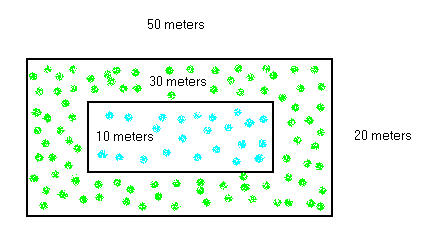
Question 13: In Tim's house, a rectangular swimming pool whose length is 30 meters and width is 10 meters is surrounded by grass. The pool with the grassy area makes a large rectangle whose length is 50 meters and width is 20 meters. What area is occupied by the grass?
► View Step-by-Step Solution
Area of large rectangle (pool and grass) = \(50 \times 20 = 1000 \text{ m}^2\).
Area of pool = \(30 \times 10 = 300 \text{ m}^2\).
Area of grass = \(1000 - 300 = 700 \text{ m}^2\). -
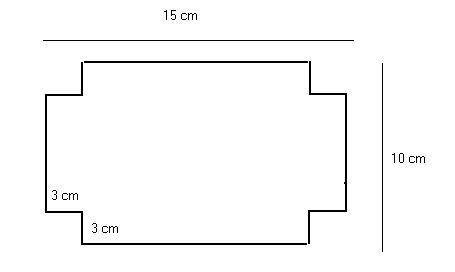
Question 14: Mary wants to make a box. She starts with a piece of cardboard whose length is 15 centimeters and width is 10 centimeters. Then she cuts congruent squares with a side of 3 centimeters from each of the four corners. What is the area of the cardboard after she cuts the 4 corners?
► View Step-by-Step Solution
Total area before cutting = \(15 \times 10 = 150 \text{ cm}^2\).
Area of one corner square = \(3 \times 3 = 9 \text{ cm}^2\).
Total area of 4 corners = \(4 \times 9 = 36 \text{ cm}^2\).
Remaining area = \(150 - 36 = 114 \text{ cm}^2\). -
Question 15: A painter charges $225.00 for materials and $35.00 per hour for labor. The total cost of painting an office is $330.00. How many hours did it take the painter to paint the office?
► View Step-by-Step Solution
Labor cost = Total cost - Materials cost = \(330.00 - 225.00 = \$105.00\).
Number of hours = \(105.00 \div 35 = 3 \text{ hours}\). -
Question 16: Three toy cars and 4 toy trains cost $18. Two toy cars and 3 toy trains cost $13. What is the price of one toy car and the price of one toy train if both prices are whole numbers of Dollars?
► View Step-by-Step Solution
Table Method:
Guess price of 1 car Guess price of 1 train 3 cars + 4 trains ($18?) 2 cars + 3 trains ($13?) 1 1 \(3(1)+4(1) = 7\) - 1 2 \(3(1)+4(2) = 11\) - 1 3 \(3(1)+4(3) = 15\) - 1 4 \(3(1)+4(4) = 19\) - 2 1 \(3(2)+4(1) = 10\) - 2 2 \(3(2)+4(2) = 14\) - 2 3 \(3(2)+4(3) = 18\) \(\color{red}{2(2)+3(3) = 13 \text{ (Correct)}}\) Algebra Method:
Let \(x\) be car price and \(y\) be train price:
\(3x + 4y = 18\)
\(2x + 3y = 13\)
Solving the system yields \(x = \$2\) and \(y = \$3\). -
Question 17: A box has a length of 5 cm, a width of 3 cm, and a height of 4 cm. What is the volume of the box?
► View Step-by-Step Solution
\[ \text{Volume} = \text{length} \times \text{width} \times \text{height} = 5 \times 3 \times 4 = 60 \text{ cm}^3 \]
-
Question 18: A bag contains 6 red balls, 4 blue balls, and 10 green balls. If a ball is picked at random, what is the probability that the ball will be blue? Write your answer as a fraction in simplest form.
► View Step-by-Step Solution
Total balls = \(6 + 4 + 10 = 20\).
Blue balls = 4.
Probability = \(\dfrac{4}{20} = \dfrac{1}{5}\). -
Question 19: John bought 3.75 meters of fabric to make a curtain. He used 2.4 meters for one curtain and 0.85 meters for another. How much fabric does he have left?
► View Step-by-Step Solution
Total fabric used = \(2.4 + 0.85 = 3.25 \text{ meters}\).
Fabric left = \(3.75 - 3.25 = 0.5 \text{ meters}\). -
Question 20: Linda spent \(\dfrac{3}{4}\) of her savings on furniture. She then spent \(\dfrac{1}{2}\) of her remaining savings on a fridge. If the fridge cost her $150, what were her original savings?
► View Step-by-Step Solution
Remaining savings after furniture = \(1 - \dfrac{3}{4} = \dfrac{1}{4}\) of original savings \(x\).
Fridge cost: \(\dfrac{1}{2} \times \left(\dfrac{1}{4}x\right) = 150 \implies \dfrac{x}{8} = 150 \implies x = 1200\).
Linda's original savings were $1200. -
Question 21: The perimeter of square A is 3 times the perimeter of square B. What is the ratio of the area of square A to the area of square B?
► View Step-by-Step Solution
Let sides be \(x\) (square A) and \(y\) (square B).
Perimeters: \(4x = 3(4y) \implies x = 3y\).
Square both sides: \(x^2 = 9y^2\).
Ratio of areas = \(\dfrac{x^2}{y^2} = 9\), or \(9:1\). -
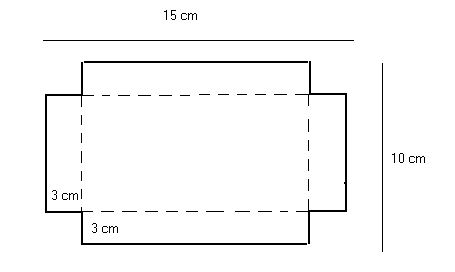
Question 22: Mary wants to make an open rectangular box. She starts with a piece of cardboard whose length is 15 centimeters and width is 10 centimeters. Then she cuts 4 congruent squares with sides of 3 centimeters at the four corners and folds at the broken lines to make the box. What is the volume of the box?
► View Step-by-Step Solution
Length of box = \(15 - 3 - 3 = 9 \text{ cm}\).
Width of box = \(10 - 3 - 3 = 4 \text{ cm}\).
Height of box = \(3 \text{ cm}\).
Volume = \(9 \times 4 \times 3 = 108 \text{ cm}^3\). -
Question 23: A small square of side \(2x\) is cut from one corner of a rectangle whose width is 10 centimeters and length is 20 centimeters. Write an expression in terms of \(x\) for the area of the remaining shape.
► View Step-by-Step Solution
Area of rectangle = \(20 \times 10 = 200\).
Area of cut square = \((2x) \times (2x) = 4x^2\).
Remaining area = \(200 - 4x^2\). -
Question 24: The coordinates of point A are (2, 3), and the coordinates of point B are (6, 7). What is the distance between points A and B?
► View Step-by-Step Solution
Using the distance formula: \[ d = \sqrt{(x_2 - x_1)^2 + (y_2 - y_1)^2} \] Substitute \((2, 3)\) and \((6, 7)\): \[ d = \sqrt{(6 - 2)^2 + (7 - 3)^2} = \sqrt{4^2 + 4^2} = \sqrt{16 + 16} = \sqrt{32} = 4\sqrt{2} \text{ units} \]