Below is a set of 10 GMAT-style geometry practice questions covering angles, triangles, circles, area, and ratios. Each question is accompanied by a detailed step-by-step solution mirroring official GMAT quantitative problem-solving.
Practice Questions with Solutions
Question 1: What is the measure of angle \(x\) if lines \(L_1\) and \(L_2\) are parallel?

Options: A) \(130^\circ\) | B) \(50^\circ\) | C) \(60^\circ\) | D) \(90^\circ\) | E) \(180^\circ\)
Solution & Explanation:
Let \(y\) be the vertical angle opposite \(x\). Since lines \(L_1\) and \(L_2\) are parallel, angle \(y\) and the \(130^\circ\) angle are supplementary:
\[ y + 130 = 180 \implies y = 50^\circ \]Vertical angles are equal, therefore:
\[ x = 50^\circ \]

Correct answer: B
Question 2: Find the value of \(x\) from the triangle angle measures.
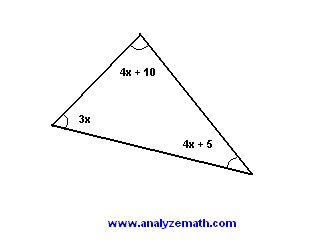
Options: A) \(0\) | B) \(5\) | C) \(10\) | D) \(15\) | E) \(20\)
Solution & Explanation:
The sum of the interior angles in a triangle is \(180^\circ\):
\[ (4x + 10) + (4x + 5) + 3x = 180 \] \[ 11x + 15 = 180 \implies 11x = 165 \implies x = 15 \]Correct answer: D
Question 3: Triangle \(ABC\) has altitudes \(AN \perp BC\) and \(BM \perp AC\). Given \(BC = 10, AC = 12, AN = 8\), find the length of altitude \(BM\).

Solution & Explanation:
The area of triangle \(ABC\) can be expressed using either base-altitude pair:
\[ \frac{1}{2}(AN)(BC) = \frac{1}{2}(BM)(AC) \]Substitute the given values:
\[ \frac{1}{2}(8)(10) = \frac{1}{2}(BM)(12) \implies 40 = 6BM \implies BM = \frac{40}{6} = \frac{20}{3} \approx 6.7 \]Answer: \(\frac{20}{3}\) (approx. 6.7)
Question 4: Triangle \(ABC\) is isosceles with \(BA = BC\). Find the measure of angle \(x\).

Solution & Explanation:
Since \(BA = BC\), triangle \(ABC\) is isosceles, meaning the base angles at \(A\) and \(C\) are equal. Given the vertex angle is \(40^\circ\):
\[ A + C + 40 = 180 \implies 2A = 140 \implies A = 70^\circ \]Angle \(x\) is supplementary to angle \(A\):
\[ x + 70 = 180 \implies x = 110^\circ \]Answer: \(110^\circ\)
Question 5: Find the area of a right isosceles triangle with hypotenuse equal to \(24\).
Solution & Explanation:
Let each leg of the right isosceles triangle be \(x\). By the Pythagorean theorem:
\[ x^2 + x^2 = 24^2 \implies 2x^2 = 576 \implies x^2 = 288 \]The area of the triangle is:
\[ A = \frac{1}{2}x^2 = \frac{1}{2}(288) = 144 \]Answer: \(144\)
Question 6: The total area of the composite figure is \(240\). Find the length of segment \(AC\).

Solution & Explanation:
The total area is the sum of the areas of two triangles sharing base \(AC\) (with heights 20 and 28):
\[ \frac{1}{2}(20)(AC) + \frac{1}{2}(28)(AC) = 240 \] \[ 10(AC) + 14(AC) = 240 \implies 24(AC) = 240 \implies AC = 10 \]Answer: \(10\)
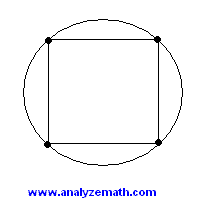
Question 7: A square is inscribed in a circle. The area of the square is \(144\). What is the area of the circle?
Solution & Explanation:
Let the side of the square be \(x\). Since area is \(144\):
\[ x^2 = 144 \implies x = 12 \]The diagonal \(d\) of the square equals the diameter of the circle:
\[ d^2 = 12^2 + 12^2 = 144 + 144 = 288 \implies d = \sqrt{288} = 12\sqrt{2} \]The radius \(r\) is half of the diameter:
\[ r = \frac{12\sqrt{2}}{2} = 6\sqrt{2} \]The area of the circle is:
\[ A = \pi r^2 = \pi(6\sqrt{2})^2 = 72\pi \]Answer: \(72\pi\)
Question 8: The measures (in degrees) of two consecutive interior angles of a parallelogram are \(2x + 10\) and \(x + 20\). Find the measures of the two angles.
Solution & Explanation:
Consecutive interior angles in a parallelogram are supplementary (sum to \(180^\circ\)):
\[ (2x + 10) + (x + 20) = 180 \implies 3x + 30 = 180 \implies 3x = 150 \implies x = 50 \]Substitute \(x = 50\) back into the angle expressions:
\[ 2(50) + 10 = 110^\circ, \quad 50 + 20 = 70^\circ \]Answer: \(110^\circ\) and \(70^\circ\)
Question 9: The perimeter of a rectangle is \(90\) and its width is \(10\). Find the area of the rectangle.
Solution & Explanation:
Using the perimeter formula for a rectangle:
\[ 2L + 2W = 90 \implies 2L + 2(10) = 90 \implies 2L + 20 = 90 \implies 2L = 70 \implies L = 35 \]The area is length times width:
\[ A = L \times W = 35 \times 10 = 350 \]Answer: \(350\)
Question 10: What is the ratio of the area of a square of side \(x\) to the area of a rectangle of width \(2x\) and length \(3x\)?
Solution & Explanation:
Square area = \(x^2\). Rectangle area = \((2x)(3x) = 6x^2\).
\[ \text{Ratio} = \frac{x^2}{6x^2} = \frac{1}{6} \]Answer: \(\frac{1}{6}\)