Free GRE Solutions and Explanations to Sample 1
Solutions and detailed explanations to questions and problems similar to the questions in the GRE test. sample 1
Solution to Question 1
The number of miles covered using 1 gallon is given by
\[
\dfrac{130}{4} = 32.5 \text{ miles/gallon}
\]
Using 6.5 gallons, the car will cover
\[
6.7 \cdot 32.5 = 217.75 \text{ miles}
\]
Solution to Question 2
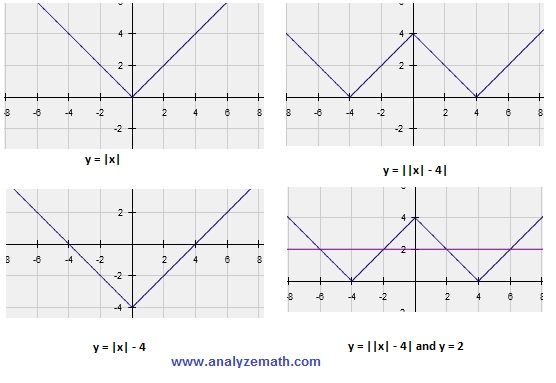
Shown below is the graph of \( ||x| - 4| \) by steps. First, top left is the V-shaped graph of \( |x| \), then below is the graph of \( |x| - 4 \) which is the graph of \( |x| \) shifted 4 units down. Top right is the graph of \( ||x| - 4| \) which is the graph of \( |x| - 4 \) where the part of the graph below the x-axis is reflected on the x-axis to make it positive or zero. Finally, the graph of \( ||x| - 4| \) and that of \( y = 2 \) shows that there are 4 points of intersection.
 .
.
Solution to Question 3
Convert all given quantities into decimal numbers
A) \[ 125\% = \dfrac{125}{100} = 1.25 \]
B) \[ 1.25 = 1.25 \]
C) \[ 1 + \dfrac{1}{3} = 1.333\ldots \]
D) \[ \dfrac{4}{3} = 1.333\ldots \]
E) \[ \dfrac{0.0015}{0.001} = \dfrac{1.5}{1} = 1.5 \]
The largest of all given quantities is \( \dfrac{0.0015}{0.001} \)
Solution to Question 4
First calculate \( | -10 - 19 | \)
\[
| -10 - 19 | = | -29 | = 29
\]
Substitute \( | -10 - 19 | \) by 29 in the given expression and calculate
\[
| | -10 - 19 | - 20 | = | 29 - 20 | = | 9 | = 9
\]
Solution to Question 5
Since division by 0 is not allowed in mathematics, the given expression is undefined for any value that makes its denominator equal to 0. The denominator of the given expression is equal to 0 if
\[
x + 2 = 0 \quad \text{or} \quad x = -2
\]
The given expression is undefined if \( x = -2 \)
Solution to Question 6
We first expand the given expression using the identity \( (x - y)(x + y) = x^2 - y^2 \) and then simplify:
\[
(\sqrt{5} - \sqrt{7})(\sqrt{5} + \sqrt{7}) = (\sqrt{5})^2 - (\sqrt{7})^2 = 5 - 7 = -2
\]
The given expression is undefined if \( x = -2 \).
Solution to Question 7
The size of angle \( \angle BAC \) is equal to \( 46^\circ \) since it is a vertical angle to the given angle of size \( 46^\circ \). We now use the fact that the sum of all angles in a triangle is equal to \( 180^\circ \).
\[
\text{size of angle ABC} + \text{size of angle ACB} + 46^\circ = 180^\circ
\]
Since \( AB \) and \( AC \) have equal lengths, triangle ABC is isosceles and therefore angles \( \angle ABC \) and \( \angle ACB \) are equal in size. Hence
\[
2 \cdot \text{size of angle ABC} + 46^\circ = 180^\circ
\]
\[
\text{size of angle ABC} = \dfrac{180^\circ - 46^\circ}{2} = 67^\circ
\]
Solution to Question 8
The sum of all three angles in a triangle is equal to \( 180^\circ \). Hence
\[
(4x + 4y) + (x + 3y) + (x + 2y) = 180
\]
Group like terms:
\[
6x + 9y = 180
\]
Substitute \( y = 10 \) in the equation and solve for \( x \):
\[
6x + 9(10) = 180
\]
Simplifying:
\[
6x = 180 - 90 = 90
\]
Thus,
\[
x = 15
\]
Solution to Question 9
Let \( L \), \( W \), and \( H \) be the length, width, and height of the rectangular solid. The volume \( V \) is given by
\[
V = LWH
\]
When \( L \), \( W \), and \( H \) are increased by 25%, they become
\[
L = L + 0.25L = L(1 + \dfrac{25}{100}) = L(1 + 0.25) = 1.25L
\]
\[
W = 1.25W
\]
\[
H = 1.25H
\]
The volume \( V_2 \) after the increase is given by
\[
V_2 = (1.25L)(1.25W)(1.25H) = 1.25^3 \cdot LWH
\]
Find the percentage \( P \) of increase of the volume as follows:
\[
P = \dfrac{V_2 - V}{V} = \dfrac{1.25^3 \cdot LWH - LWH}{LWH}
\]
\[
= \dfrac{LWH(1.25^3 - 1)}{LWH}
\]
\[
= 1.25^3 - 1 = 0.95 \quad \text{(rounded to the nearest hundredth)}
\]
\[
= 95\%
\]
Solution to Question 10
The prime numbers between 20 and 40 are
\[
23,\ 29,\ 31,\ \text{and } 37
\]
Their average is equal to
\[
\dfrac{23 + 29 + 31 + 37}{4} = 30
\]
More References and Links to Maths Practice Tests