Problem 1
Each side of the square pyramid shown below measures $10$ inches. The slant height, $H$, of this pyramid measures $12$ inches.
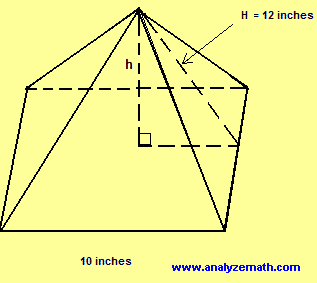
- What is the area, in square inches, of the base of the pyramid?
- What is the total surface area, in square inches, of the pyramid?
- What is $h$, the height, in inches, of the pyramid?
- Using the height you determined in part (c), what is the volume, in cubic inches, of the pyramid?
View Solution
a) Area of a square: $10 \times 10 = 100$ square inches.
b) Total Area = Base + 4 Triangles:
$$100 + 4 \left( \frac{1}{2} \times 12 \times 10 \right) = 340 \text{ square inches.}$$
c) Using the Pythagorean theorem with the slant height and half the base:
$$h = \sqrt{12^2 - 5^2} = \sqrt{119} \text{ inches.}$$
d) Volume:
$$\text{Volume} = \frac{1}{3} \times 100 \times \sqrt{119} \approx 363.6 \text{ cubic inches.}$$
Problem 2
The parallelogram shown in the figure below has a perimeter of $44$ cm and an area of $64$ cm2. Find angle $T$ in degrees.

View Solution
Set up the perimeter equation:
$$44 = 2(3x + 2) + 2(5x + 4)$$
Solve for $x$:
$$x = 2$$
The base length is $5(2) + 4 = 14$. The slanted side is $3(2) + 2 = 8$.
Find the height of the parallelogram using the area:
$$\text{height} = \frac{\text{area}}{\text{base}} = \frac{64}{14} = \frac{32}{7} \text{ cm}$$

Use trigonometry to find angle $T$:
$$\sin(T) = \frac{\text{Opposite}}{\text{Hypotenuse}} = \frac{32/7}{8} = \frac{32}{56} = \frac{4}{7}$$
$$T = \arcsin\left(\frac{4}{7}\right) \approx 34.8^\circ$$
Problem 3
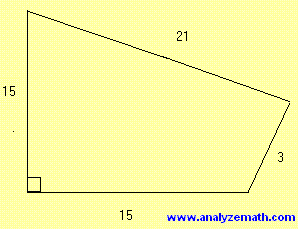
Find the area of the quadrilateral shown in the figure. (NOTE: figure not drawn to scale)
View Solution
Triangle $\triangle ABD$ is a right triangle; hence by the Pythagorean theorem:
$$BD^2 = 15^2 + 15^2 = 450$$
For triangle $\triangle BCD$, test if it is a right triangle by checking the sum of squares of its shorter sides:
$$BC^2 + CD^2 = 21^2 + 3^2 = 441 + 9 = 450$$
Since $BC^2 + CD^2 = BD^2$, triangle $\triangle BCD$ is also a right triangle.

The total area of the quadrilateral is the sum of the areas of the two right triangles:
$$\text{Area} = \left(\frac{1}{2} \times 15 \times 15\right) + \left(\frac{1}{2} \times 21 \times 3\right) = 112.5 + 31.5 = 144$$
Problem 4
In the figure below, triangle OAB has an area of $72$ units squared and triangle ODC has an area of $288$ units squared. Find $x$ as the length of segment BC and $y$ as the length of segment AD.

View Solution
Using the sine formula for the area of a triangle, evaluate $\triangle OAB$:
$$\text{Area of } \triangle OAB = 72 = \frac{1}{2} \sin(\angle AOB) \cdot OA \cdot OB$$
Since $OA = 18$ and $OB = 16$, solve for $\sin(\angle AOB)$:
$$\sin(\angle AOB) = \frac{2 \cdot 72}{18 \cdot 16} = \frac{1}{2}$$
Since $\angle DOC$ and $\angle AOB$ are vertical angles, $\sin(\angle DOC) = \sin(\angle AOB) = \frac{1}{2}$.
Now evaluate the area of $\triangle ODC$:
$$\text{Area of } \triangle ODC = 288 = \frac{1}{2} \sin(\angle DOC) \cdot OD \cdot OC$$
$$288 = \frac{1}{2} \left(\frac{1}{2}\right) \cdot (18 + y)(16 + x)$$
$$1152 = (18 + y)(16 + x)$$
The points A, B, C, and D lie on a circle. By the Intersecting Secants Theorem:
$$OA \cdot OD = OB \cdot OC$$
$$18(18 + y) = 16(16 + x)$$
Now we have a system of equations:
1) $(18 + y)(16 + x) = 1152$
2) $18(18 + y) = 16(16 + x) \Rightarrow (18 + y) = \frac{8}{9}(16 + x)$
Substitute equation 2 into equation 1:
$$\left(\frac{8}{9}(16 + x)\right)(16 + x) = 1152$$
$$(16 + x)^2 = 1152 \times \frac{9}{8} = 1296$$
$$16 + x = 36 \Rightarrow x = 20$$
Substitute $x = 20$ back into equation 2:
$$18 + y = \frac{8}{9}(16 + 20) = \frac{8}{9}(36) = 32$$
$$y = 14$$
Problem 5
Find the dimensions of the rectangle that has a length $3$ meters more than its width and a perimeter equal in value to its area.
View Solution
Let $L$ be the length and $W$ be the width of the rectangle. Given: $L = W + 3$
Perimeter: $2L + 2W = 2(W + 3) + 2W = 4W + 6$
Area: $LW = (W + 3)W = W^2 + 3W$
Since the area and perimeter are equal in value:
$$W^2 + 3W = 4W + 6$$
Solve the quadratic equation:
$$W^2 - W - 6 = 0$$
$$(W - 3)(W + 2) = 0$$
The width cannot be negative, so $W = 3$. Substitute to find the length:
$$L = 3 + 3 = 6$$
Answer: Width = $3$ meters, Length = $6$ meters.
Problem 6
Find the circumference of a circular disk whose area is $100 \pi$ square centimeters.
View Solution
Let $r$ be the radius of the disk. The area is $100\pi$; hence,
$$100\pi = \pi r^2$$
Solve for $r$:
$$r = 10$$
The circumference is:
$$C = 2\pi r = 20\pi \text{ cm}$$
Problem 7
A semicircle of area $1250 \pi$ square centimeters is inscribed inside a rectangle. The diameter of the semicircle coincides with the length of the rectangle. Find the area of the rectangle.
View Solution
Let $r$ be the radius of the semicircle. The area is:
$$1250\pi = \frac{1}{2} \pi r^2$$
Solving for $r$:
$$2500 = r^2 \Rightarrow r = 50$$
The length of the rectangle is $2r = 100$ (since the semicircle is inscribed).
The width of the rectangle is $r = 50$ (since the semicircle is inscribed).
The area of the rectangle is:
$$\text{Area} = 100 \times 50 = 5000 \text{ cm}^2$$