Division by Zero
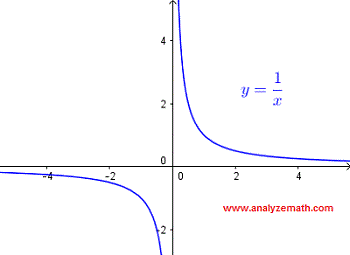
The function $y = \frac{1}{x}$ is only defined when $x \neq 0$. In interval notation, the domain is $(-\infty, 0) \cup (0, \infty)$. As seen in the graph below, the function is undefined at the vertical line $x = 0$.
Step-by-Step Questions, Solutions, and Graphical Interpretations
A rational function is defined as the ratio of two polynomials. The domain consists of all real numbers except those that make the denominator equal to zero.
The function $y = \frac{1}{x}$ is only defined when $x \neq 0$. In interval notation, the domain is $(-\infty, 0) \cup (0, \infty)$. As seen in the graph below, the function is undefined at the vertical line $x = 0$.
Find the domain of the function: \[ f(x) = \dfrac{1}{x - 2} \]
The function is undefined where the denominator is zero:
\[ x - 2 = 0 \quad \Rightarrow \quad x = 2 \]Domain: All real numbers except $x = 2$.
\[ (-\infty, 2) \cup (2, \infty) \]
Find the domain of the function: \[ f(x) = \dfrac{x + 3}{(x - 1)(x + 2)} \]
The denominator is zero if either factor is zero:
\[ (x - 1) = 0 \quad \text{or} \quad (x + 2) = 0 \] \[ x = 1, \quad x = -2 \]Domain: $(-\infty, -2) \cup (-2, 1) \cup (1, \infty)$.

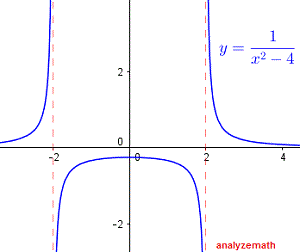
Find the domain of the function: \[ f(x) = \dfrac{1}{x^2 - 4} \]
Set the denominator to zero and factor:
\[ x^2 - 4 = 0 \quad \Rightarrow \quad (x - 2)(x + 2) = 0 \] \[ x = 2, \quad x = -2 \]Domain: $(-\infty, -2) \cup (-2, 2) \cup (2, \infty)$.
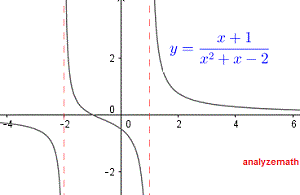
Find the domain of: \[ f(x) = \dfrac{x + 1}{x^2 + x - 2} \]
Factor the trinomial denominator:
\[ x^2 + x - 2 = (x + 2)(x - 1) \]The denominator is zero at $x = -2$ and $x = 1$.
Domain: $(-\infty, -2) \cup (-2, 1) \cup (1, \infty)$.
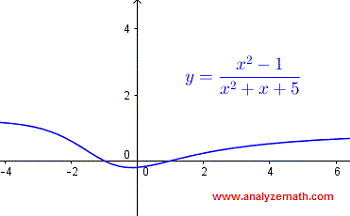
Find the domain of: \[ f(x) = \dfrac{x^2 - 1}{x^2 + x + 5} \]
Check if $x^2 + x + 5 = 0$ has real roots using the discriminant ($\Delta$):
\[ \Delta = b^2 - 4ac = (1)^2 - 4(1)(5) = -19 \]Since $\Delta < 0$, there are no real values that make the denominator zero.
Domain: All real numbers, $(-\infty, \infty)$.