Find The Inverse of a Relation from its Graph

Step-by-Step Examples, Mirror Reflections, and Solved Questions

An inverse of a relation is found by interchanging the coordinates of every ordered pair in the original set. Geometrically, this results in a graph that is perfectly symmetrical to the original across the line $y = x$.

The Reflection Principle

If a point $(a, b)$ exists on the graph of a relation, the point $(b, a)$ must exist on the graph of its inverse. This coordinate swap is equivalent to a geometric reflection across the diagonal line $y = x$.

Worked Examples

Example 1: Linear Segment Reflection

Sketch the graph of the inverse for the relation shown below:
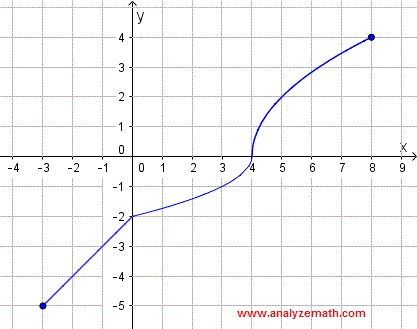
Original relation for Example 1
View Solution

Step 1: Identify key points on the blue (original) graph:
$(8, 4), (5, 2), (4, 0), (3, -1), (0, -2), (-2, -4), (-3, -5)$

Step 2: Interchange the $x$ and $y$ coordinates to find the inverse (red) points:
$(4, 8), (2, 5), (0, 4), (-1, 3), (-2, 0), (-4, -2), (-5, -3)$

Plotted reflection points for Example 1

Step 3: Connect the reflected points to complete the inverse graph.

Final inverse graph for Example 1

Example 2: Curved Relation Reflection

Sketch the graph of the inverse for the following curved relation:

Original curved relation for Example 2
View Solution

Step 1: Identify key points on the original curve:
$(6, 3), (2, -5), (0, -1), (-2, -5), (-3, -3)$

Step 2: Switch the coordinates for the inverse points:
$(3, 6), (-5, 2), (-1, 0), (-5, -2), (-3, -3)$

Plotted reflection points for Example 2

Step 3: Connect the points to form the inverse curve, which reflects the original across $y = x$.

Final inverse graph for Example 2

Practice Questions

Question A

Practice Question A
View Solution

Coordinates: $(4, 2), (2, 2), (1, -1), (0, -2), (-1, -1), (-2, -4)$

Inverse Points: $(2, 4), (2, 2), (-1, 1), (-2, 0), (-1, -1), (-4, -2)$

Solution for Practice A

Question B

Practice Question B
View Solution

Coordinates: $(5, 6), (4, 1), (2, -1), (0, -3), (-1, -8)$

Inverse Points: $(6, 5), (1, 4), (-1, 2), (-3, 0), (-8, -1)$

Solution for Practice B

Continue Your Learning