Questions: Solve Logarithmic Equations
Question 1: Solve $\log(2x - 3) = \log(3 - x) - 2$
Step 1: Determine the domain.
The arguments of the logarithms must be positive:
$2x - 3 > 0 \Rightarrow x > 1.5$
$3 - x > 0 \Rightarrow x < 3$
Therefore, the domain for this equation is $1.5 < x < 3$.
Step 2: Rewrite the equation with the log terms on one side:
$$ \log(2x - 3) - \log(3 - x) = -2 $$
Step 3: Rewrite substituting $-2$ by $\log 10^{-2}$:
$$ \log(2x - 3) - \log(3 - x) = \log 10^{-2} $$
Step 4: Use the quotient rule $\log A - \log B = \log\left(\dfrac{A}{B}\right)$:
$$ \log\left( \dfrac{2x - 3}{3 - x}\right) = \log 10^{-2} $$
Step 5: Function $\log(x)$ is one-to-one, so we deduce:
$$ \dfrac{2x - 3}{3 - x} = 10^{-2} = \dfrac{1}{100} $$
Step 6: Solve for $x$:
$$ 100(2x - 3) = 3 - x $$
$$ 200x - 300 = 3 - x $$
$$ 201x = 303 \Rightarrow x = \dfrac{303}{201} = \dfrac{101}{67} $$
Step 7: Verify against the domain.
$\dfrac{101}{67} \approx 1.507$. Since $1.507$ is between $1.5$ and $3$, the solution is valid.
Final Answer: $x = \dfrac{101}{67}$

Question 2: Solve $\log x - \log(x^2 - 1) = -2 \log(x - 1)$
Step 1: Determine the domain.
$x > 0$
$x^2 - 1 > 0 \Rightarrow x > 1$ or $x < -1$
$x - 1 > 0 \Rightarrow x > 1$
The intersection of these conditions is $x > 1$. The domain is $(1, \infty)$.
Step 2: Use log rules to rewrite both sides (quotient rule on the left, power rule on the right):
$$ \log \left( \dfrac{x}{x^2 - 1}\right) = \log \left((x - 1)^{-2}\right) $$
Step 3: Drop the logs (one-to-one property):
$$ \dfrac{x}{(x - 1)(x + 1)} = \dfrac{1}{(x - 1)^2} $$
Step 4: Since $x > 1$, $x - 1 \neq 0$. Multiply both sides by $(x - 1)^2(x + 1)$ to clear denominators:
$$ x(x - 1) = x + 1 $$
Step 5: Solve the quadratic equation:
$$ x^2 - x = x + 1 \Rightarrow x^2 - 2x - 1 = 0 $$
Solutions: $x_1 = 1 + \sqrt{2} \approx 2.41$ and $x_2 = 1 - \sqrt{2} \approx -0.41$
Step 6: Verify against the domain.
$x_2 = 1 - \sqrt{2}$ is not greater than $1$, so it is rejected (extraneous).
Final Answer: $x = 1 + \sqrt{2}$

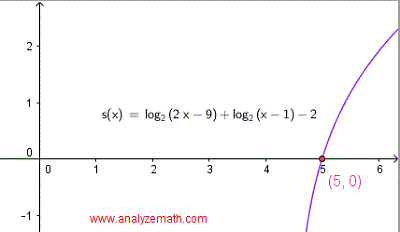
Question 3: Solve $\log_2(2x - 9) = 2 - \log_2(x - 1)$
Step 1: Determine the domain.
$2x - 9 > 0 \Rightarrow x > 4.5$
$x - 1 > 0 \Rightarrow x > 1$
The intersection is $x > 4.5$. The domain is $(4.5, \infty)$.
Step 2: Bring logs to one side and substitute $2$ with $\log_2 4$:
$$ \log_2(2x - 9) + \log_2(x - 1) = \log_2 4 $$
Step 3: Apply the product rule:
$$ \log_2\left( (2x - 9)(x - 1) \right) = \log_2 4 $$
Step 4: Equate arguments and expand:
$$ (2x - 9)(x - 1) = 4 $$
$$ 2x^2 - 11x + 9 = 4 \Rightarrow 2x^2 - 11x + 5 = 0 $$
Step 5: Solve the quadratic by factoring:
$$ (2x - 1)(x - 5) = 0 $$
Solutions: $x = \dfrac{1}{2}$ and $x = 5$.
Step 6: Verify against the domain.
$x = \dfrac{1}{2}$ is less than $4.5$, so it is extraneous. Only $x = 5$ falls in the domain.
Final Answer: $x = 5$
Question 4: Solve $2 \ln(x + 3) - \ln(x + 1) = 3 \ln 2$
Step 1: Determine the domain.
$x + 3 > 0 \Rightarrow x > -3$
$x + 1 > 0 \Rightarrow x > -1$
The intersection is $x > -1$. The domain is $(-1, \infty)$.
Step 2: Use the power rule on both sides:
$$ \ln(x + 3)^2 - \ln(x + 1) = \ln(2^3) $$
Step 3: Use the quotient rule:
$$ \ln \left( \dfrac{(x + 3)^2}{x + 1} \right) = \ln 8 $$
Step 4: Drop the natural logs and solve:
$$ \dfrac{(x + 3)^2}{x + 1} = 8 \Rightarrow (x + 3)^2 = 8(x + 1) $$
$$ x^2 + 6x + 9 = 8x + 8 \Rightarrow x^2 - 2x + 1 = 0 $$
Step 5: Factor the quadratic:
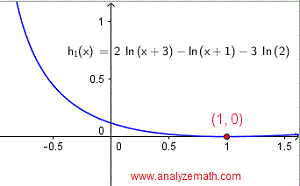
$$ (x - 1)^2 = 0 \Rightarrow x = 1 $$
Step 6: Verify against the domain.
$x = 1$ is greater than $-1$, so the solution is valid.
Final Answer: $x = 1$
Question 5: Solve $\left( \log_2(x) \right)^2 - \log_2(x^2) = 8$
Step 1: Determine the domain.
From $\log_2(x)$, $x > 0$.
From $\log_2(x^2)$, $x^2 > 0 \Rightarrow x \neq 0$.
The intersection is $x > 0$. The domain is $(0, \infty)$.
Step 2: Use the power rule to simplify the second term:
$$ (\log_2(x))^2 - 2 \log_2(x) = 8 $$
Step 3: Use substitution. Let $u = \log_2(x)$:
$$ u^2 - 2u - 8 = 0 $$
Step 4: Solve for $u$ by factoring:
$$ (u - 4)(u + 2) = 0 \Rightarrow u = 4 \text{ or } u = -2 $$
Step 5: Substitute back to solve for $x$:
$$ \log_2(x) = 4 \Rightarrow x = 2^4 = 16 $$
$$ \log_2(x) = -2 \Rightarrow x = 2^{-2} = \dfrac{1}{4} $$
Step 6: Verify against the domain.
Both $16$ and $\dfrac{1}{4}$ are strictly greater than $0$.
Final Answer: $x = 16$ and $x = \dfrac{1}{4}$

Question 6: Solve $10 \log(\log(x)) = 1$
Step 1: Determine the domain.
For the inner log: $x > 0$.
For the outer log: $\log(x) > 0 \Rightarrow x > 1$.
The intersection is $x > 1$. The domain is $(1, \infty)$.
Step 2: Divide both sides by $10$:
$$ \log(\log(x)) = 0.1 $$
Step 3: Convert the outer logarithm to exponential form (base 10):
$$ \log(x) = 10^{0.1} $$
Step 4: Convert the inner logarithm to exponential form:
$$ x = 10^{\left(10^{0.1}\right)} \approx 10^{1.2589} \approx 18.15 $$
Step 5: Verify against the domain.
$18.15 > 1$, so the solution is valid.
Final Answer: $x = 10^{\left(10^{0.1}\right)}$

Challenge Questions for Extra Practice
Test your skills with these advanced logarithmic and exponential problems (remember to check your domains!):
- Challenge 1: Solve for $x$: $$ \log_3(x) + \log_3(x-2) = 1 $$
- Challenge 2: Solve for $x$ (leave in exact natural log form): $$ 2^x = 5^{x-1} $$
- Challenge 3: Solve for $x$: $$ \log(x^2) = (\log x)^2 $$
Click here to reveal the final answers
- Answer 1: $x = 3$. (The domain is $x > 2$, so the algebraic solution $x = -1$ is rejected).
- Answer 2: $x = \dfrac{\ln 5}{\ln 5 - \ln 2}$
- Answer 3: $x = 1$ and $x = 100$. (The domain is $x > 0$).
Links and References
- Solve Logarithmic Equations
- Logarithmic Functions
- Middle School Math (Grades 6, 7, 8, 9) - Free Questions and Problems With Answers
- High School Math (Grades 10, 11 and 12) - Free Questions and Problems With Answers
- Primary Math (Grades 4 and 5) with Free Questions and Problems With Answers
- Home Page