Questions: Match and Identify Polynomials
Question 1: Eliminate incorrect graphs
Give four different reasons why the graph below cannot possibly be the graph of the polynomial function $$ p(x) = x^4-x^2+1 $$
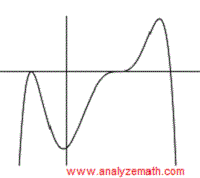
Solution: The four reasons are:
- Symmetry: The given polynomial function $p(x) = x^4-x^2+1$ contains only even powers, making it an even function. Therefore, its graph must be symmetric with respect to the y-axis. The given graph is not symmetric with respect to the y-axis.
- Real Zeros: The polynomial $p(x)$ can be analyzed by substituting $u = x^2$. The discriminant of $u^2 - u + 1$ is $\Delta = (-1)^2 - 4(1)(1) = -3$. Because the discriminant is negative, the polynomial has no real zeros. However, the given graph clearly has x-intercepts.
- Y-Intercept: The y-intercept is calculated by evaluating $p(0) = 0^4 - 0^2 + 1 = 1$, which is positive. The y-intercept of the given graph is clearly negative.
- End Behavior: Having a positive leading coefficient ($a = 1$) and an even degree ($n = 4$), the polynomial must have a graph where both the left and right sides rise ($y \to \infty$). In the given graph, both sides are falling.
Question 2: Match equations to complex graphs
Match the polynomial functions to their graphs where all x-intercepts are shown.
$$ f(x) = (x+1)(x-1)^2(x+2)^2 $$
$$ g(x) = -(x+1)(x-1)^4 $$
$$ h(x) = (x+1)(x-1)^3(x-3) $$
$$ i(x) = (x+1)^2(x-2)^3 $$
$$ j(x) = (x+1)^2(1-x)(x-2)^2 $$
$$ k(x) = -(x+1)^2(x-1)^2(x-3) $$

Solution:
According to their equations, all 6 given polynomial functions are of degree 5 (sum of the exponents of the factors). However, their leading coefficients are of different signs. We classify the polynomials into two groups:
Group I: Positive Leading Coefficients
Polynomials $f$, $h$, and $i$ have positive leading coefficients.
$$ f(x) = (x + 1)(x - 1)^2(x + 2)^2 $$
$$ h(x) = (x + 1)(x - 1)^3(x - 3) $$
$$ i(x) = (x + 1)^2(x - 2)^3 $$
Having degree 5 (odd) and positive leading coefficients, these graphs have the following end behavior:
As $x \to \infty$, $y \to \infty$ (right side rises).
As $x \to -\infty$, $y \to -\infty$ (left side falls).
The given graphs in parts a), c), and e) match this end behavior. We match them using their roots and multiplicities:
- Polynomial $f(x)$ has a zero of multiplicity 1 at $x = -1$ (crosses), multiplicity 2 at $x = 1$ (touches), and multiplicity 2 at $x = -2$ (touches). This corresponds to graph e).
- Polynomial $h(x)$ has a zero of multiplicity 1 at $x = -1$ (crosses), multiplicity 3 at $x = 1$ (crosses and flattens), and multiplicity 1 at $x = 3$ (crosses). This corresponds to graph a).
- Polynomial $i(x)$ has a zero of multiplicity 2 at $x = -1$ (touches) and multiplicity 3 at $x = 2$ (crosses and flattens). This corresponds to graph c).
Group II: Negative Leading Coefficients
The polynomials $g$, $j$, and $k$, when expanded, have negative leading coefficients (Note: for $j(x)$, the term $(1-x)$ creates the negative coefficient).
$$ g(x) = - (x + 1)(x - 1)^4 $$
$$ j(x) = (x + 1)^2(1 - x)(x - 2)^2 $$
$$ k(x) = - (x + 1)^2(x - 1)^2(x - 3) $$
Having degree 5 (odd) and negative leading coefficients, these graphs have the following end behavior:
As $x \to \infty$, $y \to -\infty$ (right side falls).
As $x \to -\infty$, $y \to \infty$ (left side rises).
The given graphs in parts b), d), and f) match this behavior. We match them using their roots:
- Polynomial $g(x)$ has a zero of multiplicity 1 at $x = -1$ (crosses), multiplicity 4 at $x = 1$ (touches). This corresponds to graph f).
- Polynomial $j(x)$ has a zero of multiplicity 2 at $x = -1$ (touches), multiplicity 1 at $x = 1$ (crosses), and multiplicity 2 at $x = 2$ (touches). This corresponds to graph d).
- Polynomial $k(x)$ has a zero of multiplicity 2 at $x = -1$ (touches), multiplicity 2 at $x = 1$ (touches), and multiplicity 1 at $x = 3$ (crosses). This corresponds to graph b).
Challenge Questions for Extra Practice
Test your understanding of end behavior, multiplicities, and polynomial graphing:
- Challenge 1: A polynomial of degree 4 has a double root at $x=2$, a single root at $x=-1$, and a single root at $x=4$. Its y-intercept is at $(0, 16)$. Write the equation of the polynomial in factored form.
- Challenge 2: Determine the end behavior of the polynomial $P(x) = -3x^2(x-4)^3(2x+1)^2$. (Hint: What is the degree and leading coefficient?)
- Challenge 3: True or False: If a polynomial graph crosses the x-axis at $x=c$ without flattening out, the factor $(x-c)$ must have a multiplicity of exactly 1.
Click here to reveal the final answers
- Answer 1: $P(x) = -1(x-2)^2(x+1)(x-4)$. (The coefficient $a=-1$ is found by setting $P(0) = a(-2)^2(1)(-4) = -16a = 16$).
- Answer 2: The degree is $2 + 3 + 2 = 7$ (odd). The leading coefficient is negative ($-3 \times 1^3 \times 2^2 = -12$). Therefore, as $x \to -\infty$, $y \to \infty$; and as $x \to \infty$, $y \to -\infty$.
- Answer 3: True. A multiplicity of 3 or higher (odd) will cross the axis but will noticeably flatten (point of inflection) at the root.