Sine functions are powerful mathematical tools used to model periodic phenomena that repeat over time. This webpage explores how sine functions help solve real-world problems involving motion, cycles, and oscillations. Whether it's analyzing the movement of an oscillating mass, predicting the number of daylight hours throughout the year, estimating monthly average temperatures, modeling the rotation of a Ferris wheel, understanding high and low tides, or optimizing solar panel performance, sine functions provide accurate and practical solutions. Dive into each example to see how math meets the real world through sinusoidal models.
Problems with Solutions
Problem 1
A mass attached to a spring is pulled toward the floor so that its height above the floor is 10 mm (millimeters). The mass is then released and starts moving up and down reaching maximum and minimum heights of 20 and 10 mm, respectively, with a cycle of 0.8 seconds.
- Assume that the height $h(t)$ of the mass is a sinusoidal function, where $t$ is the time in seconds. Sketch a graph of $h$ from $t = 0$ to $t = 0.8$ seconds. $t = 0$ is the time at which the mass is released.
- Find a sinusoidal function for the height $h(t)$.
- For how many seconds is the height of the mass above 17 mm over one cycle?
Solution
-
The mass is released at $t = 0$ when $h$ is minimum. Half a cycle later $h$ reaches its maximum and another half a cycle it reaches its minimum again. Hence over one cycle, $h$ varies with $t$ as follows:

-
According to the graph obtained in part a), $h(t)$ could be modeled by a cosine function shifted (translated) vertically up and horizontally to the right. Hence
$$ h(t) = a \cos[ b(t - d) ] + c $$
Let $h_{\text{max}}$ be the maximum value of $h$ and $h_{\text{min}}$ be the minimum value of $h$. Hence
$$ |a| = \dfrac{h_{\text{max}} - h_{\text{min}}}{2} = \dfrac{20 - 10}{2} = 5 , \quad a = \pm 5 $$
$$ c = \dfrac{h_{\text{max}} + h_{\text{min}}}{2} = \dfrac{20 + 10}{2} = 15 $$
$$ \text{Period} = \dfrac{2\pi}{|b|} = 0.8 \Rightarrow b = \pm 2.5\pi $$
We use $a = 5$ and $b = 2.5\pi$. The shift of the cosine function is to the right and equal to half a period. Hence $d = 0.4$
$$ h(t) = 5 \cos[ 2.5\pi(t - 0.4) ] + 15 $$
Check that $h$ has a minimum at $t = 0$:
$$ h(0) = 5 \cos[ 2.5\pi(0 - 0.4) ] + 15 = 5 \cos( -\pi ) + 15 = 10 $$
Check that $h$ has a maximum at $t = 0.4$:
$$ h(0.4) = 5 \cos[ 2.5\pi(0.4 - 0.4) ] + 15 = 5 \cos( 0 ) + 15 = 20 $$
-
Below is shown the graph of $y = h(t)$ and $y = 17$. We first need to find $t_1$ and $t_2$ which are the values of $t$ for which $h(t) = 17$ by solving the equation

$$ 5 \cos[ 2.5\pi(t - 0.4) ] + 15 = 17 $$
$$ \cos[ 2.5\pi(t - 0.4) ] = \dfrac{17 - 15}{5} = 0.4 $$
$$ 2.5\pi(t - 0.4) = \arccos(0.4) $$
$$ t = \dfrac{\arccos(0.4)}{2.5\pi} + 0.4 = 0.547 \text{ seconds} $$
The solution $t$ found above is larger than $0.4$, which is the position of the maximum, and smaller than $0.8$ and it therefore corresponds to $t_2$. Hence
$$ t_2 = \dfrac{\arccos(0.4)}{2.5\pi} + 0.4 = 0.547 \text{ seconds} $$
$t_1$ is obtained using the symmetry of the two solutions with respect to the position of the maximum at $t = 0.4$. Hence
$$ t_1 = 0.4 - (0.547 - 0.4) = 0.252 \text{ seconds} $$
The height of the mass is more than 17 meters for
$$ t_2 - t_1 = 0.547 - 0.252 = 0.295 \text{ seconds} $$
Problem 2
The number of hours of daylight $H$ in a certain area is approximately given by the function
$$ H(t) = 2.5 \cos\left[ b(t - d) \right] + 11.5 $$
where $H$ is in hours and $t$ in days, and the function has a period of one year (365 days).
- Find $b$ ($b > 0$) and $d$ if $H$ is maximum on June 21st (month of February has 28 days).
- Which day is the shortest (has the smallest number of hours of daylight)?
Solution
-
Since the period is known and equal to 365 days, we use the formula:
$$ 365 = \dfrac{2\pi}{b} \quad \Rightarrow \quad b = \dfrac{2\pi}{365} $$
If we set $d = 0$ in the function
$$ H(t) = 2.5 \cos[b(t - d)] + 11.5 $$
it becomes
$$ H(t) = 2.5 \cos(bt) + 11.5 $$
which has a maximum at $t = 0$.
In our problem, the maximum happens on June 21st, which corresponds to
$$ t = 31 + 28 + 31 + 30 + 31 + 21 = 172 $$
(days from January 1st to June 21st).
Therefore, the horizontal shift is 172 units to the right, and $d = 172$. Hence,
$$ H(t) = 2.5 \cos\left[\dfrac{2\pi}{365}(t - 172)\right] + 11.5 $$
-
The shortest day corresponds to the value of $t$ that gives the minimum of $H$, which is:
$$ 11.5 - 2.5 = 9 $$
We solve the equation:
$$ 2.5 \cos\left[\dfrac{2\pi}{365}(t - 172)\right] + 11.5 = 9 $$
$$ \cos\left[\dfrac{2\pi}{365}(t - 172)\right] = \dfrac{9 - 11.5}{2.5} = -1 = \cos(\pi) $$
which gives
$$ \dfrac{2\pi}{365}(t - 172) = \pi $$
$$ t = \dfrac{365\pi}{2\pi} + 172 = 354.5 \text{ days} $$
Note: We could also determine this by recognizing that the time from a maximum to the following minimum in a cosine function is half the period. Therefore, the minimum occurs at:
$$ t = 172 + \dfrac{1}{2}(365) = 354.5 \text{ days} $$
To calculate the number of days from January through November:
$$ t = 31 + 28 + 31 + 30 + 31 + 30 + 31 + 31 + 30 + 31 + 30 = 334 $$
Then, the number of days into December is:
$$ 354.5 - 334 = 20.5 $$
which approximately corresponds to December 21st.
Problem 3
The monthly average temperature $T$ (in $^{\circ} \mathrm{C}$) in a certain city may be approximated by
$$ T(t) = a \cos\left[ b(t - d) \right] + c $$
where $t$ is the time in months, $t = 0$ corresponds to January 1st, and we assume that the function $T(t)$ has a period of 12 months.
- Find $a$, $b$ (with $b > 0$), $c$, and $d$ if $T$ has a maximum of $22.4^{\circ} \mathrm{C}$ in the middle of July ($t = 6.5$) and a minimum of $-10^{\circ} \mathrm{C}$.
- In which month is $T$ minimum?
- Over how many months is $T$ greater than $18^{\circ} \mathrm{C}$?
Solution
-
The minimum and maximum values of $T$, denoted $T_{\text{max}}$ and $T_{\text{min}}$ respectively, allow us to find $a$ and $c$ as follows:
We are given:
$$ T_{\text{max}} = 22.4 \quad \text{and} \quad T_{\text{min}} = -10 $$
$$ c = \dfrac{T_{\text{max}} + T_{\text{min}}}{2} = 6.2 $$
$$ |a| = \dfrac{T_{\text{max}} - T_{\text{min}}}{2} = 16.2 \quad \text{(we take } a > 0 \text{)} $$
The graph of $T$ is that of a cosine function $a \cos(bt)$ shifted 6.5 units to the right. Hence,
$$ T(t) = 16.2 \cos[ b(t - 6.5) ] + 6.2 $$
We now use the period to find $b$. The period is 12, and since
$$ \text{Period} = \dfrac{2\pi}{b} = 12 , \quad \text{we get } b = \dfrac{\pi}{6} $$
Thus, the temperature function is
$$ T(t) = 16.2 \cos\left[ \dfrac{\pi}{6}(t - 6.5) \right] + 6.2 $$
-
Find $t$ for which $T$ is minimum. The minimum value of $T$ is -10. We solve:
$$ 16.2 \cos\left[ \dfrac{\pi}{6}(t - 6.5) \right] + 6.2 = -10 $$
$$ \cos\left[ \dfrac{\pi}{6}(t - 6.5) \right] = -1 = \cos(\pi) $$
$$ \dfrac{\pi}{6}(t - 6.5) = \pi $$
$$ t = 12.5 $$
Note: We could have answered this using the fact that the distance between a maximum and the next minimum in a sinusoidal function is half the period. So,
$$ t = 6.5 + \dfrac{1}{2}(12) = 12.5 \text{ days} $$
Since $t = 12.5$ is slightly more than one period (12 months), it corresponds to mid-January, meaning the temperature is minimum around that time.
-
We now find the times $t_1$ and $t_2$ at which $T = 18$ by solving the equation:
$$ 16.2 \cos\left[ \dfrac{\pi}{6}(t - 6.5) \right] + 6.2 = 18 $$
$$ \cos\left[ \dfrac{\pi}{6}(t - 6.5) \right] = \dfrac{18 - 6.2}{16.2} $$
$$ \dfrac{\pi}{6}(t - 6.5) = \arccos\left( \dfrac{18 - 6.2}{16.2} \right) $$
$$ t = \dfrac{6}{\pi} \arccos\left( \dfrac{18 - 6.2}{16.2} \right) + 6.5 = 7.94 \text{ months} $$
From the graph of $T(t)$ and the horizontal line $y = 18$, the solution $t = 7.94$ corresponds to $t_2 = 7.94$. By symmetry,
$$ t_1 = 6.5 - (t_2 - 6.5) = 6.5 - (7.94 - 6.5) = 5.06 \text{ months} $$
The number of months during which $T > 18$ is:
$$ t_2 - t_1 = 7.94 - 5.06 = 2.88 \text{ months (approximately 3 months)} $$
Problem 4
The diameter of a large Ferris wheel is 48 meters and it takes 2.8 minutes for the wheel to complete one revolution. A rider gets onto the wheel at its lowest point which is 60 cm above ground at $t = 0$.
- Find a sinusoidal function $h(t)$ that gives the height $h$, in meters, of the rider above ground as a function of the time $t$ in minutes.
- Find the time intervals for which the rider is at a height less than 30 meters for the period of time from $t = 0$ to $t = 2.8$ minutes.
- How many minutes, from $t = 0$, does it take the rider to reach the highest point for the second time?
Solution
-
The minimum height $h_{\text{min}}$ above the ground is 0.6 meters. The maximum height $h_{\text{max}}$ is equal to the minimum height plus the diameter of the wheel.
$$ h_{\text{max}} = 0.6 + 48 = 48.6 $$
Since $h(t)$ is minimum at $t = 0$, it would be easier to model it by a reflected cosine function. Hence:
$$ h(t) = a \cos[b(t - d)] + c $$
$$ |a| = \dfrac{h_{\text{max}} - h_{\text{min}}}{2} = -\dfrac{48.6 - 0.6}{2} = 24 $$
Two solutions for $a$ are $\pm 24$.
We select $a = -24$ where the minus sign accounts for the reflection on the horizontal axis.
$$ c = \dfrac{h_{\text{max}} + h_{\text{min}}}{2} = \dfrac{48.6 + 0.6}{2} = 24.6 $$
The period is 2.8, and since:
$$ \text{period} = \dfrac{2\pi}{b} \Rightarrow b = \dfrac{2\pi}{2.8} $$
$$ h(t) = -24 \cos\left( \dfrac{2\pi}{2.8} t \right) + 24.6 $$
Check: At $t = 0$,
$$ h(0) = -24 \cos(0) + 24.6 = -24(1) + 24.6 = 0.6 \, \text{m} $$
At $t = 1.4$ (half a period later),
$$ h(1.4) = -24 \cos\left( \dfrac{2\pi}{2.8} \cdot 1.4 \right) + 24.6 = -24 \cos(\pi) + 24.6 = 48.6 \, \text{m} $$
-
We first need to solve the equation:
$$ -24 \cos\left( \dfrac{2\pi}{2.8} t \right) + 24.6 = 30 $$
$$ \cos\left( \dfrac{2\pi}{2.8} t \right) = \dfrac{30 - 24.6}{-24} $$
$$ t = \dfrac{2.8}{2\pi} \arccos\left( \dfrac{30 - 24.6}{-24} \right) = 0.8 \, \text{minutes} $$
The solution corresponds to $t_1$, the first intersection of the graph of $h(t)$ and the line $y = 30$. Hence:
$$ t_1 = 0.8 \, \text{min}, \quad t_2 = 2.8 - 0.8 = 2 \, \text{min} $$
$h(t) \lt 30$ from $t = 0$ to $t = 0.8$ and from $t = 2$ to $t = 2.8$, for a total of 1.6 minutes.
-
The rider reaches the maximum at $t = \dfrac{1}{2} \cdot 2.8$ for the first time and again at:
$$ t = \dfrac{1}{2} \cdot 2.8 + 2.8 = 4.2 \, \text{minutes} $$
to reach the maximum height for the second time.
Problem 5
Because of the gravitational attractions of the moon and the sun on the Earth, water in seas and oceans tend to rise and fall periodically corresponding to what is called high and low tides. In a typical situation, the time between two high tides is close to 12 hours. In a certain coastal area, the depth of water may be approximated by a sinusoidal function of the form
$$ d(t) = -2.5 \cos[ b(t - 2) ] + 3.5 $$
where $d$ is in meters and $t$ is in hours, with $t = 0$ corresponding to 12 am.
- Find $b$ ($b > 0$) if $d$ has a period of 12 hours.
- From $t = 0$ to $t = 12$, at what time is $d$ the smallest (low tide) and at what time is it the highest (high tide)?
- From $t = 0$ to $t = 12$, what are the intervals of time during which the depth of the water is 4.5 meters or more?
Solution
-
Using the period, we have
$$ 12 = \dfrac{2\pi}{b} $$
$$ b = \dfrac{\pi}{6} $$
-
$d(t)$ is now given by
$$ d(t) = -2.5 \cos\left( \dfrac{\pi}{6}(t - 2) \right) + 3.5 $$
The smallest value of $d$ is
$$ -2.5 + 3.5 = 1 $$
Hence $d$ is smallest for $t$ such that
$$ -2.5 \cos\left( \dfrac{\pi}{6}(t - 2) \right) + 3.5 = 1 $$
Solve to get:
$$ \cos\left( \dfrac{\pi}{6}(t - 2) \right) = 1 $$
$$ \dfrac{\pi}{6}(t - 2) = 0 $$
$$ t = 2 \quad \text{(corresponding to 2 am)} $$
The highest value of $d$ is
$$ 2.5 + 3.5 = 6 $$
Hence $d$ is largest for $t$ such that
$$ -2.5 \cos\left( \dfrac{\pi}{6}(t - 2) \right) + 3.5 = 6 $$
Solve to get:
$$ \cos\left( \dfrac{\pi}{6}(t - 2) \right) = -1 $$
$$ \dfrac{\pi}{6}(t - 2) = \pi $$
$$ t = 8 \quad \text{(corresponding to 10 am)} $$
NOTE: We could have answered part b) using the fact that the distance between a minimum and the following maximum in a sinusoidal function is half a period. Therefore,
$$ d \text{ is maximum at } t = 2 + \dfrac{1}{2} \cdot 12 = 8 $$
-
We first need to find $t$ for which $h(t) = 4.5$ by solving the equation
$$ -2.5 \cos\left( \dfrac{\pi}{6}(t - 2) \right) + 3.5 = 4.5 $$

which may be written as:
$$ \cos\left( \dfrac{\pi}{6}(t - 2) \right) = \dfrac{1}{-2.5} $$
Solve for $t$:
$$ t_1 = \dfrac{6}{\pi}\cdot \arccos\left( -\dfrac{1}{2.5} \right) + 2 = 5.8 \text{ hours} $$
$$ t_2 = 8 + (8 - 5.8) = 10.2 \text{ hours (using symmetry with respect to position of maximum)} $$
Total number of hours for which $d(t) > 4.5 \, \text{m}$ is:
$$ 10.2 - 5.8 = 4.4 \text{ hours} $$
Problem 6
Due to the high and low tides, the depth $d$ of water in a certain coastal area may be expressed by a sinusoidal function. The highest tide occurs at 8 am and the lowest tide occurs 6 hours later. The maximum level of water is 2.8 meters and the lowest level of water is 0.4 meters.
- Use sinusoidal functions to find the depth $d(t)$ of the water, in meters, as a function of time $t$ in hours. (Assume that 8 am corresponds to $t = 0$).
- Find the depth of water at noon.
- Use the graph of $d(t)$ and analytical calculations to calculate the interval of time during which the depth $d$ is below $1.5 \, \text{m}$ from 12 pm to 6 pm.
Solution
-
Let $d(t)$ be written as
$$ d(t) = a \cos[b(t - d)] + c $$
The minimum $d_{\min}$ and the maximum $d_{\max}$ of $d$ are
$$ d_{\min} = 0.4 $$
$$ d_{\max} = 2.8 $$
$$ c = \dfrac{d_{\max} + d_{\min}}{2} = \dfrac{2.8 + 0.4}{2} = 1.6 $$
$$ |a| = \dfrac{d_{\max} - d_{\min}}{2} = \dfrac{2.8 - 0.4}{2} = 1.2 $$
Since $d(t)$ has a minimum at $t = 0$ (8 am), we can select $a = -1.2$ and $d = 0$
$$ d(t) = -1.2 \cos(bt) + 1.6 $$
where it is easy to check that $d = -1.2 + 1.6 = 0.4$ at $t = 0$.
We now use the period to find $b$ ($b > 0$) as follows
$$ \text{period} = 12 = \dfrac{2\pi}{b} $$
$$ \Rightarrow b = \dfrac{\pi}{6} $$
$d(t)$ is now written as
$$ d(t) = -1.2 \cos\left( \dfrac{\pi}{6}t \right) + 1.6 $$
where it is easy to check that the maximum occurs at $t = 6$.
-
At noon $t = 4$, hence
$$ d(4) = -1.2 \cos\left( \dfrac{\pi}{6} \cdot 4 \right) + 1.6 = 2.2 \, \text{m} $$
-
The graph of $d(t)$ is shown below with vertical lines corresponding to 12 pm to 6 pm and a horizontal line corresponding to $d = 1.5$. The depth of the water is less than 1.5 from $t_0$ to 6 pm ($t = 10$). We need to find $t_0$, which is a point of intersection of $d(t)$ and $y = 1.5$, by solving the equation
$$ -1.2 \cos\left( \dfrac{\pi}{6}t \right) + 1.6 = 1.5 $$
$$ t = \dfrac{6 \cdot \arccos\left( \dfrac{1.5 - 1.6}{-1.2} \right)}{\pi} \approx 2.84 $$
The solution found corresponds to the left point of intersection of $d(t)$ and $y = 1.5$. The right point $t_0$ may be found using the symmetry of the graph with respect to the maximum point. Hence
$$ t_0 = 6 + (6 - 2.84) = 9.16 \, \text{hours} $$
$0.16$ hours corresponds to
$$ 0.16 \times 60 \, \text{minutes} \approx 10 \text{ minutes} $$
$9.16$ hours corresponds to
$$ \approx 5:10 \, \text{pm} $$
From 12 pm to 6 pm, the depth of water is below 1.5 from 5:10 pm to 6 pm.
Problem 7
A system of solar panels produces a daily average power $P$ that changes during the year. It is maximum on the 21st of June (day with the highest number of daylight hours) and equal to $20 \ \text{kWh/day}$. We assume that $P$ varies with the time $t$ according to the sinusoidal function:
$$ P(t) = a \cos[b(t - d)] + c $$
where $t = 0$ corresponds to the first of January, $P$ is the power in kWh/day, and $P(t)$ has a period of 365 days (28 days in February). The minimum value of $P$ is $4 \ \text{kWh/day}$.
- Find the parameters $a$, $b$, $c$, and $d$.
- Sketch $P(t)$ over one period from $t = 0$ to $t = 365$.
- When is the power produced by the solar system minimum?
- The power produced by this solar system is sufficient to power a group of machines if the power produced by the system is greater than or equal to $16 \ \text{kWh/day}$. For how many days, in a year, is the power produced by the system sufficient?
Solution
-
Let $P(t)$ be written as
$$ P(t) = a \cos[b(t - d)] + c $$
The minimum $P_{\text{min}}$ and the maximum $P_{\text{max}}$ of $P(t)$ are given:
$$ P_{\text{min}} = 4 $$
$$ P_{\text{max}} = 20 $$
$$ c = \dfrac{P_{\text{max}} + P_{\text{min}}}{2} = \dfrac{20 + 4}{2} = 12 $$
$$ |a| = \dfrac{P_{\text{max}} - P_{\text{min}}}{2} = \dfrac{20 - 4}{2} = 8 $$
We now need to find the number of days $t$ after January 1st at which $P(t)$ is maximum by counting the days of the months from January to May and adding 21 days in June:
$$ t = 31 + 28 + 31 + 30 + 31 + 21 = 172 $$
We now use the period to find $b$ (with $b > 0$) as follows:
$$ \text{period} = 365 = \dfrac{2\pi}{b} $$
$$ \Rightarrow b = \dfrac{2\pi}{365} $$
A cosine function without shift has a maximum at $t = 0$. $P(t)$ has a maximum at $t = 172$. We can model $P(t)$ by a cosine function shifted 172 units to the right:
$$ P(t) = 8 \cos\left(\dfrac{2\pi}{365}(t - 172)\right) + 12 $$
Check that $P(t)$ is maximum at $t = 172$:
$$ P(172) = 8 \cos\left(\dfrac{2\pi}{365}(172 - 172)\right) + 12 = 8 \cos(0) + 12 = 20 $$
-
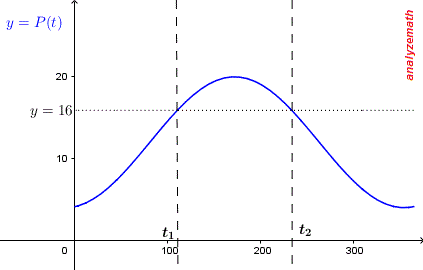
The graph of $P(t)$ is shown below.
-
There is a difference of half a period between the maximum at $t = 172$ and the minimum after that maximum. Hence $P(t)$ is minimum at
$$ t = 172 + 0.5(365) = 354.5 $$
The first 11 months have 334 days. Hence, 354.5 corresponds to December 21st, the day on which $P(t)$ is minimum.
-
To find the number of days for which the power produced is sufficient, we need to find $t_1$ and $t_2$ corresponding to the points of intersection of $P(t)$ and $y = 16$, as shown in the graph, by solving the equation:
$$ P(t) = 16 $$
$$ 8 \cos\left(\dfrac{2\pi}{365}(t - 172)\right) + 12 = 16 $$
$$ \cos\left(\dfrac{2\pi}{365}(t - 172)\right) = \dfrac{1}{2} $$
$$ t = 172 + \dfrac{365}{2\pi} \arccos\left(\dfrac{1}{2}\right) = 232.8 $$
The solution found above is greater than 172, corresponding to the maximum. Hence, the solution above corresponds to $t_2$ in the graph (right-side solution). The solution on the left is found by symmetry:
$$ t_1 = 172 - (232.8 - 172) = 111.2 $$
$$ t_2 - t_1 = 232.8 - 111.2 = 121.6 \text{ days} $$
The system produces enough power for about 121 days.