Learn how to solve complex equations that can be transformed into quadratic equations using substitution methods. This page provides Grade 12 math problems with step-by-step solutions and graphical interpretations to help students master quadratic equation solving techniques.
Step-by-Step Practice Problems
Question 1: Bi-Quadratic Equations
Solve the equation:
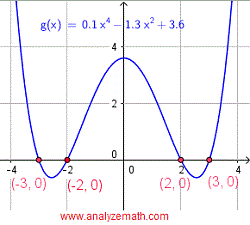
$$ 0.1x^4 - 1.3x^2 + 3.6 = 0 $$
Solution:
Let $u = x^2$ which gives $u^2 = x^4$, and rewrite the given equation in terms of $u$:
$$ 0.1u^2 - 1.3u + 3.6 = 0 $$
Solve the above quadratic equation to find $u$.
$$ u = 4 \quad \text{and} \quad u = 9 $$
We now use the substitution $u = x^2$ to solve for $x$.
$$ x^2 = 4 \implies x = \pm 2 $$
$$ x^2 = 9 \implies x = \pm 3 $$
The four x-intercepts of the graph of $y = 0.1x^4 - 1.3x^2 + 3.6$ are the graphical solutions to the equation as shown below.
Question 2: Equations with Radicals
Solve the equation:
$$ \sqrt{x} = 3 - \dfrac{1}{4}x $$
Solution:
Let $u = \sqrt{x}$ which gives $u^2 = x$, and rewrite the equation in terms of $u$:
$$ u = 3 - \dfrac{u^2}{4} $$
Multiply all terms by 4, simplify, write the quadratic in standard form and solve:
$$ 4u = 12 - u^2 $$
$$ u^2 + 4u - 12 = 0 $$
$$ (u + 6)(u - 2) = 0 $$
$$ u = -6 \quad \text{and} \quad u = 2 $$
Use the substitution $u = \sqrt{x}$ to solve for $x$.
$$ \sqrt{x} = -6 \implies \text{no real solution} $$
$$ \sqrt{x} = 2 \implies x = 4 $$
The x-intercept of the graph is the graphical solution to the equation as shown below.

Question 3: Rational Substitutions
Solve the equation:
$$ \left(3 - \dfrac{4}{x}\right)^2 - 6\left(3 - \dfrac{4}{x}\right) = 16 $$
Solution:
Let $y = 3 - \dfrac{4}{x}$ which gives $y^2 = \left(3 - \dfrac{4}{x}\right)^2$, and rewrite the equation in terms of $y$:
$$ y^2 - 6y = 16 $$
Simplify and solve:
$$ y^2 - 6y - 16 = 0 $$
$$ (y - 8)(y + 2) = 0 $$
$$ y = -2 \quad \text{and} \quad y = 8 $$
Solve for $x$.
For $y = -2$, we substitute back into the equation for $x$:
$$ 3 - \dfrac{4}{x} = -2 \implies \dfrac{4}{x} = 5 \implies x = \dfrac{4}{5} $$
For $y = 8$, we substitute back into the equation for $x$:
$$ 3 - \dfrac{4}{x} = 8 \implies \dfrac{4}{x} = -5 \implies x = -\dfrac{4}{5} $$
The x-intercepts of the graph are the graphical solutions to the equation as shown below.

Question 4: Fractional Exponents
Solve the equation:
$$ 2(x - 1)^{2/3} + 3(x - 1)^{1/3} - 2 = 0 $$
Solution:
Let $y = (x - 1)^{1/3}$ which gives $y^2 = (x - 1)^{2/3}$, and rewrite the equation in terms of $y$:
$$ 2y^2 + 3y - 2 = 0 $$
$$ (2y - 1)(y + 2) = 0 $$
$$ y = -2 \quad \text{and} \quad y = \dfrac{1}{2} $$
Solve for $x$.
$$ (x - 1)^{1/3} = -2 \implies x - 1 = (-2)^3 \implies x - 1 = -8 \implies x = -7 $$
$$ (x - 1)^{1/3} = \dfrac{1}{2} \implies x - 1 = \left(\dfrac{1}{2}\right)^3 \implies x - 1 = \dfrac{1}{8} \implies x = \dfrac{9}{8} $$
The x-intercepts of the graph are the graphical solutions to the equation as shown below.

Question 5: Rational Expressions in Quadratic Form
Find all real solutions for the equation:
$$ 2\left(\dfrac{2}{x - 3}\right)^2 - \dfrac{2}{x - 3} - 3 = 0 $$
Solution:
Let $u = \dfrac{2}{x - 3}$ which gives $u^2 = \left(\dfrac{2}{x - 3}\right)^2$, and rewrite the equation in terms of $u$:
$$ 2u^2 - u - 3 = 0 $$
$$ (2u - 3)(u + 1) = 0 $$
$$ u = -1 \quad \text{and} \quad u = \dfrac{3}{2} $$
Solve for $x$.
$$ \dfrac{2}{x - 3} = -1 \implies x - 3 = -2 \implies x = 1 $$
$$ \dfrac{2}{x - 3} = \dfrac{3}{2} \implies 3(x - 3) = 4 \implies 3x - 9 = 4 \implies 3x = 13 \implies x = \dfrac{13}{3} $$
The x-intercepts of the graph are the graphical solutions to the equation as shown below.

Challenge Problems
Test your understanding of quadratic substitutions with these advanced scenarios.
Challenge 1: Negative Exponents
Solve the equation for all real values of $x$:
$$ x^{-2} - 3x^{-1} - 4 = 0 $$
Solution:
This equation is in quadratic form if we let $u = x^{-1}$ (which means $u = \dfrac{1}{x}$). Notice that $u^2 = (x^{-1})^2 = x^{-2}$.
Rewrite the equation in terms of $u$:
$$ u^2 - 3u - 4 = 0 $$
Factor the quadratic:
$$ (u - 4)(u + 1) = 0 $$
This gives us two solutions for $u$:
$$ u = 4 \quad \text{and} \quad u = -1 $$
Now, substitute $x^{-1}$ back in for $u$ to solve for $x$:
For $u = 4$:
$$ \dfrac{1}{x} = 4 \implies x = \dfrac{1}{4} $$
For $u = -1$:
$$ \dfrac{1}{x} = -1 \implies x = -1 $$
Both solutions are valid since $x \neq 0$.
Final Answers: $x = \dfrac{1}{4}, \ x = -1$
Challenge 2: Exponential Quadratic Form
Find the exact real solutions for the exponential equation:
$$ e^{2x} - 5e^x + 6 = 0 $$
Solution:
Using the properties of exponents, recognize that $e^{2x} = (e^x)^2$. This means the equation is quadratic in form.
Let $u = e^x$. The equation becomes:
$$ u^2 - 5u + 6 = 0 $$
Factor the quadratic equation:
$$ (u - 2)(u - 3) = 0 $$
This yields the roots:
$$ u = 2 \quad \text{and} \quad u = 3 $$
Now substitute back $u = e^x$:
For $u = 2$:
$$ e^x = 2 \implies \ln(e^x) = \ln(2) \implies x = \ln(2) $$
For $u = 3$:
$$ e^x = 3 \implies \ln(e^x) = \ln(3) \implies x = \ln(3) $$
Since the exponential function $e^x$ is always positive, both $u=2$ and $u=3$ are valid (no extraneous roots are produced).
Final Answers: $x = \ln(2), \ x = \ln(3)$