Grade 12 trigonometry problems and questions with step-by-step solutions are presented below. These exercises cover trigonometric identities, equations, proofs, and real-world geometric applications.
Step-by-Step Practice Problems
Question 1: Prove an Identity
Prove the identity: $$ \tan^2(x) - \sin^2(x) = \tan^2(x) \sin^2(x) $$
Solution:
We start with the left-hand side of the given identity.
Use the identity $\tan(x) = \dfrac{\sin(x)}{\cos(x)}$ to write:
$$ \tan^2(x) - \sin^2(x) = \left(\dfrac{\sin(x)}{\cos(x)}\right)^2 - \sin^2(x) $$
$$ = \dfrac{\sin^2(x)}{\cos^2(x)} - \sin^2(x) $$
Find a common denominator:
$$ = \dfrac{\sin^2(x) - \cos^2(x) \sin^2(x)}{\cos^2(x)} $$
Factor out $\sin^2(x)$ from the numerator:
$$ = \dfrac{\sin^2(x) \left(1 - \cos^2(x)\right)}{\cos^2(x)} $$
Apply the Pythagorean identity $1 - \cos^2(x) = \sin^2(x)$:
$$ = \dfrac{\sin^2(x) \sin^2(x)}{\cos^2(x)} $$
$$ = \sin^2(x) \tan^2(x) $$
This is exactly equal to the right-hand side of the given identity.
Question 2: Double Angle Identities
Prove the identity: $$ \dfrac{1 + \cos(x) + \cos(2x)}{\sin(x) + \sin(2x)} = \cot(x) $$
Solution:
Use the double angle identities $\cos(2x) = 2 \cos^2(x) - 1$ and $\sin(2x) = 2 \sin(x) \cos(x)$ in the left-hand side of the given identity:
$$ \dfrac{1 + \cos(x) + \cos(2x)}{\sin(x) + \sin(2x)} $$
$$ = \dfrac{1 + \cos(x) + 2 \cos^2(x) - 1}{\sin(x) + 2 \sin(x) \cos(x)} $$
Simplify the numerator by canceling the $1$ and $-1$:
$$ = \dfrac{\cos(x) + 2 \cos^2(x)}{\sin(x) + 2 \sin(x) \cos(x)} $$
Factor $\cos(x)$ from the numerator and $\sin(x)$ from the denominator:
$$ = \dfrac{\cos(x) (1 + 2 \cos(x))}{\sin(x) (1 + 2 \cos(x))} $$
Cancel the common binomial factor $(1 + 2 \cos(x))$:
$$ = \dfrac{\cos(x)}{\sin(x)} $$
$$ = \cot(x) $$
This is equal to the right-hand side.
Question 3: Compound Angles
Prove the identity: $$ 4 \sin(x) \cos(x) = \dfrac{\sin(4x)}{\cos(2x)} $$
Solution:
Use the double angle identity $\sin(2\theta) = 2 \sin(\theta) \cos(\theta)$. By substituting $\theta = 2x$, we can rewrite $\sin(4x)$ as $2 \sin(2x) \cos(2x)$.
Substitute this into the right-hand side of the given identity:
$$ \dfrac{\sin(4x)}{\cos(2x)} = \dfrac{2 \sin(2x) \cos(2x)}{\cos(2x)} $$
Cancel $\cos(2x)$:
$$ = 2 \sin(2x) $$
Apply the double angle identity again for $\sin(2x)$:
$$ = 2 \times [2 \sin(x) \cos(x)] $$
$$ = 4 \sin(x) \cos(x) $$
This is equal to the left-hand side.
Question 4: Solving Trigonometric Equations
Solve the trigonometric equation:
$$ \sin(x) + \sin\left(\dfrac{x}{2}\right) = 0 \quad \text{for} \quad 0 \le x \le 2\pi $$
Solution:
Use the identity $\sin(2\theta) = 2 \sin(\theta) \cos(\theta)$ to rewrite $\sin(x)$ by setting $\theta = \dfrac{x}{2}$:
$$ \sin(x) = \sin\left(2 \left( \dfrac{x}{2} \right)\right) = 2 \sin\left(\dfrac{x}{2}\right) \cos\left(\dfrac{x}{2}\right) $$
Substitute this into the given equation:
$$ 2 \sin\left(\dfrac{x}{2}\right) \cos\left(\dfrac{x}{2}\right) + \sin\left(\dfrac{x}{2}\right) = 0 $$
Factor out $\sin\left(\dfrac{x}{2}\right)$:
$$ \sin\left(\dfrac{x}{2}\right) \left( 2 \cos\left(\dfrac{x}{2}\right) + 1 \right) = 0 $$
This gives two separate equations to solve:
a) $\sin\left(\dfrac{x}{2}\right) = 0$
The solutions for the angle are $\dfrac{x}{2} = 0$ and $\dfrac{x}{2} = \pi$.
Solve for $x$ to obtain: $x = 0$ and $x = 2\pi$.
b) $2 \cos\left(\dfrac{x}{2}\right) + 1 = 0$
This may be written as $\cos\left(\dfrac{x}{2}\right) = -\dfrac{1}{2}$.
The solutions for the angle are $\dfrac{x}{2} = \dfrac{2\pi}{3}$ and $\dfrac{x}{2} = \dfrac{4\pi}{3}$.
Solve for $x$ to obtain: $x = \dfrac{4\pi}{3}$ and $x = \dfrac{8\pi}{3}$.
Note that $\dfrac{8\pi}{3}$ is greater than $2\pi$ and falls outside the given interval, so it is rejected.
Final Solutions: $\left\{ 0, \dfrac{4\pi}{3}, 2\pi \right\}$
Question 5: Factored Equations
Solve the trigonometric equation:
$$ (2\sin(x) - 1)(\tan(x) - 1) = 0 \quad \text{for} \quad 0 \le x \le 2\pi $$
Solution:
The given equation is already in factored form, which leads directly to two equations to solve:
$$ 2\sin(x) - 1 = 0 \quad \text{and} \quad \tan(x) - 1 = 0 $$
The above equations may be written as:
$$ \sin(x) = \dfrac{1}{2} \quad \text{and} \quad \tan(x) = 1 $$
The solutions of the equation $\sin(x) = \dfrac{1}{2}$ in the interval $[0, 2\pi]$ are:
$$ x = \dfrac{\pi}{6} \quad \text{and} \quad x = \dfrac{5\pi}{6} $$
The solutions of the equation $\tan(x) = 1$ in the interval $[0, 2\pi]$ are:
$$ x = \dfrac{\pi}{4} \quad \text{and} \quad x = \dfrac{5\pi}{4} $$
Final Solutions: $\left\{ \dfrac{\pi}{6}, \dfrac{\pi}{4}, \dfrac{5\pi}{6}, \dfrac{5\pi}{4} \right\}$
Question 6: Sum and Difference Formulas
Solve the trigonometric equation:
$$ \cos(2x) \cos(x) - \sin(2x) \sin(x) = 0 \quad \text{for} \quad 0 \le x \le 2\pi $$
Solution:
Use the formula for $\cos(A + B) = \cos(A)\cos(B) - \sin(A)\sin(B)$ to condense the expression. Here, let $A = 2x$ and $B = x$:
$$ \cos(2x + x) = \cos(2x) \cos(x) - \sin(2x) \sin(x) $$
Hence the given equation may be written as:
$$ \cos(3x) = 0 $$
Since $x \in [0, 2\pi]$, the domain for $3x$ is $[0, 6\pi]$. Solve the equation for $3x$ to obtain all zeros of the cosine function in this extended interval:
$$ 3x = \dfrac{\pi}{2}, \dfrac{3\pi}{2}, \dfrac{5\pi}{2}, \dfrac{7\pi}{2}, \dfrac{9\pi}{2}, \dfrac{11\pi}{2} $$
Divide each by $3$ to solve for $x$:
Final Solutions: $\left\{ \dfrac{\pi}{6}, \dfrac{\pi}{2}, \dfrac{5\pi}{6}, \dfrac{7\pi}{6}, \dfrac{3\pi}{2}, \dfrac{11\pi}{6} \right\}$
Question 7: Simplifying Expressions
Simplify the trigonometric expression:
$$ \dfrac{\sin(2x) - \cos(x)}{\cos(2x) + \sin(x) - 1} $$
Solution:
Use the identities $\sin(2x) = 2 \sin(x) \cos(x)$ and $\cos(2x) = 1 - 2 \sin^2(x)$ to rewrite the expression:
$$ \dfrac{2 \sin(x) \cos(x) - \cos(x)}{1 - 2 \sin^2(x) + \sin(x) - 1} $$
Simplify the denominator by canceling $1$ and $-1$:
$$ = \dfrac{2 \sin(x) \cos(x) - \cos(x)}{-2 \sin^2(x) + \sin(x)} $$
Factor $\cos(x)$ from the numerator and $\sin(x)$ from the denominator:
$$ = \dfrac{\cos(x)(2 \sin(x) - 1)}{\sin(x)(-2 \sin(x) + 1)} $$
Notice that $(2 \sin(x) - 1)$ and $(-2 \sin(x) + 1)$ are opposites (they multiply by $-1$ to equal each other). Cancel them out, leaving a $-1$:
$$ = - \dfrac{\cos(x)}{\sin(x)} $$
$$ = - \cot(x) $$
Question 8: Evaluating Exact Values
Prove that:
$$ \sin(105^\circ) = \dfrac{\sqrt{6} + \sqrt{2}}{4} $$
Solution:
$105^\circ$ may be written as the sum of two special angles:
$$ 105^\circ = 60^\circ + 45^\circ $$
Hence:
$$ \sin(105^\circ) = \sin(60^\circ + 45^\circ) $$
Use the identity $\sin(A + B) = \sin(A)\cos(B) + \cos(A)\sin(B)$ to write:
$$ \sin(105^\circ) = \sin(60^\circ)\cos(45^\circ) + \cos(60^\circ)\sin(45^\circ) $$
Use the table of special angles for exact values:
$$ = \left(\dfrac{\sqrt{3}}{2}\right)\left(\dfrac{\sqrt{2}}{2}\right) + \left(\dfrac{1}{2}\right)\left(\dfrac{\sqrt{2}}{2}\right) $$
Multiply the fractions:
$$ = \dfrac{\sqrt{6}}{4} + \dfrac{\sqrt{2}}{4} $$
$$ = \dfrac{\sqrt{6} + \sqrt{2}}{4} $$
Question 9: Multiple Angle Calculations
If $\sin(x) = \dfrac{2}{5}$ and $x$ is an acute angle, find the exact values of:
- $\cos(2x)$
- $\cos(4x)$
- $\sin(2x)$
- $\sin(4x)$
Solution:
If $\sin(x) = \dfrac{2}{5}$, then using the Pythagorean identity $\cos(x) = \sqrt{1 - \sin^2(x)}$:
$$ \cos(x) = \sqrt{1 - \left(\dfrac{2}{5}\right)^2} = \sqrt{1 - \dfrac{4}{25}} = \sqrt{\dfrac{21}{25}} = \dfrac{\sqrt{21}}{5} $$
a) Find $\cos(2x)$:
Use the identity $\cos(2x) = 1 - 2\sin^2(x)$:
$$ \cos(2x) = 1 - 2\left(\dfrac{4}{25}\right) = 1 - \dfrac{8}{25} = \dfrac{17}{25} $$
c) Find $\sin(2x)$ first (needed for parts b and d):
Use the identity $\sin(2x) = 2 \sin(x) \cos(x)$:
$$ \sin(2x) = 2 \left(\dfrac{2}{5}\right) \left(\dfrac{\sqrt{21}}{5}\right) = \dfrac{4\sqrt{21}}{25} $$
b) Find $\cos(4x)$:
Use the identity $\cos(4x) = 2\cos^2(2x) - 1$:
$$ \cos(4x) = 2\left(\dfrac{17}{25}\right)^2 - 1 = 2\left(\dfrac{289}{625}\right) - 1 = \dfrac{578}{625} - \dfrac{625}{625} = -\dfrac{47}{625} $$
d) Find $\sin(4x)$:
Use the identity $\sin(4x) = \sin(2(2x)) = 2 \sin(2x) \cos(2x)$:
$$ \sin(4x) = 2 \left(\dfrac{4\sqrt{21}}{25}\right) \left(\dfrac{17}{25}\right) = \dfrac{136\sqrt{21}}{625} $$
Question 10: Geometric Application
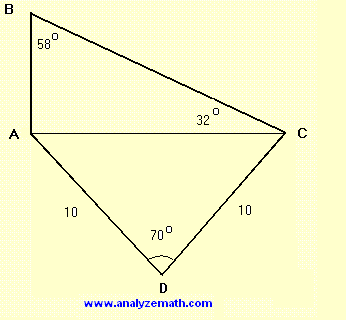
Find the length of side $AB$ in the figure below. Round your answer to 3 significant digits.
Solution:
Note that triangle $DAC$ is isosceles. Therefore, if we draw the perpendicular from $D$ to $AC$, it will cut $AC$ into two equal halves and bisect angle $D$.

Using the right triangle whose hypotenuse is $AD$ ($10$ units) and angle is $\dfrac{70^\circ}{2} = 35^\circ$, we can write:
$$ \sin(35^\circ) = \dfrac{\dfrac{1}{2}AC}{10} \implies \dfrac{1}{2}AC = 10 \sin(35^\circ) $$
Which gives:
$$ AC = 20 \sin(35^\circ) $$
Next, note that the two internal angles $B$ and $C$ of triangle $ABC$ add up to $90^\circ$ and therefore the third angle of triangle $ABC$ (Angle $A$) is a right angle.
We can therefore write:
$$ \tan(32^\circ) = \dfrac{AB}{AC} $$
Which gives:
$$ AB = AC \tan(32^\circ) $$
Substitute the value of $AC$ into the equation:
$$ AB = 20 \sin(35^\circ)\tan(32^\circ) \approx 7.17 \quad \text{(rounded to 3 significant digits)} $$
Challenge Problems
Test your mastery of identities and algebraic manipulation with these advanced trigonometric scenarios.
Challenge 1: Trigonometric Substitution
Solve the equation for all real values of $x \in [0, 2\pi]$:
$$ 2\sin^2(x) + 3\cos(x) = 0 $$
Solution:
Use the Pythagorean identity $\sin^2(x) = 1 - \cos^2(x)$ to express everything in terms of cosine:
$$ 2(1 - \cos^2(x)) + 3\cos(x) = 0 $$
$$ 2 - 2\cos^2(x) + 3\cos(x) = 0 $$
Multiply by $-1$ to make the leading term positive:
$$ 2\cos^2(x) - 3\cos(x) - 2 = 0 $$
Let $u = \cos(x)$ to reveal the quadratic form:
$$ 2u^2 - 3u - 2 = 0 \implies (2u + 1)(u - 2) = 0 $$
This yields two equations:
$$ \cos(x) = -\dfrac{1}{2} \quad \text{and} \quad \cos(x) = 2 $$
Because the range of the cosine function is $[-1, 1]$, the equation $\cos(x) = 2$ has no real solution.
We solve $\cos(x) = -\dfrac{1}{2}$ for $x$ in the domain $[0, 2\pi]$:
$$ x = \dfrac{2\pi}{3}, \ \dfrac{4\pi}{3} $$
Challenge 2: Sum-to-Product Proof
Prove the following identity:
$$ \sin(3x) + \sin(x) = 2\sin(2x)\cos(x) $$
Solution:
We can prove this by starting on the left-hand side and applying the Sum-to-Product identity:
$$ \sin(A) + \sin(B) = 2\sin\left(\dfrac{A+B}{2}\right)\cos\left(\dfrac{A-B}{2}\right) $$
Let $A = 3x$ and $B = x$. Substitute these into the formula:
$$ \sin(3x) + \sin(x) = 2\sin\left(\dfrac{3x+x}{2}\right)\cos\left(\dfrac{3x-x}{2}\right) $$
Simplify the fractions inside the trigonometric functions:
$$ = 2\sin\left(\dfrac{4x}{2}\right)\cos\left(\dfrac{2x}{2}\right) $$
$$ = 2\sin(2x)\cos(x) $$
The identity is proven.