Calculate Areas of Shapes - Grade 6

Grade 6 examples and questions to calculate areas of rectangles, squares, triangles, parallelograms, and trapezoids with detailed solutions and explanations.

Formulas to Calculate Areas

The formulas to calculate the areas of common 2D shapes are presented below:

area of rectangle

Rectangle

Area = L × W

area of square

Square

Area = S2

area of triangle

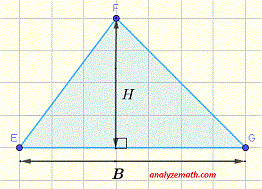
Triangle

Area = ½ × H × B

area of parallelogram

Parallelogram

Area = L × H

area of trapezoid

Trapezoid

Area = ½ × H × (B1 + B2)

Questions and Problems

Question 1

Use the grid to determine the dimensions of the figures below and then use the formulas to calculate their areas.

area of different figures on a grid
View Solution

We first determine the dimensions needed to calculate the area from the grid, then use the appropriate formulas for each figure.

  • a) The figure is a rectangle of width \(AD = 3\) units and length \(DC = 4\) units.
    \(\text{Area} = \text{Length} \times \text{Width} = 4 \times 3 = 12 \text{ units}^2\)
  • b) The figure is a square of side \(HG = 3\) units.
    \(\text{Area} = \text{Side} \times \text{Side} = 3 \times 3 = 9 \text{ units}^2\)
  • c) The figure is a right triangle of height \(H = ML = 3\) units and base \(B = MN = 4\) units.
    \(\text{Area} = \frac{1}{2} \times H \times B = \frac{1}{2} \times 3 \times 4 = 6 \text{ units}^2\)
  • d) The figure is a right triangle with the same dimensions as part c): Height \(H = IJ = 3\) units and base \(B = JK = 4\) units.
    \(\text{Area} = \frac{1}{2} \times H \times B = \frac{1}{2} \times 3 \times 4 = 6 \text{ units}^2\)
  • e) The figure is a parallelogram of length \(L = OP = 5\) units and the perpendicular height \(H\) between \(OP\) and \(RQ\) is \(3\) units.
    area of parallelogram solution
    \(\text{Area} = L \times H = 5 \times 3 = 15 \text{ units}^2\)
    Note that H is perpendicular to both OP and RQ.

Question 2

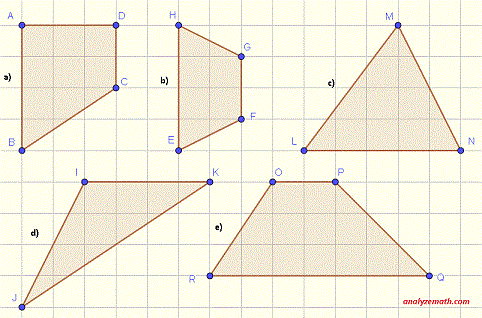
Determine the dimensions of the figures below from the grid and then calculate their areas.

area of more different figures on a grid
View Solution

We first identify the figure, determine its dimensions from the grid, and then calculate the area.

  • a) The figure is a trapezoid with \(AB\) and \(DC\) parallel. Base \(B_1 = DC = 2\) units, base \(B_2 = AB = 4\) units, and the height \(H = AD = 3\) units.
    \(\text{Area} = \frac{1}{2} \times H \times (B_1 + B_2) = \frac{1}{2} \times 3 \times (2 + 4) = \frac{1}{2} \times 3 \times 6 = 9 \text{ units}^2\)
  • b) The figure is a trapezoid with \(GF\) and \(HE\) parallel. Base \(B_1 = GF = 2\) units, base \(B_2 = HE = 4\) units, and the height \(H = 2\) units.
    \(\text{Area} = \frac{1}{2} \times H \times (B_1 + B_2) = \frac{1}{2} \times 2 \times (2 + 4) = \frac{1}{2} \times 2 \times 6 = 6 \text{ units}^2\)
  • c) The figure is a triangle of base \(B = LN = 5\) units and height \(H = 4\) units.
    area of triangle solution
    \(\text{Area} = \frac{1}{2} \times B \times H = \frac{1}{2} \times 5 \times 4 = \frac{20}{2} = 10 \text{ units}^2\)
  • d) The figure is a triangle of base \(B = IK = 4\) units and height \(H = 4\) units.
    area of triangle solution
    \(\text{Area} = \frac{1}{2} \times B \times H = \frac{1}{2} \times 4 \times 4 = \frac{16}{2} = 8 \text{ units}^2\)
  • e) The figure is a trapezoid with base \(B_1 = OP = 2\) units, base \(B_2 = RQ = 7\) units, and height \(H = 3\) units.
    \(\text{Area} = \frac{1}{2} \times H \times (B_1 + B_2) = \frac{1}{2} \times 3 \times (2 + 7) = \frac{1}{2} \times 3 \times 9 = 13.5 \text{ units}^2\)

More References and Links