Grade 6 Math Practice Test

Comprehensive Grade 6 math practice test questions spanning 16 essential topics. Expand the View Solution tab under each question to reveal detailed step-by-step explanations and verify your answers.

Note: These questions should be solved without a calculator unless otherwise specified to build strong foundational arithmetic skills.

1 - Numbers

1.1) Which properties (associativity, commutativity, distributivity, identity of addition, identity of multiplication) are used to write the following equalities?

  1. \((5 + 4) + 1 = 5 + (4 + 1)\)
  2. \(2(4 + 7) = 2 \times 4 + 2 \times 7\)
  3. \(11 + 9 = 9 + 11\)
  4. \(33 + 0 = 33\)
  5. \(5 \times 1 = 5\)
  6. \(9 \times 6 = 6 \times 9\)
  7. \((7 - 2)6 = 7 \times 6 - 2 \times 6\)
  8. \(3 \times 6 - 3 \times 2 = 3(6 - 2)\)
View Solution
  1. \((5 + 4) + 1 = 5 + (4 + 1)\) : Associativity of addition
  2. \(2(4 + 7) = 2 \times 4 + 2 \times 7\) : Distributivity
  3. \(11 + 9 = 9 + 11\) : Commutativity of addition
  4. \(33 + 0 = 33\) : Identity of addition
  5. \(5 \times 1 = 5\) : Identity of multiplication
  6. \(9 \times 6 = 6 \times 9\) : Commutativity of multiplication
  7. \((7 - 2) \times 6 = 7 \times 6 - 2 \times 6\) : Distributivity
  8. \(3 \times 6 - 3 \times 2 = 3(6 - 2)\) : Distributivity in reverse (factoring)

1.2) Which of the following numbers are prime numbers?
\( 0, 1, 2, 3, 4, 5, 6, 7, 8, 9, 10, 11 \)

View Solution

A prime number has exactly two distinct positive divisors: 1 and itself. Note that 0 and 1 are not prime.

The prime numbers are: 2, 3, 5, 7, 11.

1.3) In which place value is the \( 2 \) in the number \(1296\)?

View Solution

The 2 is in the Hundreds place.

1.4) Evaluate the following expressions:

  1. \((9 - 3) + 2\)
  2. \(7 - (5 - 2)\)
  3. \((3 + 7) \times 3\)
  4. \((8 - 2) \times 3\)
View Solution
  1. \((9 - 3) + 2 = 6 + 2 = \mathbf{8}\)
  2. \(7 - (5 - 2) = 7 - 3 = \mathbf{4}\)
  3. \((3 + 7) \times 3 = 10 \times 3 = \mathbf{30}\)
  4. \((8 - 2) \times 3 = 6 \times 3 = \mathbf{18}\)

1.5) Which digit is in the tenths place in the number \( 12.83 \)?

View Solution

The first digit after the decimal point is the tenths place. The digit is 8.

1.6) Round the following to the nearest whole number:

  1. \(0.41\)
  2. \(1.2999\)
  3. \(123.5\)
View Solution
Rules of rounding:
  • If the digit in the tenths place is less than 5, remove all digits after the decimal point without changing the ones digit.
  • If the tenths digit is equal to 5 or more, remove all digits after the decimal point and add 1 to the ones digit.
  1. \(0.41\) rounded is 0 (the tenths digit is 4, which is less than 5).
  2. \(1.2999\) rounded is 1 (the tenths digit is 2, which is less than 5).
  3. \(123.5\) rounded is 124 (the tenths digit is 5, which rounds up).

1.7) Which of the following statements is true?

  1. \(0.1 > 0.3\)
  2. \(1.2 < 1.3\)
  3. \(0.5 < 0.05\)
View Solution
  1. \(0.1 > 0.3\) : False
  2. \(1.2 < 1.3\) : True
  3. \(0.5 < 0.05\) : False (0.50 is greater than 0.05)

1.8) Evaluate the following expressions:

  1. \(0.4 \times 3\)
  2. \(8 - 3 \times 0.2\)
  3. \(0.5 \div 5\)
View Solution
  1. \(0.4 \times 3 = \mathbf{1.2}\)
  2. \(8 - 3 \times 0.2 = 8 - 0.6 = \mathbf{7.4}\)
  3. \(0.5 \div 5 = \mathbf{0.1}\)

2 - Factors, Multiples and Divisibility

2.1) What is the Greatest Common Factor (GCF) of \( 8 \) and \( 12 \)?

View Solution
  • Factors of 8: 1, 2, 4, 8
  • Factors of 12: 1, 2, 3, 4, 6, 12
  • Common factors: 1, 2, 4

The greatest common factor is 4.

2.2) What is the Least Common Multiple (LCM) of \( 3 \) and \( 7 \)?

View Solution
  • Multiples of 3: 3, 6, 9, 12, 15, 18, 21, 24...
  • Multiples of 7: 7, 14, 21, 28...

The least common multiple is 21.

2.3) Which of the following numbers is divisible by \( 5 \)?

  1. \(125\)
  2. \(123\)
  3. \(200\)
View Solution

Rule: Any number ending in 0 or 5 is divisible by 5.

Therefore, 125 and 200 are divisible by 5.

2.4) Which of the following numbers is divisible by \( 2 \)?

  1. \(35\)
  2. \(280\)
  3. \(476\)
View Solution

Rule: Any number ending in an even digit (0, 2, 4, 6, 8) is divisible by 2.

Therefore, 280 and 476 are divisible by 2.

2.5) Which of the following numbers is divisible by \( 3 \)?

  1. \(105\)
  2. \(101\)
  3. \(234\)
View Solution

Rule: A number is divisible by 3 if the sum of its digits is divisible by 3.

  1. \(105 \rightarrow 1+0+5 = 6\) (Divisible by 3)
  2. \(101 \rightarrow 1+0+1 = 2\) (Not divisible by 3)
  3. \(234 \rightarrow 2+3+4 = 9\) (Divisible by 3)

Therefore, 105 and 234 are divisible by 3.

3 - Fractions and Mixed Numbers

3.1) Which of the following are improper fractions?

  1. \(\dfrac{2}{5}\)
  2. \(\dfrac{10}{3}\)
  3. \(\dfrac{3}{3}\)
View Solution

Definition: An improper fraction is a fraction whose numerator is greater than or equal to its denominator.

Therefore, \(\dfrac{10}{3}\) and \(\dfrac{3}{3}\) are improper fractions.

3.2) Convert the following improper fractions to mixed numbers:

  1. \(\dfrac{7}{5}\)
  2. \(\dfrac{8}{3}\)
  3. \(\dfrac{9}{2}\)
View Solution
  1. \(\dfrac{7}{5} = \dfrac{5+2}{5} = \dfrac{5}{5} + \dfrac{2}{5} = \mathbf{1 \dfrac{2}{5}}\)
  2. \(\dfrac{8}{3} = \dfrac{6+2}{3} = \dfrac{6}{3} + \dfrac{2}{3} = \mathbf{2 \dfrac{2}{3}}\)
  3. \(\dfrac{9}{2} = \dfrac{8+1}{2} = \dfrac{8}{2} + \dfrac{1}{2} = \mathbf{4 \dfrac{1}{2}}\)

3.3) Find the missing value that makes the fractions equivalent:

  1. \(\dfrac{1}{2} = \dfrac{?}{4}\)
  2. \(\dfrac{2}{5} = \dfrac{6}{?}\)
  3. \(\dfrac{1}{3} = \dfrac{?}{9}\)
View Solution

Rule: Multiply or divide the numerator and denominator by the same number to find equivalent fractions.

  1. Multiply numerator and denominator by 2: \(\dfrac{1 \times 2}{2 \times 2} = \dfrac{\mathbf{2}}{4}\)
  2. Multiply numerator and denominator by 3: \(\dfrac{2 \times 3}{5 \times 3} = \dfrac{6}{\mathbf{15}}\)
  3. Multiply numerator and denominator by 3: \(\dfrac{1 \times 3}{3 \times 3} = \dfrac{\mathbf{3}}{9}\)

3.4) Evaluate the following expressions:

  1. \(\dfrac{4}{10} - \dfrac{1}{10}\)
  2. \(\dfrac{1}{2} + \dfrac{3}{4}\)
  3. \(\dfrac{1}{2} \times \dfrac{2}{3}\)
  4. \(\dfrac{3}{4} \div \dfrac{1}{2}\)
  5. \(\dfrac{3}{4} \div 3\)
  6. \(2 \times \dfrac{2}{6}\)
  7. \(1\dfrac{1}{4} + 2\dfrac{1}{4}\)
  8. \(3\dfrac{2}{5} - 1\dfrac{1}{5}\)
View Solution
  1. \(\dfrac{4-1}{10} = \mathbf{\dfrac{3}{10}}\)
  2. \(\dfrac{2}{4} + \dfrac{3}{4} = \mathbf{\dfrac{5}{4}}\)
  3. \(\dfrac{1 \times 2}{2 \times 3} = \dfrac{2}{6} = \mathbf{\dfrac{1}{3}}\)
  4. \(\dfrac{3}{4} \times \dfrac{2}{1} = \dfrac{6}{4} = \mathbf{\dfrac{3}{2}}\)
  5. \(\dfrac{3}{4} \times \dfrac{1}{3} = \dfrac{3}{12} = \mathbf{\dfrac{1}{4}}\)
  6. \(\dfrac{2}{1} \times \dfrac{2}{6} = \dfrac{4}{6} = \mathbf{\dfrac{2}{3}}\)
  7. \((1+2) + \left(\dfrac{1}{4} + \dfrac{1}{4}\right) = 3\dfrac{2}{4} = \mathbf{3\dfrac{1}{2}}\)
  8. \((3-1) + \left(\dfrac{2}{5} - \dfrac{1}{5}\right) = \mathbf{2\dfrac{1}{5}}\)

3.5) Write as a decimal:

  1. \(\dfrac{7}{10}\)
  2. \(\dfrac{17}{100}\)
View Solution
  1. \(7 \div 10 = \mathbf{0.7}\)
  2. \(17 \div 100 = \mathbf{0.17}\)

3.6) In the diagrams below, a whole circle or square is one unit. Represent each of the colored (in red) parts as a fraction or a mixed number.

a)
Mixed Number

b)
Fraction

c)
Mixed Number

View Solution
  1. There is one full circle and one-fourth of another. Answer: \(1 \dfrac{1}{4}\)
  2. There is one-fourth of the square shaded. Answer: \(\dfrac{1}{4}\)
  3. There are three full squares and three-eighths of another. Answer: \(3 \dfrac{3}{8}\)

4 - Exponents

4.1) Rewrite the following expressions using exponents:

  1. \( 2 \times 2 \times 2 \times 2 \times 2 \)
  2. Five squared
  3. \( 4 \) cubed
  4. \( 6 \) to the seventh power
View Solution
  1. \( 2 \times 2 \times 2 \times 2 \times 2 = \mathbf{2^5} \)
  2. Five squared = \(\mathbf{5^2}\)
  3. 4 cubed = \(\mathbf{4^3}\)
  4. 6 to the seventh power = \(\mathbf{6^7}\)

4.2) Evaluate the following expressions:

  1. \( 2^3 \)
  2. \( 1^5 \)
  3. \( 4^2 \)
  4. \( 1000^0 \)
View Solution
  1. \( 2^3 = 2 \times 2 \times 2 = \mathbf{8} \)
  2. \( 1^5 = 1 \times 1 \times 1 \times 1 \times 1 = \mathbf{1} \)
  3. \( 4^2 = 4 \times 4 = \mathbf{16} \)
  4. \( 1000^0 = \mathbf{1} \) (Any non-zero number to the power of 0 is 1)

5 - Ratios and Rates

5.1) There are 2 red balls and 3 blue balls in a bag. What is the ratio of:

  1. red to blue balls?
  2. blue to red balls?
  3. blue to the total number of balls?
View Solution
  1. Red to blue = 2:3
  2. Blue to red = 3:2
  3. Blue to total (which is 2+3=5) = 3:5

5.2) There are 11 girls and 8 boys in a class. What is the ratio of:

  1. girls to boys?
  2. boys to the total number of students?
View Solution
  1. Girls to boys = 11:8
  2. Boys to total (which is 11+8=19) = 8:19

5.3) Sam bought 5 kilograms of tomatoes at the cost of $15. Find the unit rate in dollars/kilogram.

View Solution

\(\$15 \div 5 \text{ kg} = \) \(\$3 / \text{kg}\)

5.4) A car traveled 120 kilometers (km) in 2 hours (hrs). Find the unit rate in km/hr.

View Solution

\(120 \text{ km} \div 2 \text{ hours} = \) \(60 \text{ km/hr}\)

5.5) There are 600 students in a school and the ratio of boys to girls is equal to \(1:3\). How many boys are in this school?

View Solution

The ratio of boys to girls is \(1:3\). This means for every 1 boy, there are 3 girls, making a total of 4 "parts" in the student body.

If \(x\) is the number of boys, then \(3x\) is the number of girls.

$$x + 3x = 600$$

$$4x = 600$$

$$x = 600 \div 4 = \mathbf{150 \text{ boys}}$$

Check: If there are 150 boys, there are \(3 \times 150 = 450\) girls. \(150 + 450 = 600\).

6 - Percent and Related Problems

6.1) What is \( 60\% \) of \( 20 \)?

View Solution

\(\dfrac{60}{100} \times 20 = \dfrac{1200}{100} = \mathbf{12}\)

6.2) Write \( 35\% \) as a decimal number.

View Solution

\(35\% = \dfrac{35}{100} = \mathbf{0.35}\)

6.3) Write \( 15\% \) as a reduced fraction.

View Solution

\(15\% = \dfrac{15}{100}\). Divide numerator and denominator by 5: \(\mathbf{\dfrac{3}{20}}\)

6.4) What is \( 50\% \) of \( \dfrac{1}{4} \)?

View Solution

\(\dfrac{50}{100} \times \dfrac{1}{4} = \dfrac{1}{2} \times \dfrac{1}{4} = \mathbf{\dfrac{1}{8}}\)

6.5) Write the fraction \( \dfrac{3}{5} \) as a percentage.

View Solution

\(\dfrac{3}{5} = 0.6 = \dfrac{60}{100} = \mathbf{60\%}\)

6.6) Amanda has a monthly salary of $3000. She spends $600 per month on clothes. What percent of her monthly salary does she spend on clothes?

View Solution

\(\dfrac{600}{3000} = \dfrac{6}{30} = \dfrac{1}{5} = 0.20 = \mathbf{20\%}\)

6.7) The price of an item changed from $125 to $100. What was the change in percent?

View Solution

Change in percent = \(\dfrac{\text{new price - original price}}{\text{original price}}\)

$$= \dfrac{100 - 125}{125} = \dfrac{-25}{125} = -0.2 = \mathbf{-20\%}$$

6.8) A shirt initially costs $40 and it is discounted by 40%. What is the price of the shirt after the discount?

View Solution

Discount = \(40\% \times 40 = \dfrac{40}{100} \times 40 = \$16\)

New Price = \(\$40 - \$16 = \mathbf{\$24}\)

7 - Convert Units of Measurement

7.1) How many hectoliters (hL) are in 320 liters (L) knowing that \( 1 \text{ hL} = 100 \text{ L} \)?

View Solution

Divide by 100: \(320 \div 100 = \mathbf{3.2 \text{ hL}}\)

7.2) How many meters (m) are in 234500 millimeters (mm) knowing that \( 1 \text{ m} = 1000 \text{ mm} \)?

View Solution

Divide by 1000: \(234500 \div 1000 = \mathbf{234.5 \text{ m}}\)

7.3) How many kilometers (km) are in 2300 meters (m) knowing that \( 1 \text{ km} = 1000 \text{ m} \)?

View Solution

Divide by 1000: \(2300 \div 1000 = \mathbf{2.3 \text{ km}}\)

7.4) How many milliliters (mL) are in 1.2 liters (L) knowing that \( 1 \text{ L} = 1000 \text{ mL} \)?

View Solution

Multiply by 1000: \(1.2 \times 1000 = \mathbf{1200 \text{ mL}}\)

7.5) How many hours (hrs) are in 7200 seconds (sec) knowing that \( 1 \text{ hr} = 3600 \text{ sec} \)?

View Solution

Divide by 3600: \(7200 \div 3600 = \mathbf{2 \text{ hrs}}\)

7.6) How many miles (mi) are in 2640 yards (yd) knowing that \( 1 \text{ mi} = 1760 \text{ yd} \)?

View Solution

Divide by 1760: \(2640 \div 1760 = \mathbf{1.5 \text{ mi}}\)

7.7) How many inches (in) are in 3 meters (m) knowing that \( 1 \text{ m} = 39.37 \text{ in} \)?

View Solution

Multiply by 39.37: \(3 \times 39.37 = \mathbf{118.11 \text{ in}}\)

8 - Mathematical Expressions

8.1) Evaluate the expression \( x + 2 \) for \( x = 0.2 \).

View Solution

\( 0.2 + 2 = \mathbf{2.2} \)

8.2) Evaluate the expression \( 2 (x + 2) \) for \( x = 3 \).

View Solution

\( 2 (3 + 2) = 2(5) = \mathbf{10} \)

8.3) Evaluate the expression \( a - b \) for \( a = 3 \) and \( b = 2 \).

View Solution

\( 3 - 2 = \mathbf{1} \)

8.4) Evaluate the expression \( \dfrac{2 x}{3} \) for \( x = 6 \).

View Solution

\( \dfrac{2(6)}{3} = \dfrac{12}{3} = \mathbf{4} \)

8.5) Write mathematical expressions and equations for:

  1. 3 less than \(x\)
  2. 5 times \((x+2)\)
  3. \((2x + 1)\) squared
  4. The sum of \(x\) and 1 multiplied by 3 is equal to 2.
View Solution
  1. \(\mathbf{x - 3}\)
  2. \(\mathbf{5(x + 2)}\)
  3. \(\mathbf{(2x + 1)^2}\)
  4. \(\mathbf{3(x + 1) = 2}\)

8.6) Write mathematical inequalities for:

  1. 3 is less than \(x\)
  2. 5 is at least \(x\)
  3. \(y\) is at most 9
  4. The difference of \(x\) and 2 is less than or equal to -2.
View Solution
  1. \(\mathbf{3 < x}\)
  2. \(\mathbf{5 \ge x}\)
  3. \(\mathbf{y \le 9}\)
  4. \(\mathbf{x - 2 \le -2}\)

8.7) Expand the brackets and simplify:

  1. \( 2(x + 4) \)
  2. \( 3(a + b + 2) \)
  3. \( \dfrac{1}{4}(8x + 4) \)
  4. \( 0.2(x + 2) \)
View Solution
  1. \( 2x + 8 \)
  2. \( 3a + 3b + 6 \)
  3. \( \dfrac{8}{4}x + \dfrac{4}{4} = \mathbf{2x + 1} \)
  4. \( 0.2x + 0.4 \)

8.8) Factor the expressions:

  1. Find the Greatest Common Factor (GCF) of 9 and 6
  2. Write 9 and 6 as a product of the GCF found in a) and another number.
  3. Write \( 9x + 6 \) as the product of the GCF found in a) and an expression between brackets.
View Solution
  1. Factors of 9 are 1, 3, 9. Factors of 6 are 1, 2, 3, 6. The GCF is 3.
  2. \(9 = \mathbf{3 \times 3}\), and \(6 = \mathbf{3 \times 2}\).
  3. \( 9x + 6 = 3(3x) + 3(2) = \mathbf{3(3x + 2)} \)

9 - Equation with One Variable and Related Problems

9.1) Solve the equations:

  1. \( x + 2 = 8 \)
  2. \( 2x = 6 \)
  3. \( x - 3 = 7 \)
View Solution
  1. \(x + 2 - 2 = 8 - 2 \implies \mathbf{x = 6}\)
  2. \(2x \div 2 = 6 \div 2 \implies \mathbf{x = 3}\)
  3. \(x - 3 + 3 = 7 + 3 \implies \mathbf{x = 10}\)

9.2) The perimeter of a rectangular garden is 10 meters and its length is 3 meters. Let \( x \) be the width of the garden.

  1. Write an equation in \( x \) to solve for the width.
  2. Solve the equation obtained in part a).
  3. Check your answer to the problem.
View Solution
  1. Perimeter = \(2 \times L + 2 \times W\). So, \(10 = 2(3) + 2x \implies \mathbf{2x + 6 = 10}\).
  2. \(2x = 10 - 6 \implies 2x = 4 \implies \mathbf{x = 2}\) meters.
  3. Check: \(2(3) + 2(2) = 6 + 4 = 10\). This matches the given perimeter.

10 - Coordinate Plane

10.1) Identify the quadrant or axis on a coordinate plane of each point without plotting them.

  1. \( (0,1) \)
  2. \( (-2,-3) \)
  3. \( (2,9) \)
  4. \( (-4,6) \)
  5. \( (3,-4) \)
  6. \( (-3,0) \)
View Solution
  1. \((0,1)\) is on the positive y-axis.
  2. \((-2,-3)\) is in Quadrant III.
  3. \((2,9)\) is in Quadrant I.
  4. \((-4,6)\) is in Quadrant II.
  5. \((3,-4)\) is in Quadrant IV.
  6. \((-3,0)\) is on the negative x-axis.

10.2) Determine the coordinates of the points on the coordinate plane below.

Points on a Coordinate Plane
View Solution
  • \(A = \mathbf{(-1, 1)}\)
  • \(B = \mathbf{(0, -1)}\)
  • \(C = \mathbf{(2, 0)}\)
  • \(D = \mathbf{(3, 1)}\)
  • \(E = \mathbf{(-2, -1)}\)
  • \(F = \mathbf{(3, -2)}\)
  • \(G = \mathbf{(0, 3)}\)
  • \(H = \mathbf{(0, 0)}\)

10.3) John is walking at a constant speed of 5 kilometers per hour (km/hr).

a) Complete the table below where \( d \) is the distance in km and \( t \) is the time in hours.
Table of Distance Versus Time

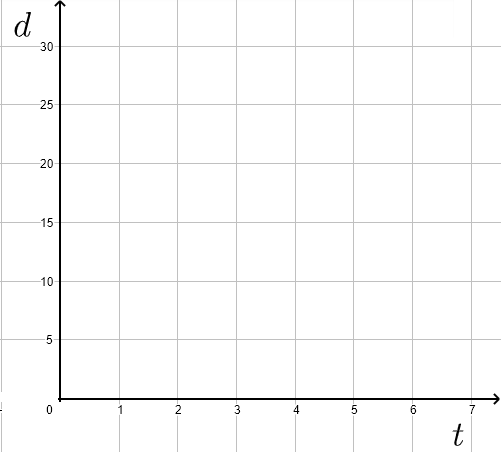
b) Plot the points on the coordinate plane and join the points obtained.
Coordinate Plane

View Solution

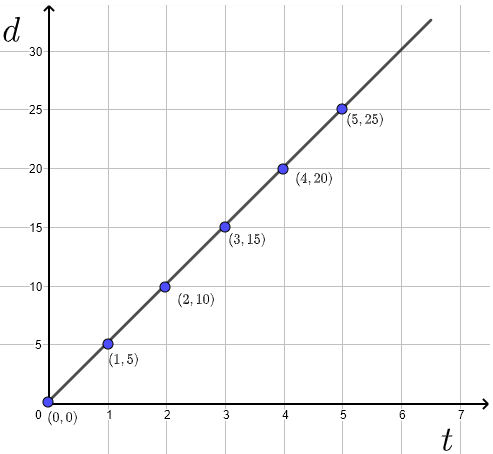
a) Distance \(d = 5 \times t\):

Time \(t\) (hrs)012345
Distance \(d\) (km)0510152025

b) Graph of the line:

Coordinate Plane with Points Plotted

11 - Inequalities

11.1) Represent the numbers \( -4, 0, 5, -6, 4 \) on a number line and decide which of the following statements is true.

  1. \( -4 < 0 \)
  2. \( 0 > 4 \)
  3. \( -6 < -4 \)
  4. \( -6 > 5 \)
  5. \( 0 < 6 \)
View Solution

Number Line

Numbers further left are smaller.

  1. \(-4 < 0\) : True ($-4$ is to the left of 0)
  2. \(0 > 4\) : False
  3. \(-6 < -4\) : True
  4. \(-6 > 5\) : False
  5. \(0 < 6\) : True (assuming 6 is plotted to the right of 5)

12 - Geometry

12.1) The sum of all internal angles of a triangle is equal to:

  1. \( 360^{\circ} \)
  2. \( 180^{\circ} \)
  3. \( 270^{\circ} \)
View Solution

The correct answer is b) \( 180^{\circ} \).

12.2) Two straight lines intersect at point \( O \). In the figure below, angles \( \angle AOB \) and \( \angle BOC \) are:

Supplementary Angles
  1. Complementary
  2. Supplementary
  3. Neither complementary nor supplementary
View Solution

Because they form a straight line, they sum to \(180^{\circ}\). The correct answer is b) Supplementary.

12.3) Three straight lines intersect at point \( O \). Which of these pairs of angles are vertical?

Vertical Angles
  1. \(\angle AOB\) and \(\angle DOF\)
  2. \(\angle BOC\) and \(\angle EOF\)
  3. \(\angle COD\) and \(\angle FOB\)
  4. \(\angle FOB\) and \(\angle COE\)
  5. \(\angle AOC\) and \(\angle DOE\)
  6. \(\angle BOD\) and \(\angle EOA\)
View Solution

Vertical angles are opposite each other when two lines cross. The valid vertical pairs from the list are:

  • b) \(\angle BOC\) and \(\angle EOF\)
  • d) \(\angle FOB\) and \(\angle COE\)
  • f) \(\angle BOD\) and \(\angle EOA\)

12.4) Give the number of sides for each of the geometric figures listed below.

  1. Pentagon
  2. Trapezoid
  3. Triangle
  4. Kite
View Solution
  1. Pentagon: 5 sides
  2. Trapezoid: 4 sides
  3. Triangle: 3 sides
  4. Kite: 4 sides

12.5) Which of the following is true about an isosceles triangle?

  1. Two of its angles are equal but the three sides are not equal.
  2. Two angles are equal and the opposite sides to the equal angles are equal.
  3. Two sides are equal but all the angles are different.
View Solution

The correct answer is b). To be precise: an isosceles triangle has two sides that are equal in length, and the angles opposite to those equal sides are also equal in measure.

12.6) Calculate the perimeter of a rectangle with a length of 10 cm and a width of 5 cm.

View Solution

Perimeter \(= 2 \times \text{Length} + 2 \times \text{Width} = 2(10) + 2(5) = 20 + 10 = \mathbf{30 \text{ cm}}\).

12.7) Calculate the area of a circle of radius 1 m.

View Solution

Area \(= \pi \times r^2 \approx 3.14 \times (1)^2 = \mathbf{3.14 \text{ square meters}}\).

12.8) ABCD is a rectangle bounded on the left side by segment AE. Find the area of the shaded (in blue) surface given that the length of segment DE is equal to 2 cm.

Rectangle with a Right Triangle
View Solution

Area of the entire rectangle ABCD \(= \text{length} \times \text{width} = 10 \times 7 = 70 \text{ cm}^2\).

Area of the unshaded right triangle ADE \(= \frac{1}{2} \times \text{base} \times \text{height} = \frac{1}{2} \times 2 \times 7 = 7 \text{ cm}^2\).

Area of the shaded region \(= \text{Total Area} - \text{Triangle Area} = 70 - 7 = \mathbf{63 \text{ cm}^2}\).

13 - Three Dimensional Figures

13.1) Determine the number of edges and faces of the truncated pyramid shown below.

Truncated Pyramid
View Solution

Number of edges = 4 (top) + 4 (bottom) + 4 (sides) = 12 edges.

Number of faces = 1 (top) + 1 (bottom) + 4 (sides) = 6 faces.

13.2) Given the rectangular prism below:

Rectangular Prism
  1. Find the area of the rectangles ABCD, ADHE and DCGH.
  2. Find the surface area of the rectangular prism.
  3. Find the volume of the rectangular prism.
View Solution
  1. Area ABCD (top) \(= 6 \times 4 = \mathbf{24 \text{ sq units}}\)
    Area ADHE (side) \(= 4 \times 10 = \mathbf{40 \text{ sq units}}\)
    Area DCGH (front) \(= 6 \times 10 = \mathbf{60 \text{ sq units}}\)
  2. Surface area is twice the sum of the three distinct faces:
    \(SA = 2 \times (24 + 40 + 60) = 2 \times 124 = \mathbf{248 \text{ sq units}}\).
  3. Volume \(= \text{length} \times \text{width} \times \text{height} = 6 \times 4 \times 10 = \mathbf{240 \text{ cubic units}}\).

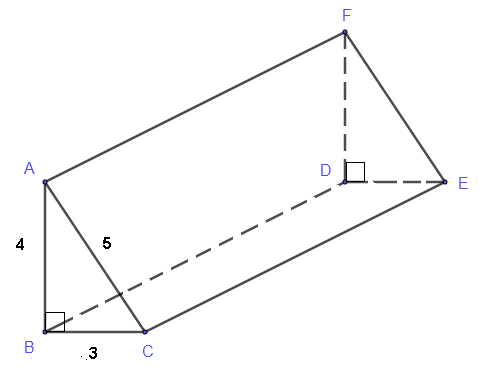
13.3) Given that the volume of the triangular prism below is 24, find its total surface area.

Triangular Prism
View Solution

First, find the area of the triangular base. It is a right triangle with legs 3 and 4:
Area of base \(a = \frac{1}{2} \times 3 \times 4 = 6\).

The volume is the area of the base times the length of the prism (\(AF\)):
\(24 = 6 \times AF \implies AF = 4\).

The total surface area is the sum of the two triangular bases and the three rectangular faces:
Two bases: \(6 + 6 = 12\).
Three rectangles: \((4 \times 4) + (3 \times 4) + (5 \times 4) = 16 + 12 + 20 = 48\).

Total Surface Area \(= 12 + 48 = \mathbf{60 \text{ sq units}}\).

14 - Data and Graphs

14.1) The number of hours Harry spent training for his soccer match during 5 days of the week are shown in the line plot below. How many hours did Harry spend training for his match during the week?

Line Plot Hours of Training
View Solution

Add the hours for each day: 3 (Mon) + 3 (Tue) + 2 (Wed) + 4 (Thu) + 3 (Fri).

Total \(= 3 + 3 + 2 + 4 + 3 = \mathbf{15 \text{ hours}}\).

14.2) The number of students (on the vertical axis) and the range of scores (on the horizontal axis) on an English test are shown in the histogram below.

Histogram Grades English Test
  1. How many students scored in the range 90-99?
  2. How many more students scored in the range 80-89 than students who scored in the range 60-69?
View Solution
  1. From the histogram, 3 students scored in the 90-99 range.
  2. 7 students scored 80-89, and 4 students scored 60-69.
    Difference \(= 7 - 4 = \) 3 more students.

15 - Statistics

15.1) Calculate the range, mean, mode and median of the data set: \( \{ 1, 4, 2, 2, 3, 2, 7 \} \)

View Solution

First, order the data: \(1, 2, 2, 2, 3, 4, 7\)

  • Range: Largest value - Smallest value \(= 7 - 1 = \mathbf{6}\).
  • Mean: \(\frac{1 + 2 + 2 + 2 + 3 + 4 + 7}{7} = \frac{21}{7} = \mathbf{3}\).
  • Mode: The most frequent value is 2 (appears three times).
  • Median: The middle value in the ordered list is 2.

16 - Probabilities

16.1) Which of the following cannot be a measure of probability?

  1. 1
  2. -0.5
  3. 2
  4. 0
  5. 0.0001
View Solution

Probability must always be a number between 0 and 1 (inclusive). Therefore, b) -0.5 and c) 2 cannot be probabilities.

16.2) Probability Outcomes:

  1. How many outcomes are possible if you flip a coin?
  2. How many outcomes are possible if you select one of five different cards at random?
  3. How many outcomes are possible if you flip a coin and select one of five different cards at random?
View Solution
  1. Flipping a coin has 2 outcomes (heads, tails).
  2. Selecting from 5 cards has 5 outcomes.
  3. Doing both creates \(2 \times 5 =\) 10 possible outcomes.

16.3) Die Roll Probability:

  1. What are all the possible outcomes if you roll a fair die with numbers from 1 to 6 on the 6 faces?
  2. When you roll a fair die, what is the probability that the number obtained is equal to 0?
  3. What is the probability that the number obtained is equal to 5?
  4. What is the probability that the number obtained is greater than 4?
View Solution
  1. The 6 possible outcomes are: {1, 2, 3, 4, 5, 6}.
  2. 0 is not on a standard die, so the probability is 0.
  3. There is one 5, so the probability is \(\dfrac{1}{6}\).
  4. The numbers greater than 4 are 5 and 6 (two outcomes). The probability is \(\dfrac{2}{6} = \mathbf{\dfrac{1}{3}}\).

More References and Links