Practice Questions & Solutions
Question 1
A sequence follows the rule: Start at 2, multiply by 3, and add 2 each time. What is the 5th number in the sequence?
View Solution
Follow the sequence rule step-by-step:
- 1st number: 2
- 2nd number: \(2 \times 3 + 2 = 8\)
- 3rd number: \(8 \times 3 + 2 = 26\)
- 4th number: \(26 \times 3 + 2 = 80\)
- 5th number: \(80 \times 3 + 2 = 242\)
The 5th number is 242.
Question 2
A square with a side of 2 cm is cut out from each corner of a rectangular cardboard measuring 12 cm in length and 8 cm in width. What is the area of the cardboard after the four squares are removed?
View Solution
First, calculate the original area of the cardboard:
\[ \text{Area} = \text{length} \times \text{width} = 12 \times 8 = 96 \text{ cm}^2 \]
Next, find the area of one square cut from a corner:
\[ \text{Area} = 2 \times 2 = 4 \text{ cm}^2 \]
Since there are four corners, the total area removed is:
\[ 4 \times 4 = 16 \text{ cm}^2 \]
Subtract the removed area from the original area to find the remaining area:
\[ 96 - 16 = \mathbf{80 \text{ cm}^2} \]
Question 3
Two numbers \( N \) and 16 have a least common multiple (LCM) of 48 and a greatest common factor (GCF) of 8. Find the value of \( N \).
View Solution
The product of two integers is always equal to the product of their LCM and GCF. Therefore:
\[ 16 \times N = 48 \times 8 \]
Solving for \( N \):
\[ N = \dfrac{48 \times 8}{16} = 3 \times 8 = \mathbf{24} \]
Question 4
Find the greatest common factor (GCF) of 24, 40, and 60.
View Solution
First, write the prime factorization of each number:
- \( 24 = 2 \times 2 \times 2 \times 3 = 2^3 \times 3 \)
- \( 40 = 2 \times 2 \times 2 \times 5 = 2^3 \times 5 \)
- \( 60 = 2 \times 2 \times 3 \times 5 = 2^2 \times 3 \times 5 \)
Identify the common prime factors with the smallest exponents. The only common prime factor among all three numbers is 2, and the smallest power of 2 common to all three is \(2^2\).
\[ \text{GCF} = 2^2 = \mathbf{4} \]
Question 5
In a school, there are 240 boys and 260 girls.
View Solution
a) Ratio of girls to boys:
\[ \dfrac{260}{240} \]
Reduce the fraction by dividing the numerator and denominator by 20: \( \dfrac{13}{12} \). The ratio is 13:12.
b) Ratio of boys to total pupils:
Total pupils = \( 240 + 260 = 500 \).
\[ \dfrac{240}{500} \]
Reduce the fraction by dividing the numerator and denominator by 20: \( \dfrac{12}{25} \). The ratio is 12:25.
Question 6
If Tim had lunch for $50.50 and he gave a 20% tip, how much did he spend in total?
View Solution
The tip is 20% of what he paid for lunch. Calculate the tip:
\[ \text{Tip} = 20\% \text{ of } 50.50 = \left( \dfrac{20}{100} \right) \times 50.50 = 10.10 \]
Add the tip to the original lunch cost:
\[ \text{Total} = 50.50 + 10.10 = \mathbf{\$60.60} \]
Question 7
Find \( k \) if \( \dfrac{64}{k} = 4 \).
View Solution
Division is related to multiplication. The equation can be rewritten as a multiplication:
\[ 64 = 4k \]
Rewrite this multiplication back as a division to solve for \( k \):
\[ k = \dfrac{64}{4} = \mathbf{16} \]
Question 8
What is \( x \) if \( x + 2y = 10 \) and \( y = 3 \)?
View Solution
Substitute \( y = 3 \) into the equation:
\[ x + 2(3) = 10 \]
\[ x + 6 = 10 \]
Subtract 6 from both sides to isolate \( x \):
\[ x = \mathbf{4} \]
Question 9
A telephone company charges an initial fee of $0.50 and then $0.11 for every additional minute. Write an expression that gives the cost \( C \) of a call that lasts \( N \) minutes.
View Solution
The cost \( C \) consists of a fixed initial fee ($0.50) and a variable rate ($0.11 multiplied by the number of minutes, \( N \)).
\[ C = \mathbf{0.50 + 0.11N} \]
Question 10
A car gets 40 kilometers per gallon of gasoline. How many gallons of gasoline would the car need to travel 180 kilometers?
View Solution
For every 40 kilometers, 1 gallon is needed. Divide the total distance by the distance per gallon to find the number of 40-km segments:
\[ \dfrac{180}{40} = 4.5 \]
The car would need 4.5 gallons of gasoline.
Question 11
A machine fills 150 bottles of water every 8 minutes. How many minutes will it take this machine to fill 675 bottles?
View Solution
First, find how many groups of 150 bottles fit into 675:
\[ \dfrac{675}{150} = 4.5 \text{ groups} \]
Since each group requires 8 minutes, multiply the number of groups by 8:
\[ 4.5 \times 8 = \mathbf{36 \text{ minutes}} \]
Question 12
A car travels at a speed of 65 miles per hour. How far will it travel in 5 hours?
View Solution
Use the distance formula:
\[ \text{Distance} = \text{Time} \times \text{Speed} \]
\[ \text{Distance} = 5 \times 65 = \mathbf{325 \text{ miles}} \]
Question 13
A rectangle \( A \) with a length of 10 centimeters and a width of 5 centimeters is similar to another rectangle \( B \) whose length is 30 centimeters. Find the area of rectangle \( B \).
View Solution
Since the rectangles are similar, the ratio of their corresponding sides is equal:
\[ \dfrac{L_2}{L_1} = \dfrac{W_2}{W_1} \]
\[ \dfrac{30}{10} = \dfrac{W_2}{5} \]
\[ 3 = \dfrac{W_2}{5} \quad \Rightarrow \quad W_2 = 15 \text{ cm} \]
Now find the area of rectangle \( B \):
\[ \text{Area}_B = 30 \times 15 = \mathbf{450 \text{ cm}^2} \]
Question 14
A school has 10 classes with the same number of students in each class. One day, the weather was bad and many students were absent. Five classes were half full, three classes were \( \frac{3}{4} \) full, and \( \frac{1}{8} \) of the students in the last two classes were absent. A total of 70 students were absent. How many students are registered in this school?
View Solution
Let \( x \) be the number of registered students in one class. We need to express the absent students as fractions of \( x \):
- 5 classes are half full (meaning \( \frac{1}{2} \) absent): \( 5 \times \left(\dfrac{1}{2}x\right) = \dfrac{5}{2}x \)
- 3 classes are \( \frac{3}{4} \) full (meaning \( \frac{1}{4} \) absent): \( 3 \times \left(\dfrac{1}{4}x\right) = \dfrac{3}{4}x \)
- 2 classes have \( \frac{1}{8} \) absent: \( 2 \times \left(\dfrac{1}{8}x\right) = \dfrac{2}{8}x = \dfrac{1}{4}x \)
Set the sum of absences equal to 70:
\[ \dfrac{5}{2}x + \dfrac{3}{4}x + \dfrac{1}{4}x = 70 \]
Find a common denominator (4):
\[ \dfrac{10}{4}x + \dfrac{3}{4}x + \dfrac{1}{4}x = \dfrac{14}{4}x = \dfrac{7}{2}x = 70 \]
Solve for \( x \):
\[ x = 70 \times \dfrac{2}{7} = 20 \text{ students per class} \]
Since there are 10 classes, the total registered student population is \( 10 \times 20 = \mathbf{200 \text{ students}} \).
Question 15
A large square is made of 16 congruent unit squares arranged in a \( 4 \times 4 \) grid. What is the total number of squares of any size hidden within the grid?

View Solution
There are squares of 4 different dimensions. We count them systematically:
- 16 squares of dimension \( 1 \times 1 \).
- 9 squares of dimension \( 2 \times 2 \).
- 4 squares of dimension \( 3 \times 3 \).
- 1 square of dimension \( 4 \times 4 \).
Total number of squares = \( 16 + 9 + 4 + 1 = \mathbf{30} \)
Question 16
John gave half of his stamps to Jim. Jim then gave half of his stamps to Carla. Carla gave \( \frac{1}{4} \) of the stamps given to her to Thomas and kept the remaining 12. How many stamps did John start with?
View Solution
Let \( x \) be the number of stamps John started with.
Jim received: \( \dfrac{1}{2}x \)
Carla received: \( \dfrac{1}{2} \times \left(\dfrac{1}{2}x\right) = \dfrac{1}{4}x \)
Carla gave \( \frac{1}{4} \) away, meaning she kept \( \frac{3}{4} \) of what she received:
\[ \text{Carla kept} = \dfrac{3}{4} \times \left(\dfrac{1}{4}x\right) = \dfrac{3}{16}x \]
We are told she kept 12 stamps. So:
\[ \dfrac{3}{16}x = 12 \]
\[ x = 12 \times \dfrac{16}{3} = \mathbf{64 \text{ stamps}} \]
Question 17
Two balls A and B rotate along a circular track. Ball A makes 4 full rotations in 120 seconds. Ball B makes 3 full rotations in 60 seconds. If they start rotating now from the same point, how long will it take them to be at the same starting point again?
View Solution
First, find the time it takes for each ball to make one full rotation.
Ball A: \( \dfrac{120}{4} = 30 \text{ seconds per rotation} \)
Ball B: \( \dfrac{60}{3} = 20 \text{ seconds per rotation} \)
They will meet at the starting point at the Least Common Multiple (LCM) of their rotation times.
\[ \text{LCM}(30, 20) = \mathbf{60 \text{ seconds}} \]
Question 18
A segment is 3 units long. It is divided into 9 equal parts. What fraction of a unit are 2 parts of the segment?
View Solution
If a 3-unit segment is divided into 9 equal parts, the length of 1 part is:
\[ 1 \text{ part} = \dfrac{3}{9} = \dfrac{1}{3} \text{ of a unit} \]
Therefore, 2 parts equal:
\[ 2 \times \dfrac{1}{3} = \mathbf{\dfrac{2}{3} \text{ of a unit}} \]
Question 19
A car is traveling 75 kilometers per hour. How many meters does the car travel in one minute?
View Solution
Convert kilometers to meters and hours to minutes:
\[ 1 \text{ kilometer} = 1000 \text{ meters} \]
\[ 1 \text{ hour} = 60 \text{ minutes} \]
Now, apply the conversions to the speed:
\[ 75 \text{ km/h} = \dfrac{75 \times 1000 \text{ meters}}{60 \text{ minutes}} \]
\[ = \dfrac{75000}{60} = \mathbf{1250 \text{ meters per minute}} \]
Question 20
Linda spent \( \frac{3}{4} \) of her savings on furniture. She then spent \( \frac{1}{2} \) of her remaining savings on a fridge. If the fridge cost her $150, what were her original savings?
View Solution
Let \( x \) be her total savings. If she spent \( \frac{3}{4} \) of her savings, she had \( \frac{1}{4} \) left.
She spent half of that remainder on a fridge, which cost $150:
\[ \dfrac{1}{2} \times \left(\dfrac{1}{4}x\right) = 150 \]
\[ \dfrac{1}{8}x = 150 \]
Multiply both sides by 8:
\[ x = 150 \times 8 = \mathbf{\$1200} \]
Question 21
The perimeter of square A is 3 times the perimeter of square B. What is the ratio of the area of square A to the area of square B?
View Solution
Let \( x \) be the side length of square A and \( y \) be the side length of square B. Their perimeters are \( 4x \) and \( 4y \).
\[ 4x = 3(4y) \quad \Rightarrow \quad 4x = 12y \quad \Rightarrow \quad x = 3y \]
The ratio of their areas is:
\[ \dfrac{\text{Area}_A}{\text{Area}_B} = \dfrac{x^2}{y^2} \]
Substitute \( x = 3y \):
\[ \dfrac{(3y)^2}{y^2} = \dfrac{9y^2}{y^2} = \mathbf{9} \] (The ratio is 9:1).
Question 22
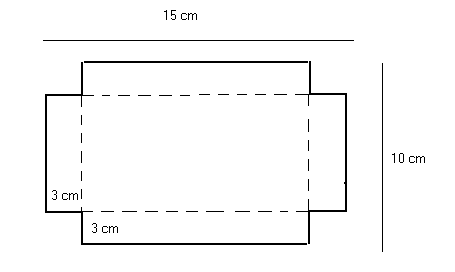
Mary wants to make an open rectangular box. She starts with a piece of cardboard whose length is 15 centimeters and width is 10 centimeters. Then she cuts 4 congruent squares with sides of 3 centimeters at the four corners and folds at the broken lines to make the box. What is the volume of the box?
View Solution
The height of the box will be the size of the square cut out (\( 3 \text{ cm} \)).
The new length is the original length minus the two squares cut from each side:
\[ \text{Length} = 15 - 3 - 3 = 9 \text{ cm} \]
The new width is the original width minus the two squares cut from each side:
\[ \text{Width} = 10 - 3 - 3 = 4 \text{ cm} \]
Calculate the volume:
\[ V = \text{length} \times \text{width} \times \text{height} = 9 \times 4 \times 3 = \mathbf{108 \text{ cm}^3} \]
Question 23
A small square of side \( 2x \) is cut from the corner of a rectangle whose width is 10 centimeters and length is 20 centimeters. Write an expression in terms of \( x \) for the area of the remaining shape.
View Solution
Find the total area of the original rectangle:
\[ A_{\text{rect}} = \text{length} \times \text{width} = 20 \times 10 = 200 \]
Find the area of the small square being cut:
\[ A_{\text{square}} = (2x) \times (2x) = 4x^2 \]
The remaining area is the rectangle's area minus the square's area:
\[ \text{Remaining Area} = \mathbf{200 - 4x^2} \]
Question 24
If the area of a circle is \( 81\pi \) square feet, find its circumference.
View Solution
The area of a circle is given by \( \pi r^2 \):
\[ \pi r^2 = 81\pi \]
Divide both sides by \( \pi \):
\[ r^2 = 81 \quad \Rightarrow \quad r = 9 \text{ feet} \]
The circumference is \( 2\pi r \):
\[ C = 2\pi(9) = \mathbf{18\pi \text{ feet}} \]
Question 25
Carla is 5 years old and Jim is 13 years younger than Peter. One year ago, Peter's age was twice the sum of Carla's and Jim's ages. Find the present age of each one of them.
View Solution
Let Peter's current age be \( P \). This makes Jim's current age \( P - 13 \).
One year ago, their ages were:
- Peter: \( P - 1 \)
- Carla: \( 5 - 1 = 4 \)
- Jim: \( (P - 13) - 1 = P - 14 \)
Set up the equation based on the condition from one year ago:
\[ P - 1 = 2 \times [4 + (P - 14)] \]
\[ P - 1 = 2(P - 10) \]
\[ P - 1 = 2P - 20 \]
Subtract \( P \) and add 20 to both sides:
\[ P = \mathbf{19} \]
Peter is 19, Jim is 6 (\(19 - 13\)), and Carla is 5.
Question 26
Lisa ran 2.4 kilometers in the morning and 1.75 kilometers in the evening. She wants to run a total of 6 kilometers in a day. How many more kilometers does she need to run to reach her goal?
View Solution
Add the distances she has already run:
\[ 2.4 + 1.75 = 4.15 \text{ km} \]
Subtract this from her total goal:
\[ 6 - 4.15 = \mathbf{1.85 \text{ km}} \]
Question 27
A recipe needs flour and sugar in the ratio 3:2. If you have 4 cups of sugar, how many cups of flour do you need?
View Solution
Let the amount of flour be \( x \). Set up the ratio:
\[ \dfrac{x}{4} = \dfrac{3}{2} \]
Cross multiply:
\[ 2x = 12 \]
\[ x = \mathbf{6 \text{ cups}} \]
Question 28
Two angles of a triangle are \( 47^\circ \) and \( 58^\circ \). What is the measure of the third angle?
View Solution
The sum of the angles in a triangle is always \( 180^\circ \). Let \( x \) be the third angle.
\[ x + 47 + 58 = 180 \]
\[ x + 105 = 180 \]
\[ x = 180 - 105 = \mathbf{75^\circ} \]
Question 29
If \( 3x + 4 = 19 \), what is the value of \( x \)?
View Solution
Subtract 4 from both sides:
\[ 3x = 19 - 4 \]
\[ 3x = 15 \]
Divide by 3:
\[ x = \dfrac{15}{3} = \mathbf{5} \]
Question 30
The temperature at 6 AM was \( -4^\circ\text{C} \). By noon, the temperature had risen by \( 11^\circ\text{C} \). Then it dropped by \( 6^\circ\text{C} \) by 6 PM. What was the temperature at 6 PM?
View Solution
Start at \( -4^\circ\text{C} \) and add the rise in temperature:
\[ -4 + 11 = 7^\circ\text{C} \]
Subtract the drop in temperature:
\[ 7 - 6 = \mathbf{1^\circ\text{C}} \]
Question 31
Amira bought a jacket for $84 after a 30% discount. What was the original price?
View Solution
Let the original price be \( x \). A 30% discount means she paid 70% of the original price:
\[ 100\% - 30\% = 70\% \]
\[ 0.70x = 84 \]
Divide by 0.70:
\[ x = \dfrac{84}{0.70} = \mathbf{\$120} \]
Question 32
The distance between Harry and Kate is 2500 meters. Kate and Harry start walking toward one another, and Kate's dog starts running back and forth between Harry and Kate at a speed of 120 meters per minute. Harry walks at a speed of 40 meters per minute while Kate walks at a speed of 60 meters per minute. What distance will the dog have traveled when Harry and Kate meet each other?
View Solution
Since they are walking toward each other, their combined speed is the sum of their individual speeds:
\[ \text{Combined Speed} = 40 + 60 = 100 \text{ m/min} \]
The time it takes for them to meet is the distance divided by their combined speed:
\[ \text{Time} = \dfrac{2500}{100} = 25 \text{ minutes} \]
The dog runs continuously for those 25 minutes at 120 meters per minute. The total distance the dog travels is:
\[ \text{Distance} = 120 \text{ m/min} \times 25 \text{ min} = \mathbf{3000 \text{ meters}} \]