Prime Factorization in Maths
Grade 7 Questions With Detailed Solutions

What is the prime factorization of numbers in maths? This page presents Grade 7 maths questions along with detailed step-by-step solutions. Click the arrow below each question to reveal the explanation.

What are factors?

Factors are numbers that, when multiplied together, result in another number.

What is prime factorization?

Prime factorization is the process of factoring a number into prime numbers ONLY.

How to Find the Prime Factorization

Prime factorization is unique for every composite number and can be achieved by successive division using prime numbers: 2, 3, 5, 7, 11, etc.

Example 1: Successive Division (Factor 30)

Step 1: Divide the given number by the first prime number (2) if it is divisible. If not, try the next prime numbers (3, 5, 7...).
$30 \div \mathbf{2} = 15$

Step 2: Divide the result of step 1 by the smallest possible prime number.
$15 \div \mathbf{3} = \mathbf{5}$

Step 3: The result of the division in step 2 is the prime number 5. We stop here.
The prime factorization involves all divisors and the final prime result:
$30 = 2 \times 3 \times 5$


Example 2: The Factor Tree Method (Factor 60)

The "tree method" is based on the exact same logic as division, but the visual presentation helps map out the branches of factors.
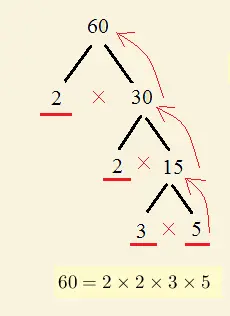
Prime factorization factor tree example for the number 60

Tip: A Prime Factors Calculator may be used to verify your work!

Practice Questions

  1. Which of the following is NOT a prime factorization?
    1. $20 = 2 \times 10$
    2. $14 = 2 \times 7$
    3. $64 = 4^3$
    4. $120 = 2^3 \times 15$
    View Solution

    Answers: a, c, and d are NOT prime factorizations.

    Prime factorization must involve only prime numbers.

    • a) $20 = 2 \times 10$: The number $10$ is composite, not prime.
    • c) $64 = 4^3$: The base number $4$ is composite. (The correct prime factorization is $2^6$).
    • d) $120 = 2^3 \times 15$: The number $15$ is composite. (The correct prime factorization is $2^3 \times 3 \times 5$).
  2. What is the prime factorization of the following numbers?
    1. $28$
    2. $32$
    3. $100$
    4. $126$
    5. $900$
    View Solution

    Divide each number successively by prime numbers until the final quotient is prime:

    1. $28 = 2 \times 2 \times 7 = \mathbf{2^2 \times 7}$
    2. $32 = 2 \times 2 \times 2 \times 2 \times 2 = \mathbf{2^5}$
    3. $100 = 2 \times 2 \times 5 \times 5 = \mathbf{2^2 \times 5^2}$
    4. $126 = 2 \times 3 \times 3 \times 7 = \mathbf{2 \times 3^2 \times 7}$
    5. $900 = 2 \times 2 \times 3 \times 3 \times 5 \times 5 = \mathbf{2^2 \times 3^2 \times 5^2}$
  3. Two numbers, A and B, are given by:
    $A = 2^3 \times 5^2 \times 11$ and $B = 2^2 \times 5 \times 13$.
    What is the prime factorization of $A \times B$?
    View Solution

    Multiply the two prime factorizations together:

    $A \times B = (2^3 \times 5^2 \times 11) \times (2^2 \times 5 \times 13)$

    Group the bases that are the same and add their exponents:

    $A \times B = (2^3 \times 2^2) \times (5^2 \times 5^1) \times 11 \times 13$

    $A \times B = \mathbf{2^5 \times 5^3 \times 11 \times 13}$

  4. Find the prime factorization of $100$ and $70$. Then, use those results to find the prime factorization of $7000$, knowing that $7000 = 100 \times 70$.
    View Solution

    First, find the individual prime factorizations:

    $100 = 2^2 \times 5^2$

    $70 = 2 \times 5 \times 7$

    Use the fact that $7000 = 100 \times 70$ to combine the factors:

    $7000 = (2^2 \times 5^2) \times (2^1 \times 5^1 \times 7^1)$

    Combine like bases by adding exponents:

    $7000 = \mathbf{2^3 \times 5^3 \times 7}$

  5. Discovering Patterns in Powers of 10:
    1. Find the prime factorization of $10$.
    2. Use the result in part (a) and the fact that $100 = 10 \times 10$ to find the prime factorization of $100$.
    3. Use the result in part (a) and the fact that $1000 = 10 \times 10 \times 10$ to find the prime factorization of $1000$.
    4. Use the results above to identify a pattern and find the prime factorization of $1,000,000$.
    View Solution
    1. $10 = \mathbf{2 \times 5}$
    2. $100 = 10 \times 10 = 10^2 = (2 \times 5) \times (2 \times 5) = \mathbf{2^2 \times 5^2}$
    3. $1000 = 10 \times 10 \times 10 = 10^3 = (2 \times 5) \times (2 \times 5) \times (2 \times 5) = \mathbf{2^3 \times 5^3}$
    4. Following the pattern established above, $10^n = 2^n \times 5^n$. Therefore, for one million:
      $1,000,000 = 10^6 = (2 \times 5)^6 = \mathbf{2^6 \times 5^6}$

More References and Links

Home Page