Practice Problems
-
In a bag full of small balls, $\dfrac{1}{4}$ of these balls are green, $\dfrac{1}{8}$ are blue, $\dfrac{1}{12}$ are yellow and the remaining $26$ are white. How many balls are blue?
View Solution
Let's define the total number of balls in the bag as $N$.
Fraction of green, blue, and yellow balls combined:
$$\dfrac{1}{4} + \dfrac{1}{8} + \dfrac{1}{12} = \dfrac{6}{24} + \dfrac{3}{24} + \dfrac{2}{24} = \dfrac{11}{24}$$Fraction of white balls:
$$\dfrac{24}{24} - \dfrac{11}{24} = \dfrac{13}{24}$$Since the 26 white balls represent $\dfrac{13}{24}$ of the total:
$$\dfrac{13}{24}N = 26 \implies N = 26 \times \dfrac{24}{13} = 48$$Number of blue balls:
$$\dfrac{1}{8} \times 48 = 6$$Answer: 6 balls are blue.
-
In a school, $50\%$ of the students are younger than $10$, $\dfrac{1}{20}$ of the students are $10$ years old and $\dfrac{1}{10}$ of the students are older than $10$ but younger than $12$. The remaining $70$ students are $12$ years or older. How many students are $10$ years old?
View Solution
Let $N$ be the total number of students.
Fraction of students younger than 12:
$$\dfrac{1}{2} + \dfrac{1}{20} + \dfrac{1}{10} = \dfrac{10}{20} + \dfrac{1}{20} + \dfrac{2}{20} = \dfrac{13}{20}$$Fraction of students 12 or older:
$$1 - \dfrac{13}{20} = \dfrac{7}{20}$$We know these remaining students equal 70:
$$\dfrac{7}{20}N = 70 \implies N = 70 \times \dfrac{20}{7} = 200$$Number of 10-year-old students:
$$\dfrac{1}{20} \times 200 = 10$$Answer: 10 students are 10 years old.
-
If the length of the side of a square is doubled, what is the ratio of the area of the original square to the area of the new square?
View Solution
Let the side length of the original square be $s$.
The area of the original square is $A_1 = s^2$.
If the side length is doubled, the new side length becomes $2s$, making the new area:
$$A_2 = (2s)^2 = 4s^2$$The ratio of the areas is:
$$\dfrac{A_1}{A_2} = \dfrac{s^2}{4s^2} = \dfrac{1}{4}$$Answer: The ratio is 1:4.
-
The division of a whole number $N$ by $13$ gives a quotient of $15$ and a remainder of $2$. Find $N$.
View Solution
Using the division algorithm: $N = \text{divisor} \times \text{quotient} + \text{remainder}$.
$$N = 13 \times 15 + 2$$
$$N = 195 + 2 = 197$$
Answer: $N = 197$.
-
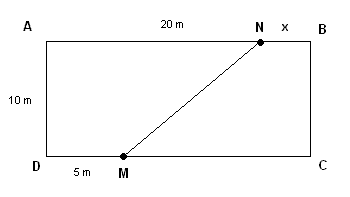
In the rectangle below, the line $MN$ cuts the rectangle into two regions. Find $x$ (the length of segment $NB$) so that the area of the quadrilateral $MNBC$ is $40\%$ of the total area of the rectangle.
View Solution
From the diagram, the total length is $AB = 20 + x$.
Calculate the total area of rectangle $ABCD$:
$$\text{Area} = (20 + x) \times 10 = 200 + 10x$$Calculate $40\%$ of this total area:
$$\text{Area of } MNBC = 0.4 \times (200 + 10x) = 80 + 4x$$The segment $MC$ is calculated as: $MC = (20 + x) - 5 = 15 + x$.
Quadrilateral $MNBC$ is a trapezoid. Calculate its area using the trapezoid formula:
$$A = \dfrac{1}{2} \times \text{height} \times (NB + MC)$$
$$A = \dfrac{1}{2} \times 10 \times (x + 15 + x) = 5(2x + 15) = 10x + 75$$Equate the two area expressions for $MNBC$:
$$10x + 75 = 80 + 4x$$
$$6x = 5 \implies x = \dfrac{5}{6}$$Answer: $x = \dfrac{5}{6}$ meters.
-
A person jogged $10$ times along the perimeter of a rectangular field at the rate of $12$ kilometers per hour for $30$ minutes. If the field has a length that is twice its width, find the area of the field in square meters.
View Solution
First, convert the time to hours: $30 \text{ min} = 0.5 \text{ hours}$.
Calculate the total distance jogged:
$$\text{Distance} = 12 \text{ km/h} \times 0.5 \text{ h} = 6 \text{ km} = 6000 \text{ m}$$Since the jogger ran 10 laps, the perimeter of the field is:
$$6000 \div 10 = 600 \text{ m}$$Let width be $W$. The length $L = 2W$. The perimeter formula is:
$$2(L + W) = 600$$
$$2(2W + W) = 600 \implies 6W = 600 \implies W = 100 \text{ m}$$The length $L = 200 \text{ m}$.
Area = $L \times W = 200 \times 100 = 20,000 \text{ m}^2$.
Answer: $20,000 \text{ m}^2$.
-
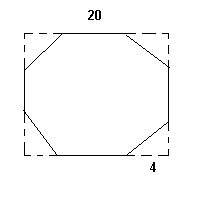
Four congruent isosceles right triangles are cut from the $4$ corners of a square with a side of $20$ units. The length of one leg of the triangles is $4$ units. What is the area of the remaining octagon?
View Solution
Area of the original square:
$$A_{\text{square}} = 20 \times 20 = 400$$Area of one isosceles right triangle:
$$A_{\text{triangle}} = \dfrac{1}{2} \times 4 \times 4 = 8$$Area of the 4 triangles combined:
$$4 \times 8 = 32$$Area of the remaining octagon:
$$400 - 32 = 368$$Answer: $368$ square units.
-
A car is traveling $75$ kilometers per hour. How many meters does the car travel in one minute?
View Solution
Convert kilometers to meters: $75 \text{ km} = 75,000 \text{ m}$.
Convert hours to minutes: $1 \text{ hour} = 60 \text{ minutes}$.
Divide the distance by the time:
$$\dfrac{75,000 \text{ m}}{60 \text{ min}} = 1250 \text{ m/min}$$Answer: $1250$ meters per minute.
-
Linda spent $\dfrac{3}{4}$ of her savings on furniture and the rest on a TV. If the TV cost her $\$200$, what were her original savings?
View Solution
The fraction of savings spent on the TV is:
$$1 - \dfrac{3}{4} = \dfrac{1}{4}$$Let $S$ be the original savings. We know that $\dfrac{1}{4}$ of her savings equals $\$200$:
$$\dfrac{1}{4}S = 200 \implies S = 200 \times 4 = 800$$Answer: $\$800$.
-
The height of water in a cylindrical container of radius $r$ is $15\text{ cm}$. What is the height of this quantity of water if it is poured into a cylindrical container of radius $2r$?
View Solution
The volume of water in the first cylinder is:
$$V_1 = \pi r^2 \times 15$$The volume of water in the second cylinder is:
$$V_2 = \pi (2r)^2 \times h = \pi (4r^2) \times h$$Since the volume remains the same, set $V_1 = V_2$:
$$15\pi r^2 = 4\pi r^2 h$$
$$15 = 4h \implies h = \dfrac{15}{4} = 3.75$$Answer: $3.75\text{ cm}$.
-
Stuart bought a sweater on sale for $30\%$ off the original price and another $25\%$ off the discounted price. If the original price of the sweater was $\$30$, what was the final price of the sweater?
View Solution
The price after the first $30\%$ discount:
$$30 - (0.30 \times 30) = 30 - 9 = \$21$$The price after the second $25\%$ discount:
$$21 - (0.25 \times 21) = 21 - 5.25 = \$15.75$$Answer: $\$15.75$.
-
John bought a shirt on sale for $25\%$ off the original price and another $25\%$ off the discounted price. If the final price was $\$16$, what was the price before the first discount?
View Solution
Let $P$ be the original price.
After the first $25\%$ discount, the price is $0.75P$.
After the second $25\%$ discount, the price is:
$$0.75P \times 0.75 = 0.5625P$$We know the final price is $\$16$:
$$0.5625P = 16 \implies P = \dfrac{16}{0.5625} = 28.444...$$Answer: Approximately $\$28.44$.
-
How many inches are in $2000$ millimeters? (round your answer to the nearest hundredth of an inch).
View Solution
We know that $1\text{ inch} = 25.4\text{ mm}$.
Divide the total millimeters by the conversion factor:
$$2000 \div 25.4 \approx 78.7401...$$Answer: $78.74\text{ inches}$.
-
The rectangular playground in Tim's school is three times as long as it is wide. The area of the playground is $75\text{ m}^2$. What is the perimeter of the playground?
View Solution
Let Width = $W$ and Length = $3W$.
Area = Length $\times$ Width:
$$3W \times W = 75 \implies 3W^2 = 75 \implies W^2 = 25 \implies W = 5\text{ m}$$The length is $L = 3 \times 5 = 15\text{ m}$.
Perimeter = $2(L + W)$:
$$2(15 + 5) = 2(20) = 40\text{ m}$$Answer: $40\text{ meters}$.
-
John had a stock of $1200$ books in his bookshop. He sold $75$ on Monday, $50$ on Tuesday, $64$ on Wednesday, $78$ on Thursday and $135$ on Friday. What percentage of the books were not sold?
View Solution
Calculate the total number of books sold:
$$75 + 50 + 64 + 78 + 135 = 402$$Calculate the books not sold:
$$1200 - 402 = 798$$Find the percentage:
$$\left( \dfrac{798}{1200} \right) \times 100 = 66.5\%$$Answer: $66.5\%$.
-
$N$ is one of the numbers below. $N$ is such that when multiplied by $0.75$ gives $1$. Which number is equal to $N$?
A) $1 \dfrac{1}{2}$ B) $1 \dfrac{1}{3}$ C) $\dfrac{5}{3}$ D) $\dfrac{3}{2}$View Solution
Set up the equation:
$$N \times 0.75 = 1 \implies N = \dfrac{1}{0.75}$$Since $0.75 = \dfrac{3}{4}$, we can rewrite:
$$N = 1 \div \dfrac{3}{4} = \dfrac{4}{3}$$Convert the options to improper fractions to compare:
A) $1 \dfrac{1}{2} = \dfrac{3}{2}$
B) $1 \dfrac{1}{3} = \dfrac{4}{3}$Answer: B.
-
In $2008$, the world population is about $6,760,000,000$. Write the $2008$ world population in scientific notation.
View Solution
To convert to scientific notation $m \times 10^n$ (where $1 \le |m| < 10$), move the decimal point $9$ places to the left.
Answer: $6.76 \times 10^9$.