Practice Questions
-
Cylinder Formulas: Find the total surface area and the volume of a closed cylindrical container with a radius of 5 cm and a height of 34 cm.Hint: Area \( A = 2\pi r^2 + 2\pi rh \), Volume \( V = \pi r^2 h \)
View Step-by-Step Solution
Step 1: Calculate the Total Surface Area
- \( A = 2\pi(5)^2 + 2\pi(5)(34) \) (Substitute \( r=5 \) and \( h=34 \))
- \( A = 2\pi(25) + 2\pi(170) \)
- \( A = 50\pi + 340\pi \)
- Area = \( 390\pi \text{ cm}^2 \)
Step 2: Calculate the Volume
- \( V = \pi(5)^2(34) \)
- \( V = \pi(25)(34) \)
- Volume = \( 850\pi \text{ cm}^3 \)
-
Cone Formulas: Find the total surface area and the volume of a closed conical container with a radius of 5 cm and a height of 15 cm. (Round your answers to the nearest whole unit).Hint: Area \( A = \pi r^2 + \pi r\sqrt{r^2 + h^2} \), Volume \( V = \dfrac{1}{3}\pi r^2 h \)
View Step-by-Step Solution
Step 1: Calculate the Total Surface Area
- First, find the slant height: \( \sqrt{5^2 + 15^2} = \sqrt{25 + 225} = \sqrt{250} \approx 15.81 \) cm.
- \( A = \pi(5)^2 + \pi(5)(15.81) \)
- \( A = 25\pi + 79.05\pi = 104.05\pi \)
- \( 104.05 \times 3.14159 \approx 326.88 \)
- Area \(\approx 327 \text{ cm}^2 \)
Step 2: Calculate the Volume
- \( V = \dfrac{1}{3}\pi(5)^2(15) \)
- \( V = \dfrac{1}{3}\pi(25)(15) = \pi(25)(5) = 125\pi \)
- \( 125 \times 3.14159 \approx 392.69 \)
- Volume \(\approx 393 \text{ cm}^3 \)
-
Working Backwards (Cubes): A cube has a total surface area of the six faces equal to 150 square feet. What is the volume of the cube?Hint: Area \( A = 6s^2 \), Volume \( V = s^3 \) (where \( s \) is the side length)
View Step-by-Step Solution
Step 1: Find the side length (\( s \))
- The total surface area is the sum of 6 identical square faces.
- \( 6s^2 = 150 \)
- \( s^2 = 25 \) (Divide by 6)
- \( s = 5 \text{ feet} \) (Take the square root)
Step 2: Calculate the Volume
- \( V = s^3 = 5^3 = 5 \times 5 \times 5 \)
- Volume = \( 125 \text{ cubic feet} \)
-
Complementary Angles: Which two angles are complementary?
- 21\(^{\circ} \) and 78\(^{\circ} \)
- 58\(^{\circ} \) and 22\(^{\circ} \)
- 67\(^{\circ} \) and 23\(^{\circ} \)
- 140\(^{\circ} \) and 40\(^{\circ} \)
Definition: Complementary angles sum to 90\(^{\circ} \).View Step-by-Step Solution
We must find the pair that adds up to exactly 90\(^{\circ} \):
- A) 21 + 78 = 99\(^{\circ} \)
- B) 58 + 22 = 80\(^{\circ} \)
- C) 67 + 23 = 90\(^{\circ} \) (These are complementary)
- D) 140 + 40 = 180\(^{\circ} \) (These are supplementary)
Answer: C
-
Supplementary Angles: Which two angles are not supplementary?
- 30\(^{\circ} \) and 150\(^{\circ} \)
- 5\(^{\circ} \) and 175\(^{\circ} \)
- 89\(^{\circ} \) and 91\(^{\circ} \)
- 23\(^{\circ} \) and 177\(^{\circ} \)
Definition: Supplementary angles sum to 180\(^{\circ} \).View Step-by-Step Solution
We must find the pair that does not add up to exactly 180\(^{\circ} \):
- A) 30 + 150 = 180\(^{\circ} \)
- B) 5 + 175 = 180\(^{\circ} \)
- C) 89 + 91 = 180\(^{\circ} \)
- D) 23 + 177 = 200\(^{\circ} \) (These do not equal 180)
Answer: D
-
Trapezoid Area: Find the height \( h \) of the trapezoid so that its area is equal to 400 square cm.
 Hint: \( A_{\text{trapezoid}} = \dfrac{1}{2}h(b_1 + b_2) \)
View Step-by-Step Solution
- The given bases are \( b_1 = 27 \) and \( b_2 = 13 \). The Area is 400.
- \( 400 = \dfrac{1}{2}h(27 + 13) \) (Substitute the known values)
- \( 400 = \dfrac{1}{2}h(40) \)
- \( 400 = 20h \)
- \( h = \dfrac{400}{20} \)
- \( h = 20 \text{ cm} \)
-
Parallelogram Area: Find the width \( w \) of the parallelogram so that its area is equal to 600 square feet.
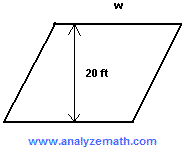 Hint: \( A_{\text{parallelogram}} = \text{base} \times \text{height} \)
View Step-by-Step Solution
- The given height is 20 feet. The Area is 600. The base is labeled \( w \).
- \( 600 = w \times 20 \)
- \( w = \dfrac{600}{20} \)
- \( w = 30 \text{ feet} \)
-
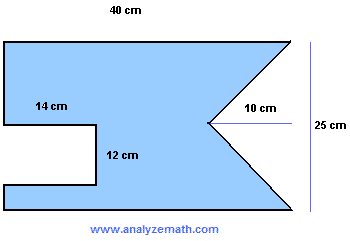
Complex Area: Find the area of the shaded shape based on the visual dimensions provided.
View Step-by-Step Solution
- The area of the shaded region is equal to the area of the large rectangle 40 by 25 from which we subtract the area of the white small rectangle 14 by 12 (left) and the area of the white triangle of height 10 and width 25 (right).
- \( \text{Area of Shaded Region} = 40 \times 25 - 14 \times 12 - \dfrac{1}{2} \times 10 \times 25 = 707 \; \text {cm}^2 \)
-
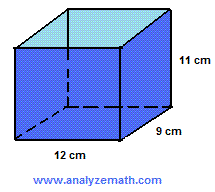
Surface Area of an Open Box: Find the total surface area of the box, which is open at the top.
View Step-by-Step Solution
To find the surface area of an open box, we calculate the area of the base (12 by 9) and add twice the area of the front (12 by 11) and twice the area of the right (11 by 9). We do not include the top face.
- Using the dimensions provided in the graphic, compute the individual rectangular faces.
- \( \text{Total Surface Area} = 12 \times 9 + 2 \times 11 \times 9 + 2 \times 11 \times 12 = 570 \; \text{cm}^2 \).
-
Coordinate Geometry: If the quadrilateral ABCD is a parallelogram, what are the coordinates of point D?

View Step-by-Step Solution
For ABCD to be a parallelogram, opposite sides must be parallel and equal in length. Using vectors, for ABCD to be a parallelogram vectors \( \vec{AB} \) and \( \vec{DC} \) must be equal.
- Components of \( \vec{AB} = \lt 8-2 , 6 - 6 \gt = \lt 6 , 0 \gt \).
- Let \( (a,b) \) be the coordinates of point D.
- Components of \( \vec{DC} = \lt 7-a , 2 - b \gt \).
- Vectors are equal if their components are equal , hence the equations : \( 7 - a = 6 \) and \( 2 - b = 0 \) .
- Solve the equations to find : \( a = 1 \) and \( b = 2 \)
- Point D is located at (1, 2).
-
Right Triangles: Which of the triangles shown are right triangles?
 Hint: In a right triangle, \( a^2 + b^2 = c^2 \) (Pythagorean Theorem) and one angle must equal 90\(^{\circ} \).
View Step-by-Step Solution
- A: The angles are given in triangle A: The third angle is equal to \(180-62-28 = 90^{\circ} \) , triangle A is a right triangle
- B: The sides are given in triagle B: Use the Pythagorean Theorem assuming the longest side of length \( 5 \) is the hypotenuse : \( 3^2 + 3.9^2 = 24.21 \) is not equal to \( 5^2 \) and therefore triangle B is NOT a right triangle.
- C: The sides are given in triagle C: Use the Pythagorean Theorem assuming the longest side of length \( 15 \) is the hypotenuse : \( 9^2 + 12^2 = 225 \) is equal to \( 15^2 = 225 \) and therefore triangle C is a right triangle.
- Triangles A and C are right triangles.
-
Triangle Angles: Find the exterior angle \( x \) if triangle ABC is a right triangle with angle B = 90\(^{\circ} \).
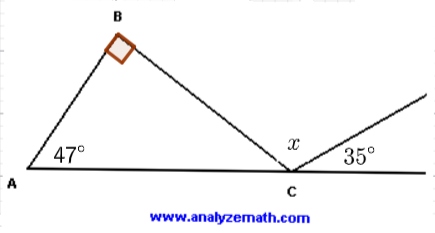 Hint: Interior angles sum to 180\(^{\circ} \). Exterior angles and their adjacent interior angle are supplementary (sum to 180\(^{\circ} \)).
View Step-by-Step Solution
- First, determine the missing interior angle using the rule that the sum of interior angles is 180\(^{\circ} \) in triangle ABC.
- The adjacent interior angle to \( x \) is \( 180^{\circ} - 90^{\circ} - 47^{\circ} = 43^{\circ} \).
- Because \( x \) forms a straight line with that interior angle and the angle of \( 35^{\circ} \), they must add up to 180\(^{\circ} \).
- \( x + 43 + 35 = 180^{\circ} \)
- Solve for \( x \) : \( x = 102^{\circ} \)
-
Similar Triangles: Find all the unknown sides \( x, y, z, \) and \( w \) if all three triangles are similar.
 Hint: When two triangles are similar, their corresponding sides are proportional: \( \dfrac{a}{a'} = \dfrac{b}{b'} = \dfrac{c}{c'} \)
View Step-by-Step Solution
To find the missing sides, set up ratios using the corresponding sides of similar triangles.
- \( \dfrac{12}{36} = \dfrac{17}{y} = \dfrac{3}{x} \)
- \( \dfrac{12}{z} = \dfrac{17}{204} = \dfrac{3}{w} \)
- Solve the equations: \( \dfrac{12}{36} = \dfrac{17}{y} \) , \( \dfrac{12}{36} = \dfrac{3}{x} \) , \( \dfrac{12}{z} = \dfrac{17}{204} \) and \( \dfrac{17}{204} = \dfrac{3}{w} \) to obtain .
- \( x = 9 \)
- \( y = 51 \)
- \( z = 144 \)
- \( w = 36 \)
-
Coordinate Reflection: A quadrilateral with vertices (-2,6), (6,8), (9,2) and (4,-1) is reflected over the x-axis. What are the coordinates of the vertices after reflection?Hint: Reflection over the x-axis: \( (x,y) \to (x,-y) \)
View Step-by-Step Solution
To reflect a point across the x-axis, the x-coordinate stays the same, and the y-coordinate changes its sign.
- \( (-2, 6) \to \) \( (-2, -6) \)
- \( (6, 8) \to \) \( (6, -8) \)
- \( (9, 2) \to \) \( (9, -2) \)
- \( (4, -1) \to \) \( (4, 1) \)
-
Volume Scales: The side of cube A is 3 times the side of cube B. The volume of cube A is 3,375 cubic feet. Find the volume of cube B.Hint: \( V = s^3 \)
View Step-by-Step Solution
Method 1: Scale Factor
- If the side length ratio is 3:1, the volume ratio is cubed: \( 3^3 : 1^3 = 27:1 \).
- This means Cube A is 27 times larger in volume than Cube B.
- \( 3375 \div 27 = \) \( 125 \text{ cubic feet} \).
Method 2: Algebra
- \( V_A = (s_A)^3 = 3375 \). Therefore, \( s_A = \sqrt[3]{3375} = 15 \text{ feet} \).
- Since \( s_A = 3 \times s_B \), then \( 15 = 3 \times s_B \), so \( s_B = 5 \text{ feet} \).
- \( V_B = (5)^3 = \) \( 125 \text{ cubic feet} \).
-
Area Scales (Similar Rectangles): The length of rectangle A is 24 cm and the length of rectangle B is 96 cm. The two rectangles are similar. Find the ratio of the area of A to the area of B.Hint: The ratio of the areas of similar figures is the square of the ratio of their corresponding sides.
View Step-by-Step Solution
- Find the ratio of their corresponding lengths: \( \dfrac{24}{96} \).
- Simplify the side ratio: \( \dfrac{24}{96} = \dfrac{1}{4} \).
- To find the area ratio, square the side ratio: \( \left(\dfrac{1}{4}\right)^2 = \dfrac{1^2}{4^2} = \dfrac{1}{16} \).
- The ratio of the area of A to the area of B is 1:16.