Practice Questions & Solutions
-
Evaluate the following expressions:
a) \([-2 \times (-4) + 3] \times [3 \times (-4) - 4]\)
b) \([-2 \times (-3 + 1) + 3] \times [2 \times (-3 - 5) - 4]\)View Step-by-Step Solution
a)
\([-2 \times (-4) + 3] \times [3 \times (-4) - 4]\)
\(= [8 + 3] \times [-12 - 4]\)
\(= 11 \times (-16) = -176\)b)
\([-2 \times (-3 + 1) + 3] \times [2 \times (-3 - 5) - 4]\)
\(= [-2 \times (-2) + 3] \times [2 \times (-8) - 4]\)
\(= [4 + 3] \times [-16 - 4]\)
\(= 7 \times (-20) = -140\) -
Which of the following is NOT a rational number?
a) \(0.2\) b) \(\pi\) c) \(\dfrac{2}{5}\)View Step-by-Step Solution
Answer: b) \(\pi\)
\(\pi\) is NOT a rational number because it cannot be expressed as a simple fraction of two integers.
-
What is the value of the digit 5 in the number 34.6597?
View Step-by-Step Solution
The digit 5 is in the hundredths place, making its value \(0.05\) or \(\dfrac{5}{100}\).
-
What is the next term in the sequence? \(3, 6, 9, 12, \ldots\)
View Step-by-Step Solution
We notice that as we go from one term to the next, we add \(3\); hence the next term is equal to: \(12 + 3 = 15\).
-
What is the next term in the sequence? \(1, 3, 9, 27, \ldots\)
View Step-by-Step Solution
We notice that as we go from one term to the next, we multiply by \(3\); hence the next term is given by: \(27 \times 3 = 81\).
-
A sequence of numbers is defined by \(2n + 1\) for \(n = 1, 2, 3, \ldots\)
a) Find the first five terms of the sequence starting with \(n = 1\).
b) Is the given sequence arithmetic, geometric, or neither?View Step-by-Step Solution
a) Substitute \(n = 1, 2, 3, 4, 5\) into the expression \(2n + 1\):
For \(n=1\), \(2(1)+1 = 3\)
For \(n=2\), \(2(2)+1 = 5\)
For \(n=3\), \(2(3)+1 = 7\)
For \(n=4\), \(2(4)+1 = 9\)
For \(n=5\), \(2(5)+1 = 11\)b) Going from one term to the next, we add 2, hence it is an arithmetic sequence with a common difference equal to 2.
-
A sequence of numbers is defined by \(3 \times 2^{n-1}\) for \(n = 1, 2, 3, \ldots\)
a) Find the first five terms of the sequence starting with \(n = 1\).
b) Is the given sequence arithmetic, geometric, or neither?View Step-by-Step Solution
a) Substitute \(n = 1, 2, 3, 4, 5\) into the expression \(3 \times 2^{n-1}\):
For \(n=1\), \(3 \times 2^{1-1} = 3 \times 2^0 = 3\)
For \(n=2\), \(3 \times 2^{2-1} = 3 \times 2^1 = 6\)
For \(n=3\), \(3 \times 2^{3-1} = 3 \times 2^2 = 12\)
For \(n=4\), \(3 \times 2^{4-1} = 3 \times 2^3 = 24\)
For \(n=5\), \(3 \times 2^{5-1} = 3 \times 2^4 = 48\)b) Going from one term to the next, we multiply by 2, hence it is a geometric sequence with a common ratio equal to 2.
-
Sets \(S_1\) and \(S_2\) are defined as: \(S_1 = \{0, 2, 9, 12\}\) and \(S_2 = \{2, 9, 10, 11, 12\}\). Find the elements of:
a) \(S_1 \cap S_2\)
b) \(S_1 \cup S_2\)View Step-by-Step Solution
a) The intersection of two sets is the set of all elements common to both sets. Hence \(S_1 \cap S_2 = \{2, 9, 12\}\).
b) The union of two sets is the set of all elements in the two sets (without repetition). Hence \(S_1 \cup S_2 = \{0, 2, 9, 10, 11, 12\}\).
-
Let \(Q\) = All Rational Numbers, \(P\) = All Irrational Numbers, \(R\) = All Real Numbers. Which is true?
a) \(Q \cap P = R\) b) \(Q \cup P = R\) c) \(Q \cup P = \text{Empty Set}\) d) \(Q \cap P = \text{Empty Set}\)View Step-by-Step Solution
Any real number is either rational or irrational but not both, hence \(Q \cap P = \text{Empty Set}\) is true. The set of all real numbers is the union of the rational and irrational numbers, hence \(Q \cup P = R\) is true.
Statements b) and d) are true.
-
Express as a product of prime factors: a) 345 b) 150 c) 210
View Step-by-Step Solution
a) \(345 = 3 \times 5 \times 23\)
b) \(150 = 2 \times 3 \times 5 \times 5\)
c) \(210 = 2 \times 3 \times 5 \times 7\)
-
What is the Greatest Common Factor (GCF) of 100 and 180?
View Step-by-Step Solution
The Greatest Common Factor of 100 and 180 is 20.
-
What is the Least Common Multiple (LCM) of 100 and 15?
View Step-by-Step Solution
The Least Common Multiple of 100 and 15 is 300.
-
Which is divisible by 3? a) 101899 b) 900234 c) 134567280
View Step-by-Step Solution
A number is divisible by 3 if the sum of its digits is divisible by 3.
a) 101899: Sum = \(1+0+1+8+9+9 = 28\). (Not divisible)
b) 900234: Sum = \(9+0+0+2+3+4 = 18\). (Yes, divisible)
c) 134567280: Sum = \(1+3+4+5+6+7+2+8+0 = 36\). (Yes, divisible)
-
Which is divisible by 4? a) 189001 b) 1005612 c) 1003456024
View Step-by-Step Solution
A number is divisible by 4 if its two digits on the right form a number that is divisible by 4.
a) 189001: Last two digits \(01\). (Not divisible)
b) 1005612: Last two digits \(12\). (Yes, divisible)
c) 1003456024: Last two digits \(24\). (Yes, divisible)
-
Which is divisible by 6? a) 234 b) 12345 c) 12114290910
View Step-by-Step Solution
For a number to be divisible by 6, it has to be divisible by 2 (even) and by 3.
a) 234: Even, sum of digits \(2+3+4=9\) (Yes, divisible)
b) 12345: Odd (Not divisible by 2, so not divisible by 6)
c) 12114290910: Even, sum of digits \(30\). (Yes, divisible)
-
Which pairs of fractions are equivalent?
a) \(\dfrac{10}{15}, \dfrac{7}{3}\) b) \(\dfrac{8}{12}, \dfrac{2}{3}\) c) \(\dfrac{7}{12}, \dfrac{21}{36}\)View Step-by-Step Solution
Start with the fraction in reduced terms and multiply by a factor in order to obtain the second fraction.
a) Multiply numerator and denominator of \(\dfrac{7}{3}\) by 5 to get \(\dfrac{35}{15}\). This does not match \(\dfrac{10}{15}\). (Not equivalent)
b) Multiply numerator and denominator of \(\dfrac{2}{3}\) by 4 to get \(\dfrac{8}{12}\). (Equivalent)
c) Multiply numerator and denominator of \(\dfrac{7}{12}\) by 3 to get \(\dfrac{21}{36}\). (Equivalent)
-
Evaluate:
a) \(\dfrac{2}{5} + \dfrac{3}{10} - \dfrac{1}{15}\) b) \(\dfrac{7}{16} \times \dfrac{4}{14}\) c) \(\dfrac{11}{2} \div 4\)
d) \(4\dfrac{3}{4} - 1\dfrac{1}{2} + 1\dfrac{1}{8}\) e) \(1\dfrac{3}{4} \div \left(3 + \dfrac{1}{3}\right)\)View Step-by-Step Solution
a) LCM of \(5, 10, 15\) is \(30\). \(\dfrac{12}{30} + \dfrac{9}{30} - \dfrac{2}{30} = \dfrac{19}{30}\)
b) \(\dfrac{7}{16} \times \dfrac{4}{14}\). Factor terms: \(\dfrac{7 \times 4}{(4 \times 4) \times (2 \times 7)}\). Cancel common factors to get \(\dfrac{1}{8}\)
c) Multiply by reciprocal: \(\dfrac{11}{2} \times \dfrac{1}{4} = \dfrac{11}{8}\)
d) Group whole parts and fractions: \((4-1+1) + (\dfrac{3}{4} - \dfrac{1}{2} + \dfrac{1}{8}) = 4 + (\dfrac{6}{8} - \dfrac{4}{8} + \dfrac{1}{8}) = 4\dfrac{3}{8}\)
e) Convert to fractions: \(\dfrac{7}{4} \div \dfrac{10}{3} = \dfrac{7}{4} \times \dfrac{3}{10} = \dfrac{21}{40}\)
-
Write as fractions in reduced form: a) \(0.2 \div 0.6\) b) \(1 \div 0.4\)
View Step-by-Step Solution
a) \(0.2 \div 0.6 = \dfrac{2}{6} = \dfrac{1}{3}\)
b) \(1 \div 0.4 = \dfrac{10}{4} = \dfrac{8+2}{4} = 2\dfrac{1}{2}\)
-
Dalia spends one quarter of her salary on food and beverages. She spends one fifth of that on soft drinks and one sixth of that on cookies. What fraction of her salary is spent on soft drinks and cookies?
View Step-by-Step Solution
Soft drinks: \(\dfrac{1}{5}\) of \(\dfrac{1}{4}\) of her salary.
Cookies: \(\dfrac{1}{6}\) of \(\dfrac{1}{4}\) of her salary.
Total: \(\dfrac{1}{5} \times \dfrac{1}{4} + \dfrac{1}{6} \times \dfrac{1}{4} = \dfrac{1}{4} \left(\dfrac{1}{5} + \dfrac{1}{6}\right) = \dfrac{1}{4} \left(\dfrac{11}{30}\right) = \dfrac{11}{120}\)
-
James spends 2 hours/day on homework Mon–Fri. Ben spends \(\dfrac{3}{4}\) as much; Linda spends \(\dfrac{5}{4}\) as much. How many hours do they spend in a week?
View Step-by-Step Solution
James: \(2 \times 5 = 10\) hours on homework during weekdays.
Ben: \(\dfrac{3}{4} \times 10 = 7.5\) hours on homework during weekdays.
Linda: \(\dfrac{5}{4} \times 10 = 12.5\) hours on homework during weekdays.
-
Sara made 1.5 L of juice. Her glasses hold \(\dfrac{1}{6}\) L. How many glasses can she fill?
View Step-by-Step Solution
Using mixed numbers, 1.5 L is written as \(1\dfrac{1}{2}\) or \(\dfrac{3}{2}\) L.
Number of glasses = \(\dfrac{3}{2} \div \dfrac{1}{6} = \dfrac{3}{2} \times 6 = 9\) glasses.
-
Evaluate:
a) \((-2)^3 - 5^3 + (-3)^4\)
b) \((-1)^{-3} - 5^0 + \dfrac{4^2}{(-2)^4}\)
c) \(\left(\dfrac{3}{4}\right)^2 + \left(\dfrac{4}{3}\right)^{-2}\)View Step-by-Step Solution
a) \(-8 - 125 + 81 = -52\)
b) \(\dfrac{1}{(-1)^3} - 1 + \dfrac{16}{16} = -1 - 1 + 1 = -1\)
c) \(\dfrac{3^2}{4^2} + \dfrac{4^{-2}}{3^{-2}} = \dfrac{9}{16} + \dfrac{3^2}{4^2} = \dfrac{9}{16} + \dfrac{9}{16} = \dfrac{18}{16} = \dfrac{9}{8}\)
-
Write in exponential form (base ten): a) 10000 b) 0.0000001 c) \(\dfrac{1}{100000}\)
View Step-by-Step Solution
a) \(10^4\) b) \(10^{-7}\) c) \(\dfrac{1}{10^5} = 10^{-5}\)
-
Write in scientific notation: a) \(12.4 \times 10^3\) b) \(0.0023 \times 10^{-2}\) c) \(\dfrac{12}{100000}\)
View Step-by-Step Solution
a) \(1.24 \times 10^4\) b) \(2.3 \times 10^{-5}\) c) \(\dfrac{12}{10^5} = 12 \times 10^{-5} = 1.2 \times 10^{-4}\)
-
Simplify: a) \(\sqrt{16}\) b) \(\sqrt{9}\) c) \(\sqrt[3]{8}\)
View Step-by-Step Solution
a) 4 because \(4^2=16\) b) 3 because \(3^2=9\) c) 2 because \(2^3=8\)
-
Reduce to simplest form: a) \(\sqrt{3 \times 25}\) b) \(\sqrt{36 \times 5}\) c) \(\sqrt[3]{8 \times 7}\)
View Step-by-Step Solution
a) \(\sqrt{3} \times \sqrt{25} = 5\sqrt{3}\) b) \(\sqrt{36} \times \sqrt{5} = 6\sqrt{5}\) c) \(\sqrt[3]{8} \times \sqrt[3]{7} = 2\sqrt[3]{7}\)
-
Leila walked for 5 hours. The graph gives distance \(d\) vs. time \(t\).
a) Write an equation \(d = kt\).
b) If she started at 8 AM, when was she 10 km away?
View Step-by-Step Solution
a) Use a point on the graph. For example, when \(t = 1\), \(d = 4\). Substitute \(t\) by 1 and \(d\) by 4 in the equation \(d = k \times t\) to obtain \(4 = k \times 1\), hence \(k = 4\). The relationship is \(d = 4t\).
b) Find time it takes Leila to walk \(d = 10\) km by solving the equation \(10 = 4t \rightarrow t = 10 \div 4 = 2.5\) hours. 2.5 hours may be written as 2:30. She is 10 km away at: 8:00 + 2:30 = 10:30 AM.
-
Does the table indicate that \(y\) is proportional to \(x\)?

a) If yes, find \(k\) such that \(y = kx\).
b) Find \(y\) for \(x=10.2\).View Step-by-Step Solution
A column that contains the ratio \(y / x\) was added and it shows that \(y / x\) is constant and equal to 3. Hence \(y\) is proportional to \(x\).

a) Since \(y / x = 3\), we can write \(y = 3x\). Hence \(k = 3\).
b) \(y = 3 \times 10.2 = 30.6\).
-
A tap fills 10 L in 2 min, 20 L in 4 min, 30 L in 6 min.
a) Plot points with \(V\) on vertical axis, \(t\) horizontal.
b) Is \(V\) proportional to \(t\)?
c) If yes, find \(k\) such that \(V = kt\).
d) Find time to fill 100 L.View Step-by-Step Solution
a) From the given information, we can write three points \((V, t)\): \((2,10)\), \((4,20)\) and \((6,30)\) which are plotted below.

b) The three points are located on the same line passing through the origin and therefore there is a proportionality relationship between \(V\) and \(t\).
c) The constant of proportionality \(k\) is \(V \div t\). \(k = 10 \div 2 = 5\). Hence \(V = 5t\).
d) Substitute \(V=100\) in the equation: \(100 = 5t \rightarrow t = 100 \div 5 = 20\) minutes.
-
An item costs $120 and increases by 12%. What is the new price?
View Step-by-Step Solution
Price after increase = $120 + 12% of $120.
Written mathematically: \(120 + \dfrac{12}{100} \times 120 = 120 + 14.4 = \$134.40\).
-
Jimmy spends 50% of his salary on rent + bills, and 15% of that amount on bills. What percent of his total salary is spent on bills?
View Step-by-Step Solution
Percent spent on bills = 15% of 50% of his salary.
Written mathematically: \(\dfrac{15}{100} \times \dfrac{50}{100} = \dfrac{750}{10000} = \dfrac{7.5}{100} = 7.5\%\).
-
A meal costs $40. Tax is 15%; tip is 5% of the taxed amount. What is the total cost?
View Step-by-Step Solution
Cost after tax = \(40 + \dfrac{15}{100} \times 40 = \$46\).
Cost after tip = \(46 + \dfrac{5}{100} \times 46 = \$48.30\).
-
Kamelea earns \( \$5000 \) and spends: \( \$400 \) on clothes, \( \$1200 \) rent, \( \$200 \) bills, \( \$1200 \) food/outings, \( \$600 \)car, and saves the rest. What percent is saved?
View Step-by-Step Solution
Kamelea's spending = \(\$400 + \$1200 + \$200 + \$1200 + \$600 = \$3600\).
Savings = Salary - spending = \(\$5000 - \$3600 = \$1400\).
Kamelea's savings in percent of salary = \(\dfrac{1400}{5000} = 0.28 = 28\%\).
-
10% of one third of a number is 3. What is the number?
View Step-by-Step Solution
Let \(x\) be the unknown number. \(\dfrac{10}{100} \times \dfrac{1}{3} \times x = 3\).
\(\dfrac{10x}{300} = 3\). Multiply both sides by 300 to get \(10x = 900 \rightarrow x = 90\).
-
Gas rose from \( \$3 \) to \( \$4 \) per gallon in the US and €1.5 to €2 per liter in France. Which saw a larger percent increase?
View Step-by-Step Solution
Percentage increase of gas in the US = \(\dfrac{4 - 3}{3} = 0.33333 = 33.33\%\).
Percentage increase of gas in France = \(\dfrac{2 - 1.5}{1.5} = 0.33333 = 33.33\%\).
Both saw the exact same percentage increase.
-
Convert 10.5 ft to meters given 1 m = 3.28084 ft.
View Step-by-Step Solution
Divide both sides of the equality by 3.28084 ft to get \(\dfrac{1 \text{ m}}{3.28084 \text{ ft}} = 1\).
\(10.5 \text{ ft} \times \dfrac{1 \text{ m}}{3.28084 \text{ ft}} = 3.20039 \text{ m}\).
-
Convert 1.3 km to yards given 1 km = 1093.61 yd.
View Step-by-Step Solution
\(1.3 \text{ km} = 1.3 \times 1093.61 \text{ yd} = 1421.69 \text{ yd}\).
-
Convert \(1.2 \text{ m}^2\) to \(\text{yd}^2\) given 1 m = 1.09361 yd.
View Step-by-Step Solution
Square both sides of the given equality to obtain \(1 \text{ m}^2 = (1.09361)^2 \text{ yd}^2 = 1.19598 \text{ yd}^2\).
\(1.2 \text{ m}^2 = 1.2 \times 1.19598 \text{ yd}^2 = 1.435176 \text{ yd}^2\).
-
Convert 100 km/hr to m/s.
View Step-by-Step Solution
\(1 \text{ km} = 1000 \text{ m}\) and \(1 \text{ hr} = 3600 \text{ sec}\).
\(\dfrac{100 \text{ km}}{1 \text{ hr}} = \dfrac{100 \times 1000 \text{ m}}{1 \times 3600 \text{ sec}} \approx 27.77777 \text{ m/sec}\).
-
Evaluate \(\dfrac{1}{x+2} - \dfrac{1}{x-2}\) for \(x=1\).
View Step-by-Step Solution
Substitute \(x\) by 1: \(\dfrac{1}{(1)+2} - \dfrac{1}{(1)-2} = \dfrac{1}{3} - \dfrac{1}{-1} = \dfrac{1}{3} + 1 = 1\dfrac{1}{3}\).
-
Evaluate \(\left|\dfrac{-x+1}{-6}\right| + x^2 - 1\) for \(x=-5\).
View Step-by-Step Solution
Substitute \(x\) by -5: \(\left|\dfrac{-(-5)+1}{-6}\right| + (-5)^2 - 1 = \left|\dfrac{5+1}{-6}\right| + 25 - 1 = |-1| + 25 - 1 = 1 + 25 - 1 = 25\).
-
Evaluate \(2^a - \sqrt{b^2}\) for \(a=2\), \(b=-2\).
View Step-by-Step Solution
Substitute \(a\) by 2 and \(b\) by -2: \(2^{(2)} - \sqrt{(-2)^2} = 4 - \sqrt{4} = 4 - 2 = 2\).
-
Simplify: a) \(3(x+2) + x - 12\) b) \(\dfrac{1}{5}(15x+20) + 2x + 4\) c) \(0.2(5x+10) + 3x - 4\)
View Step-by-Step Solution
a) \(3x + 6 + x - 12 = (3x+x) + (6-12) = 4x - 6\)
b) \(\dfrac{1}{5} \times 15x + \dfrac{1}{5} \times 20 + 2x + 4 = 3x + 4 + 2x + 4 = 5x + 8\)
c) \(0.2 \times 5x + 0.2 \times 10 + 3x - 4 = x + 2 + 3x - 4 = 4x - 2\)
-
Simplify: a) \(2x \cdot 3x\) b) \(\dfrac{1}{2}x \cdot \dfrac{4}{5}x\) c) \(3x^2 \cdot 5x^3\)
View Step-by-Step Solution
a) \((2 \times 3) \times (x \times x) = 6x^2\)
b) \(\left(\dfrac{1}{2} \times \dfrac{4}{5}\right) \times (x \times x) = \dfrac{2}{5}x^2\)
c) \((3 \times 5) \times (x^2 \times x^3) = 15x^5\)
-
Factor: a) \(21x + 7\) b) \(24 - 20x\) c) \(8b - 4a + 32\)
View Step-by-Step Solution
a) Greatest common factor of 21 and 7 is 7. \(7(3x + 1)\)
b) Greatest common factor of 24 and 20 is 4. \(4(6 - 5x)\)
c) Greatest common factor of 8, 4 and 32 is 4. \(4(2b - a + 8)\)
-
Solve the equations:
a) \(3(x - 2 ) = 3\)
b) \(2(9 - x) = - (x + 5)\)
c) \(\dfrac{x+1}{3} = 6\)
d) \(4\left(x + \dfrac{1}{4}\right) = -15\)
e) \(x - \dfrac{x}{2} = 3\)View Step-by-Step Solution
a) \(3x - 6 = 3 \rightarrow 3x = 9 \rightarrow x = 3\)
b) \(18 - 2x = -x - 5 \rightarrow 18 = x - 5 \rightarrow x = 23\)
c) Multiply by 3: \(x + 1 = 18 \rightarrow x = 17\)
d) \(4x + 1 = -15 \rightarrow 4x = -16 \rightarrow x = -4\)
e) Multiply by 2: \(2x - x = 6 \rightarrow x = 6\)
-
A rectangular garden has a length of 12m and a width of 8m. A path of width \(x\) is constructed around the garden so that the outer perimeter is twice the original perimeter.

a) Write an equation in \(x\).
b) Solve for \(x\).
c) Find the length and width of the outer perimeter.
d) Find the total area (garden + path).
e) Find the garden area.
f) Find the area of the path.View Step-by-Step Solution
a) Length of outer perimeter: \(L = 12 + 2x\). Width: \(W = 8 + 2x\). Outer perimeter = \(2(12 + 2x) + 2(8 + 2x) = 40 + 8x\). Perimeter of garden (white) = \(2(12) + 2(8) = 40\). Outer is twice the garden, so \(40 + 8x = 2 \times 40\).
b) \(40 + 8x = 80 \rightarrow 8x = 40 \rightarrow x = 5 \text{ m}\).
c) Length = \(12 + 2(5) = 22 \text{ m}\), Width = \(8 + 2(5) = 18 \text{ m}\).
d) Total Area = \(22 \times 18 = 396 \text{ m}^2\).
e) Garden Area = \(12 \times 8 = 96 \text{ m}^2\).
f) Path Area = Total Area - Garden Area = \(396 - 96 = 300 \text{ m}^2\).
-
When 10 is subtracted from twice a number and the result is multiplied by one-half, the answer is 5. What is the original number?
View Step-by-Step Solution
Let \(x\) be the original number. "10 is subtracted from twice a number" is \(2x - 10\). "Result is multiplied by half" is \(\dfrac{1}{2}(2x - 10)\). The answer is 5: \(\dfrac{1}{2}(2x - 10) = 5\).
Multiply both sides by 2: \(2x - 10 = 10 \rightarrow 2x = 20 \rightarrow x = 10\).
-
Solve: a) \(x + 2 < 4\) b) \(2(x + 3) \ge 2\) c) \(-3x + 2 \le 11\) d) \(\dfrac{4x+1}{2} \ge x + 3\)
View Step-by-Step Solution
a) \(x < 2\)
b) \(2x + 6 \ge 2 \rightarrow 2x \ge -4 \rightarrow x \ge -2\)
c) \(-3x \le 9 \rightarrow x \ge -3\) (change the symbol of the inequality because -3 is negative).
d) \(4x + 1 \ge 2x + 6 \rightarrow 2x \ge 5 \rightarrow x \ge 5/2\)
-
Which of the ordered pairs represents a function?
a) \(\{(1,2), (3,4), (5,7), (5,9)\}\)
b) \(\{(-1,-2), (3,4), (5,7), (7,9)\}\)
c) \(\{(3,3), (9,4), (5,7), (9,0)\}\)View Step-by-Step Solution
A function is a relation between two sets such that to each input there corresponds one output only.
The relation b) is a function. Choice a) has input 5 mapped to 7 and 9. Choice c) has input 9 mapped to 4 and 0.
-
Which of the graphs below may be the graph of a linear function? Find its equation.

View Step-by-Step Solution
Graph (3) is a straight line and is therefore the graph of a linear function.
Find two points (0,2) and (2,6) and find the slope: \( m = \dfrac{6-2}{2-0} = 2 \)
Write the slope intercept form of the equation of the line: \( y = 2 + 2 x \)
-
Given \(y = 2x + 1\):
a) Find \(y\) for \(x = 0\) and \(x = 1\).
b) Use these values to graph \(y = 2x + 1\).View Step-by-Step Solution
a) For \(x=0\), \(y = 2(0)+1 = 1\). For \(x=1\), \(y = 2(1)+1 = 3\). The ordered pairs are \((0, 1)\) and \((1, 3)\).
b) The graph of a linear function is a line. The two ordered pairs obtained may be used to graph the function as shown below.

-
Two functions are graphed below.
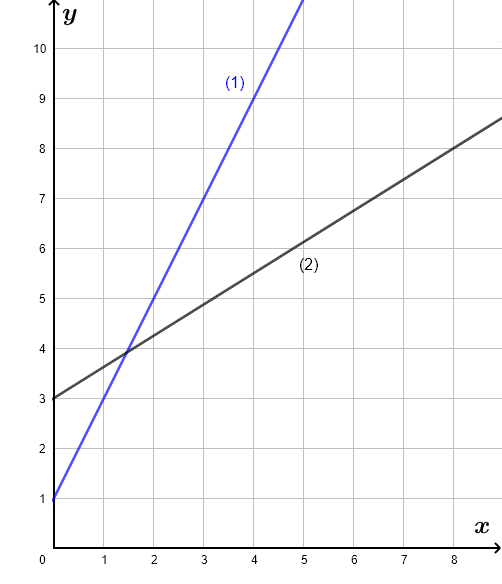
a) Without calculations, which has the higher rate of change?
b) Find coordinates of two points on each.
c) Calculate each rate of change to confirm (a).View Step-by-Step Solution
a) The function corresponding to graph (1) has a higher rate of change because it increases faster as \(x\) increases.

b) Points on Graph (1): \((0,1)\) and \((3,7)\). Points on Graph (2): \((0,3)\) and \((8,8)\).
c) Rate 1: \(\dfrac{7-1}{3-0} = \dfrac{6}{3} = 2\). Rate 2: \(\dfrac{8-3}{8-0} = 5/8\). Calculations confirm that the rate of change of (1) is higher.
-
The legs of a right triangle are 6 cm and 8 cm. What is the length of the hypotenuse?
View Step-by-Step Solution
Let \(h\) be the hypotenuse. Using Pythagorean theorem: \(h^2 = 6^2 + 8^2 = 36 + 64 = 100\). \(h = \sqrt{100} = 10 \text{ cm}\).
-
Three straight lines intersect at \(O\). Given \(\angle AOB = 31^\circ\) and \(\angle AOC = 79^\circ\), find \(\angle EOF\).

View Step-by-Step Solution
Note that \(\angle AOC = \angle AOB + \angle BOC\). So \(79^\circ = 31^\circ + \angle BOC\). Hence \(\angle BOC = 79^\circ - 31^\circ = 48^\circ\).
Angles \(\angle BOC\) and \(\angle EOF\) are vertical and therefore have equal sizes. \(\angle EOF = 48^\circ\).
-
How many lines of symmetry does a square have?
View Step-by-Step Solution
A square has 4 lines of symmetry as shown below.

-
Given \(m\angle 1 = 40^\circ\), find the measures of all eight angles in the parallel intersection.

View Step-by-Step Solution
Angles \(m\angle 1\) and \(m\angle 2\) are supplementary and sum to \(180^\circ\). So \(m\angle 2 = 180^\circ - 40^\circ = 140^\circ\).
\(m\angle 1\) and \(m\angle 3\) are vertical (equal). \(m\angle 3 = 40^\circ\).
\(m\angle 2\) and \(m\angle 4\) are vertical (equal). \(m\angle 4 = 140^\circ\).
\(m\angle 1\) and \(m\angle 5\) are corresponding (equal). \(m\angle 5 = 40^\circ\).
\(m\angle 2\) and \(m\angle 6\) are corresponding (equal). \(m\angle 6 = 140^\circ\).
\(m\angle 4\) and \(m\angle 8\) are corresponding (equal). \(m\angle 8 = 140^\circ\).
\(m\angle 3\) and \(m\angle 7\) are corresponding (equal). \(m\angle 7 = 40^\circ\).
-
Calculate the area of a circle with a diameter of 20 cm.
View Step-by-Step Solution
Radius \(r = \text{Diameter} \div 2 = 20 \div 2 = 10 \text{ cm}\). Area \(= \pi \times r^2 = 3.14 \times 10^2 = 314 \text{ cm}^2\).
-
Calculate the area of a right triangle with one leg of 16 cm and a hypotenuse of 20 cm.
View Step-by-Step Solution
Use the Pythagorean theorem to find the second leg \(b\): \(b^2 + 16^2 = 20^2 \rightarrow b^2 = 400 - 256 = 144 \rightarrow b = 12 \text{ cm}\).
Area \(= \dfrac{1}{2} \times 16 \times 12 = 96 \text{ cm}^2\).
-
In the figure, ABDE is a square and FC is a line of symmetry. Find the area of the blue arrow.

View Step-by-Step Solution
Because of the symmetry, we calculate the area of the lower part of the arrow which is a trapezoid.

Area of trapezoid \(= \dfrac{1}{2}(\overline{FG} + \overline{ED}) \times \overline{HE}\).
\(\overline{FG} = 12 + 16 - 4 = 24\). \(\overline{ED} = 16\). \(\overline{HE} = \dfrac{1}{2} \overline{AE} = 8\).
Area \(= \dfrac{1}{2}(24 + 16) \times 8 = 160\).
The area of the arrow is twice the trapezoid: \(2 \times 160 = 320 \text{ unit}^2\).
-
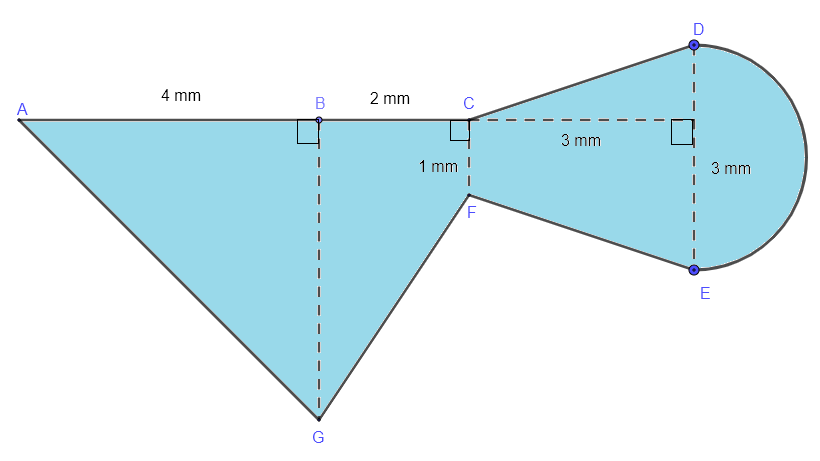
Find the area of the shape bounded by a semicircle (diameter DE) and an isosceles triangle ABG. Round to two decimal places.
View Step-by-Step Solution
We decompose the given shape into basic shapes whose areas are easily calculated using formulas.

Area of isosceles triangle ABG \(= \dfrac{1}{2} \times 4 \times 4 = 8\)
Area of trapezoid BCFG \(= \dfrac{1}{2} \times 2 \times (4+1) = 5\)
Area of trapezoid CDEF \(= \dfrac{1}{2} \times 3 \times (1+3) = 6\)
Area of semicircle of diameter DE \(= \dfrac{1}{2} \times \pi \times 1.5^2 \approx 3.53\)
Total area \(= 8 + 5 + 6 + 3.53 = 22.53 \text{ mm}^2\).
-
Find the volume and surface area (excluding the bottom) of a silo consisting of a cylinder (\(h = 10\) m) and a hemisphere (\(r = 6\) m) on top.

View Step-by-Step Solution
The volume of half the sphere \(= \dfrac{1}{2} \times \dfrac{4}{3} \pi r^3 = \dfrac{4}{6} \times 3.14 \times 6^3 = 452.16 \text{ m}^3\)
The volume of the cylinder \(= \pi \times r^2 \times h = 3.14 \times 6^2 \times 10 = 1130.4 \text{ m}^3\)
The surface area of half the sphere \(= \dfrac{1}{2} \times 4 \times \pi \times r^2 = 2 \times 3.14 \times 6^2 = 226.08 \text{ m}^2\)
The surface area of the cylinder (without the bottom) \(= 2 \times \pi \times r \times h = 2 \times 3.14 \times 6 \times 10 = 376.8 \text{ m}^2\)
Total volume of silo \(= 452.16 + 1130.4 = 1582.56 \text{ m}^3\)
Total surface area of silo \(= 226.08 + 376.8 = 602.88 \text{ m}^2\)
-
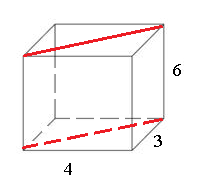
A rectangular prism is split diagonally into two congruent triangular prisms. Find the volume and surface area of one triangular prism.
View Step-by-Step Solution
Because of the symmetry, the volume of the triangular prism is half the volume of the rectangular prism.

Volume of rectangular prism \(= 6 \times 3 \times 4 = 72 \text{ unit}^3\). Volume of triangular prism \(= 36 \text{ unit}^3\).
Surface area is half the surface area of the rectangular prism plus the area of the rectangle made by the red diagonals.
Surface area of rectangular prism \(= 2 \times (6 \times 3 + 3 \times 4 + 6 \times 4) = 108 \text{ unit}^2\).
Use Pythagorean theorem to find the length \(d\) of the diagonal: \(d^2 = 3^2 + 4^2 = 25 \rightarrow d=5\).
Area of the rectangle slice \(= 5 \times 6 = 30 \text{ unit}^2\).
Surface area of triangular prism \(= \dfrac{1}{2} \times 108 + 30 = 84 \text{ unit}^2\).
-
The line plot shows average high temperatures (°C) for 12 months in Ottawa.
a) Average high of the coldest month?
b) Average high of the hottest month?
c) Difference between the coldest and hottest?
d) Smallest increase between two consecutive months?
e) Smallest decrease between two consecutive months?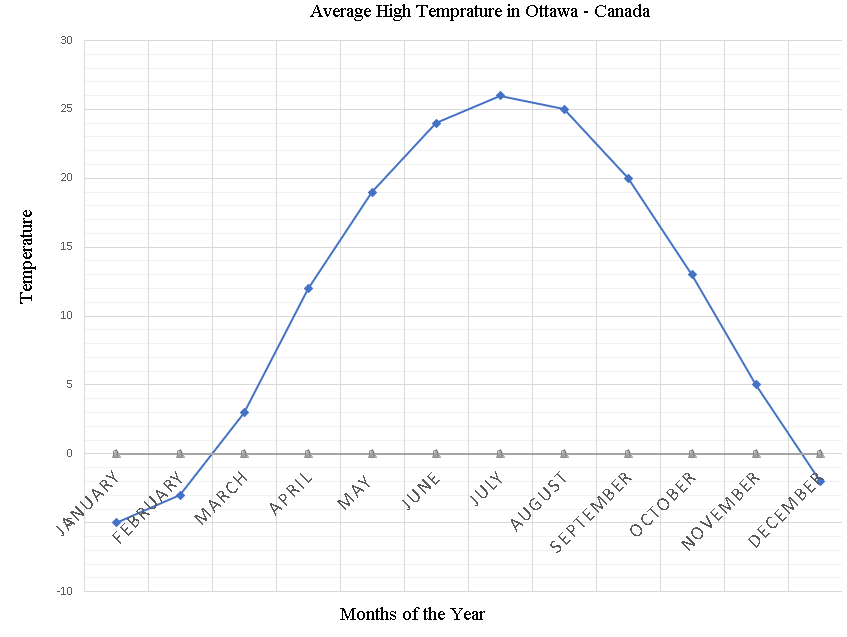
View Step-by-Step Solution
a) January has the lowest average temperature of \(-5^\circ\)C.
b) July has the highest average temperature of \(26^\circ\)C.
c) Difference \(= 26 - (-5) = 31^\circ\)C.
d) The smallest increases is from January to February and from June to July.
e) The smallest decrease is from July to August.
-
Test scores: 31, 44, 54, 69, 45, 55, 91, 76, 76, 77, 78, 70, 79, 67, 60, 85, 84, 89, 56, 67, 86, 64, 97, 88, 92.
a) Order from smallest to largest.
b) Find the range.
c) Create a frequency table starting at 30–39.
d) Make a histogram.
e) If scores below 60 are failing, what percent failed?View Step-by-Step Solution
a) Ordered: \(31, 44, 45, 54, 55, 56, 60, 64, 67, 67, 69, 70, 76, 76, 77, 78, 79, 84, 85, 86, 88, 89, 91, 92, 97\).
b) Range = Largest value - smallest value \(= 97 - 31 = 66\).
c) Start with class 30-39 and add the class width (10) to obtain the remaining classes.

d) A histogram is made using the number of students on the vertical axis and classes on the horizontal.

e) The scores in the three classes 30-39, 40-49 and 50-59 are below 60. \(1 + 2 + 3 = 6\) failed. Percentage \(= \dfrac{6}{25} = 0.24 = 24\%\).
-
Find the median, lower quartile, and upper quartile of \(\{9, 4, 3, 2, 3, 0, 2, 3, 1, 9, 10\}\).
View Step-by-Step Solution
Ordered data: \(\{0, 1, 2, 2, 3, \textbf{3}, 3, 4, 9, 9, 10\}\)
Median: The value in the middle is 3.
Lower Quartile: The median of the data values below the median \(\{0, 1, \textbf{2}, 2, 3\}\) is 2.
Upper Quartile: The median of the data values above the median \(\{3, 4, \textbf{9}, 9, 10\}\) is 9.
-
Mark scored 83, 94, 97, 93 on his first four quizzes. What must he score on the fifth quiz to average at least 90?
View Step-by-Step Solution
Let \(x\) be the fifth quiz score. Average is at least 90: \(\dfrac{83 + 94 + 97 + 93 + x}{5} \ge 90\)
Multiply by 5: \(367 + x \ge 450\).
Solve for \(x\): \(x \ge 450 - 367 \rightarrow x \ge 83\). Mark needs to score at least 83.
-
Rolling a fair 6-sided die, what is the probability of getting an even number?
View Step-by-Step Solution
Sample space = \(\{1,2,3,4,5,6\}\). Set of even numbers = \(\{2,4,6\}\).
Probability \(= \dfrac{3}{6} = \dfrac{1}{2}\).
-
Tossing a coin and rolling a die: a) Probability of a tail and a 4? b) Probability of a head and an odd number?
View Step-by-Step Solution
a) Probability of getting a tail is \(1/2\). Probability of 4 is \(1/6\). Independent events: \(\dfrac{1}{2} \times \dfrac{1}{6} = \dfrac{1}{12}\).
b) Probability of getting a head is \(1/2\). Probability of odd is \(3/6 = 1/2\). Independent events: \(\dfrac{1}{2} \times \dfrac{1}{2} = \dfrac{1}{4}\).
-
Ben selects a card from a set of 3 cards labeld (1), (2), (3), replaces it, and draws again. a) Probability of drawing 3 twice? b) Probability of drawing the same number both times?
View Step-by-Step Solution
a) There is 1 outcome with 3 in both selections \((3,3)\) out of \(3 \times 3 = 9\) possible outcomes. Probability \(= \dfrac{1}{9}\).
b) Three of the 9 outcomes have the same number: \((1,1), (2,2), (3,3)\). Probability \(= \dfrac{3}{9} = \dfrac{1}{3}\).
-
In a survey: 5 students prefer blue, 6 prefer brown, out of 20 total. What is the probability that a student selected at random prefers neither?
View Step-by-Step Solution
If 5 said blue and 6 said brown, then \(20 - 5 - 6 = 11\) picked neither.
The probability is \(\dfrac{11}{20}\).