Practice Questions & Solutions
-
A car traveled 281 miles in 4 hours 41 minutes. What was the average speed of the car in miles per hour?
View Step-by-Step Solution
We first convert the time of 4 hours 41 minutes into hours:
\[ 4\ \text{hours} + 41\ \text{minutes} = 4 + \dfrac{41}{60} = \dfrac{240 + 41}{60} = \dfrac{281}{60}\ \text{hours} \]Average speed \( S \) is given by distance divided by time:
\[ S = \dfrac{281\ \text{miles}}{\dfrac{281}{60}\ \text{hours}} = 281 \times \dfrac{60}{281} = 60\ \text{miles per hour} \] -
Solve for \( x \):
\[ 5x - 7 = 3x + 9 \]View Step-by-Step Solution
Starting with \( 5x - 7 = 3x + 9 \):
Subtract \( 3x \) from both sides: \( 2x - 7 = 9 \)
Add 7 to both sides: \( 2x = 16 \)
Divide both sides by 2: \( x = 8 \)
-
Solve the system of equations:
\[ 2x + 3y = 12 \]
\[ 4x - y = 7 \]View Step-by-Step Solution
From the second equation \( 4x - y = 7 \), solve for \( y \): \( y = 4x - 7 \)
Substitute \( y \) into the first equation \( 2x + 3y = 12 \):
\[ 2x + 3(4x - 7) = 12 \] \[ 2x + 12x - 21 = 12 \] \[ 14x - 21 = 12 \implies 14x = 33 \implies x = \dfrac{33}{14} \]Substitute \( x \) back into \( y = 4x - 7 \):
\[ y = 4\left(\dfrac{33}{14}\right) - 7 = \dfrac{132}{14} - \dfrac{98}{14} = \dfrac{34}{14} = \dfrac{17}{7} \] -
Simplify the expression:
\[ \sqrt{50} + \sqrt{18} \]View Step-by-Step Solution
First, simplify each square root by finding perfect square factors:
\[ \sqrt{50} = \sqrt{25 \times 2} = 5\sqrt{2} \] \[ \sqrt{18} = \sqrt{9 \times 2} = 3\sqrt{2} \]Add the two simplified terms: \( 5\sqrt{2} + 3\sqrt{2} = 8\sqrt{2} \)
-
Find the area of a trapezoid with parallel sides of lengths 10 cm and 14 cm, and a height of 6 cm.
View Step-by-Step Solution
The formula for the area of a trapezoid is \( A = \dfrac{1}{2} \times (b_1 + b_2) \times h \).
\[ A = \dfrac{1}{2} \times (10 + 14) \times 6 = \dfrac{1}{2} \times 24 \times 6 = 72\ \text{cm}^2 \] -
The length of a rectangle is four times its width. If the area is 100 m2, what is the length of the rectangle?
View Step-by-Step Solution
Let \( W \) be the width. The length \( L \) is \( 4W \). The area formula gives:
\[ \text{Area} = L \times W = (4W) \times W = 4W^2 \] \[ 4W^2 = 100 \implies W^2 = 25 \implies W = 5\ \text{m} \]The length is \( L = 4 \times 5 = 20\ \text{m} \).
-
The length of a rectangle is increased to 2 times its original size, and its width is increased to 3 times its original size. If the area of the new rectangle is equal to 1800 square meters, what is the area of the original rectangle?
View Step-by-Step Solution
Let original area be \( A_{\text{original}} = L \times W \).
The new dimensions are \( 2L \) and \( 3W \). The new area is:
\[ A_{\text{new}} = (2L) \times (3W) = 6(LW) = 1800 \]Solving for the original area (\( LW \)): \( L \times W = \dfrac{1800}{6} = 300\ \text{m}^2 \).
-
Each dimension of a cube has been increased to twice its original size. If the new cube has a volume of 64,000 cubic centimeters, what is the area of one face of the original cube?
View Step-by-Step Solution
Let \( x \) be the original edge length. The new edge length is \( 2x \).
The new volume is \( (2x)^3 = 8x^3 = 64,000 \).
\[ x^3 = 8,000 \implies x = \sqrt[3]{8,000} = 20\ \text{cm} \]The area of one face of the original cube is \( x^2 = 20^2 = 400\ \text{cm}^2 \).
-
Pump A can fill a tank of water in 5 hours. Pump B can fill the same tank in 8 hours. How long does it take the two pumps working together to fill the tank? (Round your answer to the nearest minute).
View Step-by-Step Solution
Pump A fills \( 1/5 \) of the tank per hour. Pump B fills \( 1/8 \) per hour.
Together they fill: \( \dfrac{1}{5} + \dfrac{1}{8} = \dfrac{13}{40} \) of the tank per hour.
Total time \( t = \dfrac{40}{13} \) hours, which is \( 3\dfrac{1}{13} \) hours.
Converting the fraction to minutes: \( \dfrac{1}{13} \times 60 \approx 4.6 \) minutes, which rounds to 5 minutes. The total time is 3 hours and 5 minutes.
-
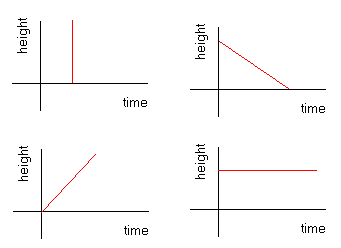
Water is being pumped, at a constant rate, into an underground storage tank that has the shape of a rectangular prism. Which of the graphs below best represent the changes in the height of water in the tank as a function of time?
View Step-by-Step Solution
As water is pumped in at a constant rate, the height must increase linearly. The graph showing a decreasing line or constant flat line is incorrect. The bottom-left graph showing a steadily increasing height correctly represents the scenario.
-
One leg of a right triangle is 18 cm, and its area is 216 square cm. Find its perimeter.
View Step-by-Step Solution
Area = \( \dfrac{1}{2} \times \text{base} \times \text{height} \). Given area = 216 and leg \( a = 18 \):
\[ 216 = \dfrac{1}{2} \times 18 \times b \implies 9b = 216 \implies b = 24\ \text{cm} \]Use the Pythagorean theorem for hypotenuse \( c \):
\[ c^2 = 18^2 + 24^2 = 324 + 576 = 900 \implies c = 30\ \text{cm} \]Perimeter = \( 18 + 24 + 30 = 72\ \text{cm} \).
-
What is the sum of the sizes of the interior angles of a polygon with 53 sides?
View Step-by-Step Solution
Formula for the sum of interior angles is \( 180(n - 2) \). For \( n = 53 \):
\[ \text{Sum} = 180(53 - 2) = 180 \times 51 = 9180^\circ \] -
Jack is taller than Sarah but shorter than both Malika and Tania. Malika is shorter than Tania. Natasha is shorter than Sarah. Who is the shortest?
View Step-by-Step Solution
From the text: Natasha < Sarah < Jack. Jack < Malika < Tania.
Combining these sizes gives the continuous order: Natasha < Sarah < Jack < Malika < Tania. Natasha is the shortest.
-
What is the height (one of the legs) and the hypotenuse of an isosceles right triangle that has an area of 800 square feet?
View Step-by-Step Solution
Let both legs be \( x \). Area = \( \dfrac{1}{2} x^2 = 800 \implies x^2 = 1600 \implies x = 40\ \text{ft} \).
The hypotenuse \( h \) using the Pythagorean theorem: \( h^2 = 40^2 + 40^2 = 3200 \).
\[ h = \sqrt{3200} = 40\sqrt{2} \approx 56.57\ \text{ft} \] -
Find the circumference of a circle inscribed inside a square with a side of 20 meters.
View Step-by-Step Solution
The diameter of the inscribed circle equals the square's side length (20 m), so the radius \( r = 10\ \text{m} \).
Circumference \( C = 2\pi r = 2\pi(10) = 20\pi \approx 62.8\ \text{m} \).
-
Two different schools (A and B) have the same number of pupils. The ratio of the boys in school A and the boys in school B is 2:1 and the ratio of the girls in school A and the girls in school B is 4:5. Find the ratio of the boys in school A to the girls in school A.
View Step-by-Step Solution
Let boys in B be \( x \), so boys in A is \( 2x \). Let girls in B be \( 5y \), so girls in A is \( 4y \).
Total pupils are equal: \( 2x + 4y = x + 5y \implies x = y \).
Ratio of boys to girls in school A: \( \dfrac{2x}{4y} = \dfrac{2x}{4x} = \dfrac{1}{2} \). The ratio is 1:2.
-
In a class, the ratio of boys to girls is 5:6. If there are 66 students in total, how many girls are in the class?
View Step-by-Step Solution
Let boys = \( 5x \) and girls = \( 6x \). Total students = \( 11x = 66 \implies x = 6 \).
Number of girls = \( 6x = 6(6) = 36 \).
-
A bag contains 5 red balls, 3 green balls, and 2 blue balls. If a ball is randomly selected from the bag, what is the probability that the ball is either red or blue?
View Step-by-Step Solution
Total balls = \( 5 + 3 + 2 = 10 \). Red or blue balls = \( 5 + 2 = 7 \).
Probability \( = \dfrac{7}{10} \).
-
A ladder is leaning against a wall. The foot of the ladder is 6 meters from the wall, and the ladder reaches a height of 8 meters. How long is the ladder?
View Step-by-Step Solution
The wall, ground, and ladder form a right triangle. The length of the ladder \( L \) is the hypotenuse:
\[ L = \sqrt{6^2 + 8^2} = \sqrt{36 + 64} = \sqrt{100} = 10\ \text{m} \] -
The price of a jacket increased from \( \$80 \) to \( \$100\). What is the percent increase?
View Step-by-Step Solution
Increase = \( \$100 - \$80 = \$20 \).
Percent increase = \( \left( \dfrac{\text{Increase}}{\text{Original}} \right) \times 100 = \left(\dfrac{20}{80}\right) \times 100 = 25\% \).
-
Joe drove at the speed of 45 miles per hour for a certain distance. He then drove at the speed of 55 miles per hour for the same distance. What is the average speed for the whole trip?
View Step-by-Step Solution
Let distance be \( d \). Total distance = \( 2d \). Total time = \( \dfrac{d}{45} + \dfrac{d}{55} \).
Common denominator is 495: \( \dfrac{11d}{495} + \dfrac{9d}{495} = \dfrac{20d}{495} \).
Average speed = \( \dfrac{2d}{\dfrac{20d}{495}} = 2d \times \dfrac{495}{20d} = \dfrac{990}{20} = 49.5\ \text{mph} \).
-
Two balls A and B rotate along a circular track. Ball A makes 2 full rotations in 26 minutes. Ball B makes 5 full rotations in 35 minutes. If they start rotating now from the same point, when will they be at the same starting point again?
View Step-by-Step Solution
Time for one rotation for A = \( 26 / 2 = 13 \) min. For B = \( 35 / 5 = 7 \) min.
The time they meet again is the LCM of 13 and 7, which is \( 13 \times 7 = 91 \) minutes.
-
The numbers \( x , y , z \) and \( w \) have an average equal to 25. The average of \( x , y \) and \( z \) is equal to 27. Find \( w \).
View Step-by-Step Solution
Sum of 4 numbers: \( x + y + z + w = 4 \times 25 = 100 \).
Sum of first 3 numbers: \( x + y + z = 3 \times 27 = 81 \).
Therefore, \( 81 + w = 100 \implies w = 19 \).
-
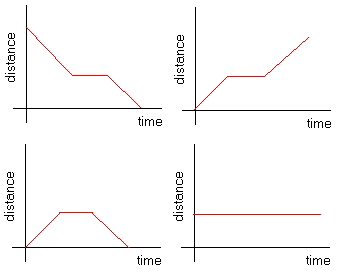
Peter drove at a constant speed for 2 hours. He then stopped for an hour to do some shopping and have a rest and then drove back home driving at a constant speed. Which graph best represents the changes in the distance from home as Peter was driving?
View Step-by-Step Solution
The distance from home should first increase (driving away), stay flat (shopping/resting), and then decrease back to zero (driving home). Only the bottom-left graph shows this exact trajectory.
-
Initially the rectangular prism on the left was full of water. Then water was poured in the right cylindrical container so that the heights of water in both containers are equal. Find the height \(h\) of water in both containers (round your answer to the nearest tenth of a cm).

View Step-by-Step Solution
Left prism volume = \( 2 \times 4 \times 10 = 80\ \text{cm}^3 \). This water is shared between the middle prism and cylinder.
Middle prism volume = \( 2 \times 4 \times h = 8h \). Cylinder volume = \( \pi (1)^2 h = \pi h \).
Total: \( 8h + \pi h = 80 \implies h(8 + \pi) = 80 \implies h = \dfrac{80}{8 + 3.14} \approx 7.2\ \text{cm} \).
-
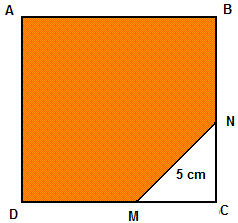
The size of the perimeter of the square ABCD is equal to 100 cm. The length of the segment MN is equal to 5 cm and the triangle MNC is an isosceles right triangle. Find the area of the pentagon ABNMD.
View Step-by-Step Solution
Square perimeter = 100, so side length = 25 cm. Total area = 625 cm².
Triangle MNC is an isosceles right triangle with hypotenuse MN = 5. By the Pythagorean theorem: \( MC^2 + NC^2 = 5^2 \). Since \( MC = NC \), \( 2MC^2 = 25 \implies MC^2 = 12.5 \).
Area of triangle = \( \dfrac{1}{2} \times MC \times NC = \dfrac{1}{2}(12.5) = 6.25\ \text{cm}^2 \).
Pentagon area = \( 625 - 6.25 = 618.75\ \text{cm}^2 \).
-
Dany bought a total of 20 game cards some of which cost $0.25 each and some of which cost $0.15 each. If Dany spent $4.20 to buy these cards, how many cards of each type did he buy?
View Step-by-Step Solution
Let \( X \) = $0.25 cards, \( Y \) = $0.15 cards.
\[ X + Y = 20 \implies Y = 20 - X \] \[ 0.25X + 0.15Y = 4.20 \implies 25X + 15Y = 420 \]Substitute \( Y \): \( 25X + 15(20 - X) = 420 \implies 10X + 300 = 420 \implies 10X = 120 \implies X = 12 \).
Therefore, \( Y = 8 \). He bought 12 cards at $0.25 and 8 cards at $0.15.
-
A six-sided die is rolled once. What is the probability that the number rolled is an even number greater than 2?
View Step-by-Step Solution
Possible outcomes: 1, 2, 3, 4, 5, 6. Even numbers greater than 2: 4 and 6.
Probability = \( \dfrac{2}{6} = \dfrac{1}{3} \).
-
A cylindrical container has a radius of 4 cm and a height of 10 cm. What is its volume? (Use \( \pi \approx 3.14 \))
View Step-by-Step Solution
Formula: \( V = \pi r^2 h \).
\[ V = 3.14 \times 4^2 \times 10 = 3.14 \times 16 \times 10 = 502.4\ \text{cm}^3 \]