Practice Questions
-
A concert sold 120 tickets. Student tickets cost $8, and adult tickets cost $12. The total revenue was $1,160. How many of each type of ticket were sold?
View Step-by-Step Solution
Let \( x \) be the number of student tickets and \( y \) be the number of adult tickets. Use the given information to write the equations:
\[ x + y = 120 \quad \text{(1)} \] \[ 8x + 12y = 1160 \quad \text{(2)} \]From equation (1), isolate \( y \):
\[ y = 120 - x \]Substitute this expression into equation (2):
\[ \begin{aligned} 8x + 12(120 - x) &= 1160 \\ 8x + 1440 - 12x &= 1160 \\ -4x &= -280 \\ x &= 70 \end{aligned} \]Now, find \( y \):
\[ y = 120 - 70 = 50 \]Answer: 70 student tickets and 50 adult tickets were sold.
-
In a triangle, one angle is three times as large as the smallest angle. The third angle is \( 20^\circ \) more than the smallest. Find all the angles.
View Step-by-Step Solution
Let the smallest angle be \( x \). Then the second angle is \( 3x \), and the third angle is \( x + 20 \).
The sum of the interior angles of a triangle is always \( 180^\circ \):
\[ x + 3x + (x + 20) = 180 \]Group like terms and solve for \( x \):
\[ \begin{aligned} 5x + 20 &= 180 \\ 5x &= 160 \\ x &= 32 \end{aligned} \]Now find each angle:
- Smallest angle: \( x = 32^\circ \)
- Second angle: \( 3x = 96^\circ \)
- Third angle: \( x + 20 = 52^\circ \)
-
Given the function \( f(x) = 2x^2 - 3x + 1 \), find \( f(2) \) and \( f(-1) \).
View Step-by-Step Solution
To find \( f(2) \), substitute \( x \) with \( 2 \) in the function:
\[ \begin{aligned} f(2) &= 2(2)^2 - 3(2) + 1 \\ &= 2(4) - 6 + 1 \\ &= 8 - 6 + 1 \\ &= 3 \end{aligned} \]To find \( f(-1) \), substitute \( x \) with \( -1 \) in the function:
\[ \begin{aligned} f(-1) &= 2(-1)^2 - 3(-1) + 1 \\ &= 2(1) + 3 + 1 \\ &= 6 \end{aligned} \] -
A cylindrical water tank has a radius of 3 meters and a height of 5 meters. How much water can it hold (in cubic meters)? Use \( \pi \approx 3.14 \).
View Step-by-Step Solution
The formula for the volume of a cylinder is \( V = \pi r^2 h \).
\[ \begin{aligned} V &= 3.14 \times (3)^2 \times 5 \\ &= 3.14 \times 9 \times 5 \\ &= 3.14 \times 45 \\ &= 141.3 \; \text{m}^3 \end{aligned} \] -
What is the probability of rolling a sum of 9 with two six-sided dice?
View Step-by-Step Solution
There are \( 6 \times 6 = 36 \) total possible outcomes when rolling two dice.
The combinations that result in a sum of 9 are:
\( (3,6), (4,5), (5,4), (6,3) \)
Since there are 4 successful outcomes out of 36 possible outcomes, the probability is:
\[ \text{Probability} = \dfrac{4}{36} = \dfrac{1}{9} \] -
Solve for \( x \): \( 2^{x+1} = 32 \)
View Step-by-Step Solution
First, write 32 as a base of 2:
\[ 32 = 2^5 \]Rewrite the equation:
\[ 2^{x+1} = 2^5 \]Since the bases are the same, we can set the exponents equal to each other:
\[ \begin{aligned} x + 1 &= 5 \\ x &= 4 \end{aligned} \] -
A 13-meter ladder leans against a wall. The base is 5 meters from the wall. How high up the wall does the ladder reach?
View Step-by-Step Solution
The ladder, the base, and the wall form a right triangle where the ladder is the hypotenuse. Let the height be \( h \). Apply the Pythagorean theorem (\( a^2 + b^2 = c^2 \)):
\[ \begin{aligned} h^2 + 5^2 &= 13^2 \\ h^2 + 25 &= 169 \\ h^2 &= 144 \\ h &= \sqrt{144} = 12 \end{aligned} \]Answer: The ladder reaches 12 meters up the wall.
-
A vending machine has only $0.25 and $1 coins. There are 50 coins in total, worth $35. How many of each type are there?
View Step-by-Step Solution
Let \( x \) be the number of $0.25 coins and \( y \) be the number of $1 coins. Set up the system of equations:
\[ x + y = 50 \quad \text{(1)} \] \[ 0.25x + 1y = 35 \quad \text{(2)} \]From equation (1), we get \( y = 50 - x \). Substitute this into equation (2):
\[ \begin{aligned} 0.25x + (50 - x) &= 35 \\ -0.75x + 50 &= 35 \\ -0.75x &= -15 \\ x &= \dfrac{-15}{-0.75} = 20 \end{aligned} \]Now find \( y \):
\[ y = 50 - 20 = 30 \]Answer: There are 20 coins of $0.25 and 30 coins of $1.
-
The sum of three consecutive odd integers is 123. What are the numbers?
View Step-by-Step Solution
The difference between two consecutive odd numbers is 2. Let the first number be \( x \). The second is \( x + 2 \) and the third is \( x + 4 \). Their sum is 123:
\[ \begin{aligned} x + (x + 2) + (x + 4) &= 123 \\ 3x + 6 &= 123 \\ 3x &= 117 \\ x &= 39 \end{aligned} \]The numbers are \( x = 39 \), \( x + 2 = 41 \), and \( x + 4 = 43 \).
Answer: The numbers are 39, 41, and 43.
-
A rectangular garden has a length that is 4 meters more than its width. Its area is 96 m2. Find the dimensions of the garden.
View Step-by-Step Solution
Let the width be \( x \) meters. Then the length is \( x + 4 \) meters. The area is length × width:
\[ x(x + 4) = 96 \]Write the quadratic equation in standard form:
\[ \begin{aligned} x^2 + 4x - 96 &= 0 \\ (x - 8)(x + 12) &= 0 \end{aligned} \]This gives solutions \( x = 8 \) or \( x = -12 \). Since width cannot be negative, we reject \(-12\).
Answer: The width is 8 m, and the length is \( 8 + 4 = 12 \) m.
-
Which number(s) is (are) equal to its (their) square?
View Step-by-Step Solution
Let \( x \) be the number. If it is equal to its square, we write the equation:
\[ x = x^2 \]Write it in standard form and factor:
\[ \begin{aligned} x - x^2 &= 0 \\ x(1 - x) &= 0 \end{aligned} \]Answer: The solutions are \( x = 0 \) and \( x = 1 \).
-
Which number(s) is (are) equal to half its (their) square?
View Step-by-Step Solution
Let \( x \) be the number. It is equal to half its square:
\[ x = \dfrac{1}{2}x^2 \]Set to zero and factor:
\[ \begin{aligned} x - \dfrac{1}{2}x^2 &= 0 \\ x\left(1 - \dfrac{1}{2}x\right) &= 0 \end{aligned} \]Answer: The solutions are \( x = 0 \) and \( x = 2 \).
-
A car travels from A to B at a speed of 40 mph then returns, using the same road, from B to A at a speed of 60 mph. What is the average speed for the round trip?
View Step-by-Step Solution
The average speed is Total Distance divided by Total Time. Let \( x \) be the one-way distance from A to B. The total round-trip distance is \( 2x \).
The time to go is \( \dfrac{x}{40} \) and the time to return is \( \dfrac{x}{60} \). The total time \( T \) is:
\[ T = \dfrac{x}{40} + \dfrac{x}{60} = \dfrac{3x + 2x}{120} = \dfrac{5x}{120} = \dfrac{x}{24} \]Now calculate the average speed:
\[ \text{Average Speed} = \dfrac{2x}{\left(\dfrac{x}{24}\right)} = 2x \cdot \dfrac{24}{x} = 48 \; \text{mph} \] -
Tom travels 60 miles per hour going to a neighboring city and 50 miles per hour coming back using the same road. He drove a total of 5 hours away and back. What is the distance from Tom's house to the city he visited? (Round your answer to the nearest mile).
View Step-by-Step Solution
Let \( x \) be the distance to the city. The time taken to go is \( \dfrac{x}{60} \) and the time to return is \( \dfrac{x}{50} \). The total time is 5 hours:
\[ \dfrac{x}{60} + \dfrac{x}{50} = 5 \]Multiply the entire equation by the common denominator (300):
\[ \begin{aligned} 300 \left(\dfrac{x}{60}\right) + 300 \left(\dfrac{x}{50}\right) &= 300(5) \\ 5x + 6x &= 1500 \\ 11x &= 1500 \\ x &= \dfrac{1500}{11} \approx 136 \; \text{miles} \end{aligned} \] -
At 11:00 a.m., John started driving along a highway at a constant speed of 50 mph. A quarter of an hour later, Jimmy started driving along the same highway in the same direction as John at a constant speed of 65 mph. At what time will Jimmy catch up with John?
View Step-by-Step Solution
Let \( t \) be the time (in hours) John has been driving since 11:00 a.m. Jimmy starts a quarter of an hour (0.25 hours) later, so his driving time is \( t - 0.25 \).
When Jimmy catches up, their distances are equal:
\[ 50t = 65(t - 0.25) \]Solve for \( t \):
\[ \begin{aligned} 50t &= 65t - 16.25 \\ -15t &= -16.25 \\ t &= \dfrac{16.25}{15} = \dfrac{65}{60} \; \text{hours} \end{aligned} \]\( \dfrac{65}{60} \) hours is exactly 1 hour and 5 minutes. Adding this to the start time (11:00 a.m.):
Answer: Jimmy catches up at 12:05 p.m.
-
Find an equation of the line passing through the point \( (-4, 5) \) and perpendicular to the line \( 5x - 3y = 4 \).
View Step-by-Step Solution
First, find the slope of the given line by converting it to slope-intercept form (\( y = mx + b \)):
\[ \begin{aligned} -3y &= -5x + 4 \\ y &= \dfrac{5}{3}x - \dfrac{4}{3} \end{aligned} \]The slope of this line is \( \dfrac{5}{3} \). Perpendicular lines have negative reciprocal slopes, so the slope of our new line is \( m = -\dfrac{3}{5} \).
Using the point-slope formula with point \( (-4, 5) \):
\[ \begin{aligned} y - 5 &= -\dfrac{3}{5}(x - (-4)) \\ y &= -\dfrac{3}{5}(x + 4) + 5 \\ y &= -\dfrac{3}{5}x - \dfrac{12}{5} + \dfrac{25}{5} \\ y &= -\dfrac{3}{5}x + \dfrac{13}{5} \end{aligned} \]Multiply by 5 to convert to standard form:
\[ 5y = -3x + 13 \quad \Rightarrow \quad 3x + 5y = 13 \] -
A rectangle field has an area of 300 square meters and a perimeter of 80 meters. What are the length and width of the field?
View Step-by-Step Solution
Let \( L \) and \( W \) be the length and width. Area and perimeter equations:
\[ L \cdot W = 300 \] \[ 2(L + W) = 80 \quad \Rightarrow \quad L + W = 40 \]From the perimeter equation, \( W = 40 - L \). Substitute this into the area equation:
\[ \begin{aligned} L(40 - L) &= 300 \\ 40L - L^2 &= 300 \\ L^2 - 40L + 300 &= 0 \\ (L - 30)(L - 10) &= 0 \end{aligned} \]The solutions are \( L = 30 \) or \( L = 10 \). Assuming length is the longer side, \( L = 30 \) m and \( W = 10 \) m.
-
A rectangular garden has a length of 100 meters and a width of 50 meters. A square swimming pool is to be constructed inside the garden. Find the length of one side of the swimming pool if the remaining area (not occupied by the pool) is equal to one-half the area of the rectangular garden.
View Step-by-Step Solution
Let \( x \) be the side of the swimming pool. The area of the pool is \( x^2 \).
If the remaining area is half the total area, then the pool itself must occupy the other half of the total area. The total area of the garden is \( 100 \times 50 = 5000 \).
\[ \begin{aligned} x^2 &= \dfrac{1}{2}(5000) \\ x^2 &= 2500 \\ x &= \sqrt{2500} = 50 \end{aligned} \]Answer: The side of the swimming pool is 50 meters.
-
ABC is an equilateral triangle with side length equal to 50 cm. BH is perpendicular to AC. MN is parallel to AC. Find the area of triangle BMN if the length of MN is equal to 12 cm.

View Step-by-Step Solution
Because \( \triangle ABC \) is equilateral and \( BH \perp AC \), \( H \) is the midpoint of \( AC \), so \( HC = \dfrac{50}{2} = 25 \) cm.
Because \( MN \parallel HC \), triangles \( \triangle BMN \) and \( \triangle BHC \) are similar. The ratio of corresponding sides is:
\[ \dfrac{MN}{HC} = \dfrac{12}{25} \]The ratio of the areas of similar triangles is the square of the ratio of their sides:
\[ \dfrac{\text{Area } BMN}{\text{Area } BHC} = \left(\dfrac{12}{25}\right)^2 \]Next, find the height \( BH \) using Pythagoras in \( \triangle BHC \):
\[ BH = \sqrt{50^2 - 25^2} = \sqrt{2500 - 625} = \sqrt{1875} = 25\sqrt{3} \]The area of \( \triangle BHC \) is:
\[ \text{Area } BHC = \dfrac{1}{2} \cdot HC \cdot BH = \dfrac{1}{2}(25)(25\sqrt{3}) = \dfrac{625\sqrt{3}}{2} \]Finally, find the Area of \( \triangle BMN \):
\[ \text{Area } BMN = \left(\dfrac{144}{625}\right) \cdot \left(\dfrac{625\sqrt{3}}{2}\right) = 72\sqrt{3} \; \text{cm}^2 \] -
The height of water in a cylindrical container with radius \( r = 5 \) cm is 10 cm. Peter needs to measure the volume of a stone with a complicated shape, so he puts the stone inside the container. The height of the water rises to 13.2 cm. What is the volume of the stone in cubic cm?

View Step-by-Step Solution
Find the initial volume of the water (\( V_1 \)):
\[ V_1 = \pi r^2 h_1 = \pi (5^2)(10) = 250\pi \; \text{cm}^3 \]Find the new volume after the stone is submerged (\( V_2 \)):
\[ V_2 = \pi r^2 h_2 = \pi (5^2)(13.2) = 330\pi \; \text{cm}^3 \]The volume of the stone is the difference:
\[ V_{\text{stone}} = 330\pi - 250\pi = 80\pi \; \text{cm}^3 \]Using \( \pi \approx 3.14159 \), the volume is approximately \( 251.3 \; \text{cm}^3 \).
-
In the figure below, the square has all its vertices on the circle. The area of the square is equal to 400 cm2. What is the area of the circular shape?

View Step-by-Step Solution
The side \( x \) of the square can be found using its area:
\[ x^2 = 400 \quad \Rightarrow \quad x = 20 \; \text{cm} \]The diagonal \( D \) of the square is equal to the diameter of the circle. Use the Pythagorean theorem to find \( D \):
\[ D^2 = x^2 + x^2 = 400 + 400 = 800 \]The area of the circle is \( A = \pi r^2 \). Since \( r = \dfrac{D}{2} \), we have \( r^2 = \dfrac{D^2}{4} \):
\[ A = \pi \left(\dfrac{D^2}{4}\right) = \pi \left(\dfrac{800}{4}\right) = 200\pi \; \text{cm}^2 \]Using \( \pi \approx 3.14 \), the area is approximately \( 628 \; \text{cm}^2 \).
-
The numbers 2, 3, 5, and \( x \) have an average equal to 4. Find \( x \).
View Step-by-Step Solution
The average is the sum of the numbers divided by the count. Setup the equation:
\[ \dfrac{2 + 3 + 5 + x}{4} = 4 \]Solve for \( x \):
\[ \begin{aligned} 10 + x &= 16 \\ x &= 6 \end{aligned} \] -
The numbers \( x, y, z \), and \( w \) have an average equal to 25. The average of \( x, y \), and \( z \) is equal to 27. Find \( w \).
View Step-by-Step Solution
The average of the 4 numbers gives us their total sum:
\[ \dfrac{x + y + z + w}{4} = 25 \quad \Rightarrow \quad x + y + z + w = 100 \]The average of the 3 numbers gives us their partial sum:
\[ \dfrac{x + y + z}{3} = 27 \quad \Rightarrow \quad x + y + z = 81 \]Substitute this partial sum back into the first equation:
\[ \begin{aligned} 81 + w &= 100 \\ w &= 19 \end{aligned} \] -
Find \( x, y, z \) so that the numbers 41, 46, \( x, y, z \) have an arithmetic mean of 50 and a mode of 45.
View Step-by-Step Solution
The arithmetic mean of the five numbers is 50:
\[ \dfrac{41 + 46 + x + y + z}{5} = 50 \] \[ 87 + x + y + z = 250 \quad \Rightarrow \quad x + y + z = 163 \]The mode is the most frequently occurring value. Since no numbers repeat yet, at least two of the unknown variables must equal 45. We cannot have \( x = y = z = 45 \) because \( 45 \times 3 = 135 \), which does not equal 163.
Therefore, two of the variables must be 45 (let's say \( x = y = 45 \)):
\[ 45 + 45 + z = 163 \quad \Rightarrow \quad 90 + z = 163 \quad \Rightarrow \quad z = 73 \]Answer: The values are 45, 45, and 73.
-
\( A \) is a constant. Find \( A \) such that the equation \( 2x + 1 = 2A + 3(x + A) \) has a solution at \( x = 2 \).
View Step-by-Step Solution
Substitute \( x = 2 \) into the given equation:
\[ \begin{aligned} 2(2) + 1 &= 2A + 3(2 + A) \\ 4 + 1 &= 2A + 6 + 3A \\ 5 &= 5A + 6 \\ 5A &= -1 \\ A &= -\dfrac{1}{5} \end{aligned} \] -
One liter is equal to 1 cubic decimeter (\( \text{dm}^3 \)), and 1 liter of water weighs 1 kilogram. What is the weight of water contained in a cylindrical container with radius equal to 50 centimeters and height equal to 1 meter?
View Step-by-Step Solution
First, convert all units to decimeters (dm) to easily calculate liters, since 10 cm = 1 dm:
- Radius \( r = 50 \) cm = 5 dm
- Height \( h = 1 \) m = 100 cm = 10 dm
Find the volume of the cylinder:
\[ V = \pi r^2 h = 3.14 \times (5)^2 \times 10 = 3.14 \times 250 = 785 \; \text{dm}^3 \]Since 1 \( \text{dm}^3 \) weighs 1 kg, the total weight is 785 kg.
-
In the figure below, triangle ABC is an isosceles right triangle. AM is perpendicular to BC and MN is perpendicular to AC. Find the ratio of the area of triangle MNC to the area of triangle ABC.
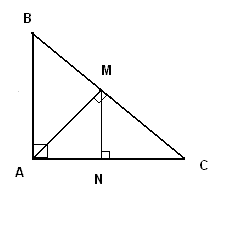
View Step-by-Step Solution
Because \( \triangle ABC \) is an isosceles right triangle, the altitude \( AM \) drawn to the hypotenuse divides the triangle into two smaller, congruent isosceles right triangles: \( \triangle ABM \) and \( \triangle ACM \).
Therefore, the area of \( \triangle ACM \) is exactly half the area of \( \triangle ABC \).
Similarly, in the isosceles right triangle \( \triangle ACM \), the altitude \( MN \) divides it into two congruent isosceles right triangles: \( \triangle AMN \) and \( \triangle CMN \).
Thus, the area of \( \triangle MNC \) is exactly half the area of \( \triangle ACM \).
Combining these, the area of \( \triangle MNC \) is \( \dfrac{1}{2} \times \dfrac{1}{2} = \dfrac{1}{4} \) the area of \( \triangle ABC \).
Answer: The ratio is 1:4.
-
Pump A can fill a tank of water in 4 hours. Pump B can fill the same tank in 6 hours. Both pumps are started at 8:00 a.m. to fill the same empty tank. An hour later, pump B breaks down and takes one hour to repair before it is restarted again. When will the tank be full? (Round your answer to the nearest minute).
View Step-by-Step Solution
The filling rate of Pump A is \( \dfrac{1}{4} \) tanks per hour. The rate of Pump B is \( \dfrac{1}{6} \) tanks per hour.
Let \( t \) be the total time (in hours) that Pump A operates. Because Pump B was broken for exactly 1 hour, it operates for \( t - 1 \) hours.
Together, they fill 1 entire tank:
\[ \dfrac{t}{4} + \dfrac{t - 1}{6} = 1 \]Multiply the equation by 12 to clear fractions:
\[ \begin{aligned} 3t + 2(t - 1) &= 12 \\ 3t + 2t - 2 &= 12 \\ 5t &= 14 \\ t &= 2.8 \; \text{hours} \end{aligned} \]Convert 2.8 hours into hours and minutes:
\[ 0.8 \times 60 = 48 \; \text{minutes} \]The total time is 2 hours and 48 minutes. Starting at 8:00 a.m., the tank will be full at 10:48 a.m.
-
Are the lines with equations \( 2x + y = 2 \) and \( x - 2y = 0 \) parallel, perpendicular or neither?
View Step-by-Step Solution
Convert each equation into slope-intercept form (\( y = mx + b \)):
\[ 2x + y = 2 \quad \Rightarrow \quad y = -2x + 2 \quad (\text{slope } m_1 = -2) \] \[ x - 2y = 0 \quad \Rightarrow \quad y = \dfrac{1}{2}x \quad (\text{slope } m_2 = \dfrac{1}{2}) \]The slopes are negative reciprocals of each other, because their product is \(-1\):
\[ m_1 \times m_2 = -2 \times \dfrac{1}{2} = -1 \]Answer: The lines are perpendicular.
-
A semicircle of area \( 50\pi \) cm2 is inscribed inside a rectangle. The diameter of the semicircle coincides with the length of the rectangle. Find the area of the rectangle.
View Step-by-Step Solution
Let \( R \) be the radius of the semicircle. The area of the semicircle is half the area of a full circle:
\[ \begin{aligned} \dfrac{1}{2}\pi R^2 &= 50\pi \\ R^2 &= 100 \\ R &= 10 \; \text{cm} \end{aligned} \]Since the semicircle's diameter coincides with the rectangle's length, the length \( L = 2R = 20 \) cm.
Because the semicircle is inscribed, its radius touches the top width of the rectangle, so the width \( W = R = 10 \) cm.
Calculate the area of the rectangle:
\[ \text{Area} = L \times W = 20 \times 10 = 200 \; \text{cm}^2 \] -
A triangle has an area of 200 cm2. Two sides of this triangle measure 26 cm and 40 cm respectively. Find the exact value of the third side.
View Step-by-Step Solution
Let \( a = 26 \), \( b = 40 \), and \( \alpha \) be the angle between them. The formula for the area of a triangle is:
\[ A = \dfrac{1}{2} a b \sin(\alpha) \]Substitute the known values to find \( \sin(\alpha) \):
\[ \begin{aligned} 200 &= \dfrac{1}{2}(26)(40)\sin(\alpha) \\ 200 &= 520\sin(\alpha) \\ \sin(\alpha) &= \dfrac{200}{520} = \dfrac{5}{13} \end{aligned} \]Using the identity \( \sin^2(\alpha) + \cos^2(\alpha) = 1 \), find \( \cos(\alpha) \). Because an angle in a triangle can be acute or obtuse, there are two possible values for \( \cos(\alpha) \):
\[ \cos(\alpha) = \pm\sqrt{1 - \left(\dfrac{5}{13}\right)^2} = \pm\sqrt{\dfrac{144}{169}} = \pm\dfrac{12}{13} \]Now, apply the Law of Cosines to find the third side \( c \):
\[ c^2 = a^2 + b^2 - 2ab\cos(\alpha) \] \[ c^2 = 26^2 + 40^2 - 2(26)(40)\left(\pm\dfrac{12}{13}\right) \] \[ c^2 = 676 + 1600 \mp 2080\left(\dfrac{12}{13}\right) \] \[ c^2 = 2276 \mp 1920 \]Calculate the two possibilities for \( c^2 \):
\[ \begin{aligned} c_1^2 &= 2276 - 1920 = 356 \\ c_2^2 &= 2276 + 1920 = 4196 \end{aligned} \]Answer: The two exact possible values for the third side are \( 2\sqrt{89} \) cm and \( 2\sqrt{1049} \) cm.