Find the Focus of a Parabolic Dish Antenna

Derive the focal distance from the diameter and depth of a parabolic reflector

Understanding the Focus of a Parabola

The position of the focus of a parabolic dish antenna (or parabolic reflector) determines where the feed horn should be placed to capture maximum signal. It can be computed precisely from the dish's diameter and depth.

Let's derive the equation of a parabola with the vertex at the origin \( (0,0) \), focus at \( F(0, f) \), and directrix \( y = -f \). Here \( f \) is the focal distance — the distance from the vertex to the focus, measured along the axis of symmetry.

Parabola with vertex at the origin, focus at F(0, f), and directrix the line y = −f
Figure 1. A parabola with focus \(F(0, f)\) and directrix \(y = -f\).

By the geometric definition, any point \( M(x,y) \) on the parabola is equidistant from the focus and the directrix:

\[ \sqrt{x^2 + (y - f)^2} = |y + f| \]

For the upward-opening parabola shown, \( y \ge 0 > -f \), so \( |y + f| = y + f \). Squaring both sides:

\[ x^2 + (y - f)^2 = (y + f)^2 \] \[ x^2 + y^2 - 2yf + f^2 = y^2 + 2yf + f^2 \]

Cancel the like terms \( y^2 \) and \( f^2 \), and collect \( y \):

\[ x^2 - 4yf = 0 \] \[ x^2 = 4yf \;\Rightarrow\; y = \frac{x^2}{4f} \]

Finding the Focal Distance from Dish Dimensions

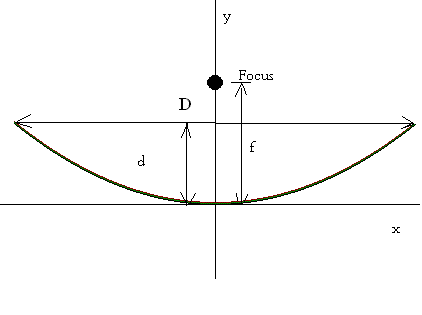
For a physical parabolic dish, measure its diameter \( D \) across the opening and its maximum depth \( d \) at the center.

Placing the vertex at the origin, the outer rim of the dish is at \( \left(\frac{D}{2}, d\right) \) and \( \left(-\frac{D}{2}, d\right) \).

Cross-section of a parabolic dish showing its diameter D, depth d, and focal point at distance f from the vertex
Figure 2. Diameter \(D\), depth \(d\), and focal distance \(f\) of a parabolic dish.

Substituting \( \left(\frac{D}{2}, d\right) \) into \( y = \dfrac{x^2}{4f} \):

\[ d = \frac{(D/2)^2}{4f} \] \[ d = \frac{D^2}{16f} \]

Solving for the focal distance \( f \):

\[ f = \frac{D^2}{16d} \]

This formula positions the feed horn of a parabolic antenna. In practice, minor adjustments during installation compensate for the fact that real dishes are not perfect mathematical parabolas.

Practice Exercises

Apply the formula to the following problems. Expand View Solution to see the full work.

Exercise 1 — Compute the focal distance

Find the focal distance \( f \) for a parabolic dish with diameter \( D = 80 \text{ cm} \) and depth \( d = 25 \text{ cm} \).

View Solution

Substitute \( D = 80 \) and \( d = 25 \) into the focal distance formula:

\[ f = \frac{D^2}{16d} = \frac{80^2}{16 \times 25} = \frac{6400}{400} \]

Answer: \( f = 16 \text{ cm} \)

Check: \(f/d = 16/25 = 0.64\), so the focus lies between the vertex and the rim plane — a fairly deep dish.

Exercise 2 — Condition for \( f = 2d \)

Find a relationship between \( D \) and \( d \) such that the focal distance equals twice the depth, \( f = 2d \).

View Solution

Set \( f = 2d \) in the focal-distance formula:

\[ \frac{D^2}{16d} = 2d \]

Multiply both sides by \( 16d \):

\[ D^2 = 32 d^2 \]

Take the positive square root:

\[ D = 4\sqrt{2}\,d \approx 5.657\,d \]

Answer: \( D = 4\sqrt{2}\,d \approx 5.657d \)

Exercise 3 — Condition for \( f > d \)

Find a relationship between \( D \) and \( d \) such that the focal distance is greater than the depth, \( f > d \).

View Solution

Set up the inequality using the focal-distance formula:

\[ \frac{D^2}{16d} > d \]

Since \( d > 0 \), multiply both sides by \( 16d \) without changing the inequality direction:

\[ D^2 > 16 d^2 \]

Take the positive square root:

\[ D > 4d \]

Answer: \( D > 4d \)

Geometrically: for the focus to lie above the rim plane, the diameter must exceed four times the depth.

Design Conditions at a Glance

Focal-distance design conditions for a parabolic dish
Condition Meaning Equivalent condition
\( f = \dfrac{D^2}{16d} \) Focal distance from diameter and depth —
\( f > d \) Focus lies above the rim plane \( D > 4d \)
\( f = 2d \) Focus at height \(2d\) above the vertex \( D \approx 5.657\,d \)

Frequently Asked Questions

What is the formula for the focal distance of a parabolic dish?

\( f = \dfrac{D^2}{16d} \), where \( D \) is the diameter and \( d \) is the depth. The focal distance \( f \) is measured from the vertex (deepest point) to the focus.

Where should the feed horn be positioned on a parabolic antenna?

At the focus of the parabola, at distance \( f = D^2/(16d) \) from the vertex along the axis of symmetry. Fine-tuning is often needed in practice because real dishes are not perfect parabolas.

When is the focus above the rim of the dish?

When \( f > d \), which simplifies to \( D > 4d \). So the diameter must exceed four times the depth.

Why do real parabolic dishes need alignment adjustments?

Manufactured dishes deviate from the ideal parabolic shape because of tolerances, panel joints, or mounting flex. The theoretical focus position is only the starting point — fine adjustments during installation compensate for the difference.

Further References & Tools

Last updated: October 17, 2026