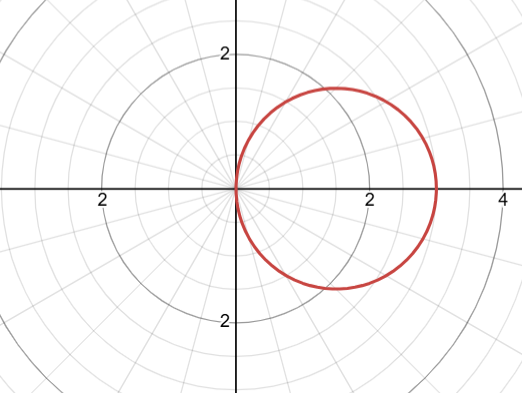
Example 1 — \(R = 4\cos t\) (a circle)
Graph the polar equation and identify the curve:
\[ R = 4\cos t \]Solution
Build a table of values at the special angles. Useful milestones:
- \(R\) is maximum (\(R = 4\)) at \(t = 0\).
- \(R = 0\) at \(t = \tfrac{\pi}{2}\).
- \(R\) is minimum (\(R = -4\)) at \(t = \pi\).
| \(t\) | \(R\) |
|---|---|
| \(0\) | \(4\) |
| \(\tfrac{\pi}{6}\) | \(\approx 3.46\) |
| \(\tfrac{\pi}{4}\) | \(\approx 2.83\) |
| \(\tfrac{\pi}{3}\) | \(2\) |
| \(\tfrac{\pi}{2}\) | \(0\) |
| \(\tfrac{2\pi}{3}\) | \(-2\) |
| \(\tfrac{3\pi}{4}\) | \(\approx -2.83\) |
| \(\tfrac{5\pi}{6}\) | \(\approx -3.46\) |
| \(\pi\) | \(-4\) |
The curve closes at \(t = \pi\) because \(\cos(\pi + s) = -\cos s\), so continuing past \(\pi\) retraces the same circle (now with negative \(R\)). Plot each \((R, t)\) in a polar grid — careful with negative \(R\): the point \((R, t)\) with \(R < 0\) lies in the opposite direction from \(t\).