Overview
The graphs of polynomial functions from degree 1 through degree 6 are shown below. Comparing them shows how the degree of a polynomial controls three key graph features:
- Turning points — at most \( n - 1 \) for a degree-\(n\) polynomial.
- X-intercepts — at most \( n \) (counting multiplicity).
- End behavior — whether the two ends of the graph point in the same direction (even degree) or opposite directions (odd degree), and whether they go up or down (determined by the sign of the leading coefficient).
Degree at a Glance
| Degree \(n\) | Name | Turning points | X-intercepts | End behavior |
|---|---|---|---|---|
| 1 | Linear | 0 | ≤ 1 | Opposite directions (line) |
| 2 | Quadratic | ≤ 1 | ≤ 2 | Same direction (both up or both down) |
| 3 | Cubic | ≤ 2 | ≤ 3 | Opposite directions |
| 4 | Quartic | ≤ 3 | ≤ 4 | Same direction |
| 5 | Quintic | ≤ 4 | ≤ 5 | Opposite directions |
| 6 | Sextic | ≤ 5 | ≤ 6 | Same direction |
Why "at most"? A degree-\(n\) polynomial may have fewer turning points, fewer x-intercepts, or none at all — depending on whether its roots and critical points are real or complex. The bounds \(n-1\) and \(n\) are the maximums, and both are attainable for suitable choices of coefficients.
Degree 1 — Linear
A first-degree polynomial \( f(x) = ax + b \) has a straight-line graph. It has no turning points and at most one x-intercept.

Degree 2 — Quadratic
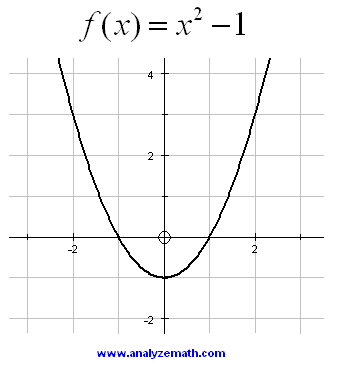
A second-degree polynomial \( f(x) = ax^2 + bx + c \) has a U-shaped (or ∩-shaped) graph — a parabola with exactly one turning point (the vertex) and at most two x-intercepts.
Degree 3 — Cubic
A third-degree polynomial has up to two turning points (one local maximum and one local minimum, or vice versa). The two ends of the graph go in opposite directions — one up, one down — because the degree is odd.

Degree 4 — Quartic
A fourth-degree polynomial can have up to three turning points, producing a "W" shape (for positive leading coefficient) or an "M" shape (for negative leading coefficient). Both ends of the graph go in the same direction because the degree is even.


Degree 5 — Quintic
A fifth-degree polynomial can have up to four turning points. Because the degree is odd, the two ends of the graph go in opposite directions.

Degree 6 — Sextic
A sixth-degree polynomial can have up to five turning points. When the maximum is achieved, the curve has three local minima and two local maxima (or vice versa) — a "double-W" shape with extra fluctuations. Both ends of the graph go in the same direction because the degree is even.
A clean "W" or "M" shape is characteristic of a quartic (degree 4) with three turning points, not a sextic. Sextics that achieve all five turning points look more like "W over W" — a double-W profile.

End Behavior Summary
| Degree | Leading coefficient \( a_n \) | As \( x \to -\infty \) | As \( x \to +\infty \) |
|---|---|---|---|
| Even | \( a_n > 0 \) | \( \to +\infty \) | \( \to +\infty \) |
| Even | \( a_n < 0 \) | \( \to -\infty \) | \( \to -\infty \) |
| Odd | \( a_n > 0 \) | \( \to -\infty \) | \( \to +\infty \) |
| Odd | \( a_n < 0 \) | \( \to +\infty \) | \( \to -\infty \) |
Frequently Asked Questions
How many turning points does a polynomial of degree \(n\) have?
At most \(n - 1\). For example, a cubic (degree 3) has at most 2 turning points; a sextic (degree 6) has at most 5.
How many x-intercepts can a polynomial of degree \(n\) have?
At most \(n\), counting multiplicity. It may have fewer, or none, depending on whether its roots are real or complex.
What is the end behavior of a polynomial graph?
End behavior describes what happens as \(x \to \pm\infty\). It's determined by the degree and the leading coefficient. Even degree: both ends go the same direction (up if \(a_n > 0\), down if \(a_n < 0\)). Odd degree: the ends go opposite directions.
What is the shape of a degree-6 polynomial graph?
A sextic with 5 turning points has three local minima and two local maxima (or vice versa) — a "double-W" shape. Clean "W" and "M" shapes are characteristic of quartics (degree 4) with 3 turning points, not sextics.
Further Reading on Polynomials
Last updated: October 17, 2026